


Guides · Amalfi Coast
10 Best Things to Do on the Amalfi Coast
By Tomas Achmedovas · CEO and co-founder

CEO and co-founder
The best things to do on the Amalfi Coast pack a lot into 50 winding kilometres: cliffside villages, a UNESCO-listed coastline, lemon terraces, sea caves, and one of Italy's great clifftop hikes. This Amalfi Coast travel guide ranks 10 attractions worth building an itinerary around, whether you have a single day from Sorrento or a full week based in Positano or Amalfi.
Each entry includes the exact location, the nearest ferry pier or bus stop, how it relates to the hub town of Amalfi, and a practical Pro Tip. The list is ordered to help you plan efficient days, because the single coast road, the SS163 Amalfi Drive, is slow and congested in peak season: the big-three towns of Positano, Amalfi, and Ravello sit close together, the Emerald Grotto and Fiordo di Furore line the road between Amalfi and Positano, and Capri is a ferry hop offshore. The whole stretch has been a UNESCO World Heritage Site since 1997.
Expect a mid-range to expensive destination: ferries, beach clubs, and villa gardens all carry fees, and summer crowds are real. Spring and September give you the same views with thinner queues. Prices and hours below reflect 2026.
Check dates for Amalfi Coast
See what is available on your dates.
1Positano - The Vertical Village


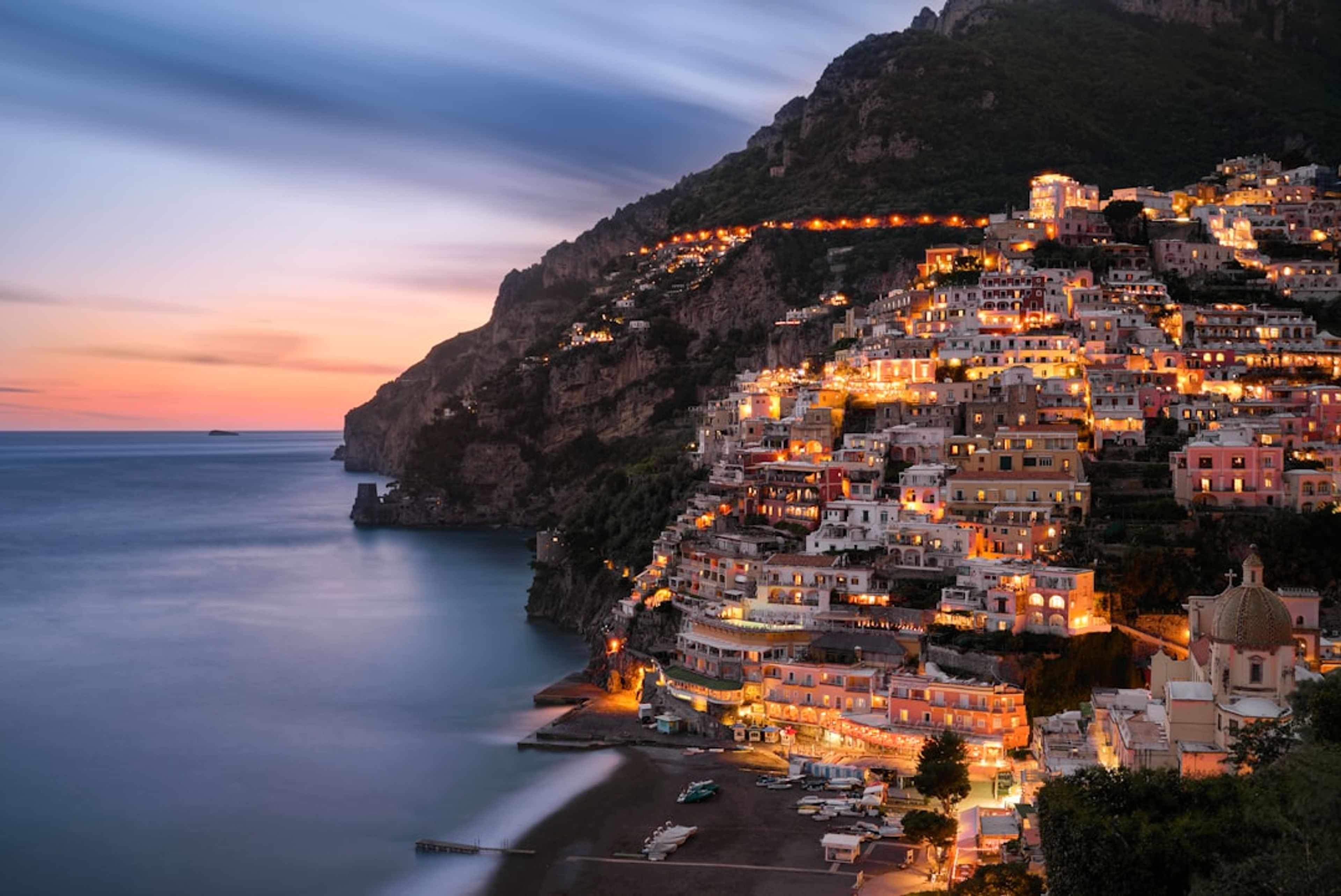
Positano is the most photographed town on the Amalfi Coast, a near-vertical cascade of pastel houses tumbling down to the sea. The town centres on the Church of Santa Maria Assunta, whose majolica-tiled dome is its landmark, and on Spiaggia Grande, the main pebble beach lined with restaurants. Steep stepped lanes thread between boutiques selling linen and the local moda Positano clothing.
There is no flat way through town, so everything is stairs - wear proper shoes and pace yourself in the heat. The internal bus loop and the ferry save the worst climbs. One of the most rewarding things to do on the Amalfi Coast is simply to walk the main path down slowly, stopping for a granita as the bell tower comes into view.
2Amalfi and the Cathedral of Sant'Andrea


Amalfi gives the coast its name and sits at its geographic centre, which makes it the most useful base for ferries and buses. The town's centrepiece is the Cathedral of Sant'Andrea, reached by a dramatic flight of 62 steps from Piazza Duomo. Its striped Arab-Norman facade dates in parts to the 9th century, and inside, the Cloister of Paradise (Chiostro del Paradiso) and the crypt of Saint Andrew are the highlights. The Amalfi Cathedral anchors a square full of cafes.
Beyond the duomo, Amalfi keeps a working-town feel, with a paper museum recalling its medieval bambagina trade and lanes climbing back into a narrow valley behind the seafront.
3Ravello and Its Clifftop Gardens


Ravello sits roughly 365 metres above the sea, a quieter and more refined counterpoint to the seaside towns, and it is best known for two historic villas. Villa Rufolo, built in the 13th century, has terraced gardens that frame one of the coast's most photographed views and host the open-air Ravello Festival each summer. A short walk away, Villa Cimbrone is famous for its Terrace of Infinity (Terrazza dell'Infinito), a marble-busted balustrade hanging over a sheer drop to the Gulf of Salerno.
Reaching Ravello means a bus or drive up a switchback road from Amalfi, since no ferry serves it. That climb keeps the crowds a little thinner than in Positano.
Check dates for Amalfi Coast
See what is available on your dates.
4The Path of the Gods Hike (Sentiero degli Dei)

The Path of the Gods (Sentiero degli Dei) is the coast's signature walk, a roughly 7.8-kilometre cliff trail running high above the sea from Bomerano, a hamlet of Agerola, to Nocelle above Positano. Taken in this direction it is mostly downhill, takes around three to four hours, and delivers nonstop views over Praiano, the islands, and the terraced slopes. It is free and needs no ticket.
This is a proper hike rather than a stroll. The path is uneven, exposed to the sun, and ends with a descent of roughly 1,500 steps down into Positano, so carry water, sun protection, and grippy shoes.
5A Boat Trip to Capri

A boat trip to Capri is the classic Amalfi Coast day out, and the island sits a short ferry ride offshore, roughly 30 to 50 minutes from Positano, Amalfi, or Sorrento depending on the service. Capri rewards a full day with the buzzy Piazzetta, the cliff-framed Faraglioni sea stacks, the Gardens of Augustus, and a chairlift up Monte Solaro for the widest view. The famous Blue Grotto (Grotta Azzurra) is weather-dependent and often has long queues.
Capri is expensive and busy, so an early ferry and a loose plan beat trying to cram everything into one visit.
6The Emerald Grotto (Grotta dello Smeraldo)

The Emerald Grotto (Grotta dello Smeraldo) is a sea cave in Conca dei Marini, between Amalfi and Positano, where sunlight entering through a submerged opening turns the water a glowing green. Unlike Capri's Blue Grotto, this one is reachable by land: a lift and stairway drop from the SS163 Amalfi Drive to the water, where a boatman rows you around the cavern past stalactites and a submerged ceramic nativity scene.
It is a short visit of about 30 minutes, and the colour is strongest when the sun is high. Entry is inexpensive, around EUR 10.
7Atrani - The Coast's Smallest Town

Atrani sits in a cove just a few minutes' walk east of Amalfi, separated only by a headland, yet it feels like a quieter world. One of the smallest municipalities in southern Italy, it gathers around Piazza Umberto I, a tiny car-free square ringed by family-run trattorias, with a small free beach a few steps away. The churches of San Salvatore de' Birecto and Santa Maria Maddalena look down over the rooftops.
Because most day-trippers never leave Amalfi, Atrani stays calm even in August, which is its real appeal. The artist M. C. Escher famously sketched its stacked houses in 1931.
8Limoncello Tasting and the Lemon Terraces

The Amalfi Coast runs on lemons - the knobbly, fragrant sfusato amalfitano grown on terraces that stripe the hillsides - and tasting limoncello made from them is among the more relaxed things to do on the Amalfi Coast. Small producers in Amalfi, including those along Via Trappainguerra, press the peels into the sweet, bright liqueur that is traditionally served ice-cold after dinner. Many offer a free taste before you buy a bottle to take home.
For more context, several farms above Amalfi, Minori, and Maiori run lemon-grove tours that explain the terracing and the harvest, which runs roughly February to October.
9The Beaches

Beaches on the Amalfi Coast are mostly pebble and small, tucked between cliffs, and they range from free public stretches to clubs charging serious money. Spiaggia Grande, Positano's main beach, has the finest setting and a paid section with loungers for around EUR 30, while a ten-minute walk leads to the quieter Fornillo beach. Amalfi's Marina Grande and the dark-sand cove of Marina di Praia in Praiano are easy, lower-key options.
Do not expect wide sandy resorts - the appeal here is the dramatic backdrop, not the sand, and many of the best coves are reachable only by steps or boat.
10Fiordo di Furore - The Hidden Fjord

The Fiordo di Furore is one of the coast's most striking sights: a narrow, fjord-like inlet carved into the cliffs in the municipality of Furore, spanned high above by a stone road bridge on the SS163. A cluster of old fishermen's houses, the Monazeni, clings to the rock beside a small pebble beach at the water's edge, reached by a long staircase down from the road.
The beach is tiny and gets busy in summer, and the well-known high-diving competition staged from the bridge draws big crowds when it runs. Outside those times the fjord is quietly dramatic.
Take this guide with you
Get every place in this guide, with addresses and map links, in your inbox — easy to open on your phone during the trip.
One email to the address on your account. No newsletter.

CEO and co-founder
Tomas is the co-founder and director of trip1, an European company specializing in reservation services. He launched the company in 2025 with a focus on building scalable, efficient operations.
10 Best Things to Do on the Amalfi Coast - FAQ
The big three towns: vertical Positano, Amalfi with its Cathedral of Sant'Andrea up 62 steps, and Ravello's clifftop gardens at Villa Rufolo and Villa Cimbrone. Add the Path of the Gods hike, a boat trip to Capri, and the Emerald Grotto, a sea cave near Conca dei Marini where sunlight turns the water green. The whole coast has been a UNESCO site since 1997.
Three to four days. The SS163 coast road is slow and ferries take time, so a realistic day covers two or three highlights, such as Positano plus Amalfi, or Amalfi plus Ravello. Give Capri and the Path of the Gods a full day each. Amalfi, in the middle of the coast, is the most practical base for ferries and buses.
It is a driving rule on the SS163 coast road. On restricted days, from 10:00 to 18:00, cars with a plate ending in an odd digit may drive on odd dates and even plates on even dates. In 2026 it applied around Easter and from late April to 2 May, and it returns on the busiest summer days. Motorbikes, taxis and buses are exempt, but rental cars are not.
Positano is the most photographed: pastel houses tumble down to Spiaggia Grande under the majolica-tiled dome of Santa Maria Assunta, best seen as you arrive by ferry. Ravello, about 365 metres above the sea, is quieter and more refined, and tiny Atrani, a ten-minute walk from Amalfi, stays calm even in August, when most day-trippers never leave Amalfi.
Avoid August if you dislike crowds. Summer brings packed ferries, full beaches and the heaviest traffic on the SS163, along with the odd-even plate rule on peak days. Winter is quiet, but many hotels and restaurants close and ferries run far less often. Spring and September give you the same views with thinner queues.
About 7.8 km, or three to four hours, from Bomerano, a hamlet of Agerola, to Nocelle above Positano. In that direction it is mostly downhill. It is free and needs no ticket, but the path is uneven and exposed to the sun, so carry water and wear grippy shoes. From Nocelle, take about 1,500 steps down to Positano or catch the local bus.