Guides · Ubud
12 Best Things to Do in Ubud, Bali: Temples, Rice Terraces & Culture
By Tomas Achmedovas · CEO and co-founder

CEO and co-founder
Ubud, Bali - The Cultural Heart of the Island
Nestled in the lush highlands of central Bali, Ubud is the island's undisputed cultural capital - a town where ancient Hindu temples sit beside organic cafes, traditional dance performances fill palace courtyards each evening, and emerald rice terraces cascade down volcanic hillsides in every direction. If you are planning a trip and wondering about the best things to do in Ubud Bali, this guide covers the 12 essential experiences that make this town one of Southeast Asia's most rewarding destinations.
Unlike the beach resorts of southern Bali, Ubud trades surf and sand for jungle valleys, artist studios, and sacred water temples. The town sits at roughly 200 metres above sea level in the Gianyar regency, where cooler temperatures and afternoon mists create a refreshing contrast to the coastal heat. From the world-famous Tegalalang Rice Terrace to the moss-covered shrines of Gunung Kawi, Ubud delivers a Bali experience rooted in spirituality, creativity, and nature.
Whether you have two days or a full week, Ubud rewards slow exploration. Walk the Campuhan Ridge at sunrise, join a purification ceremony at Tirta Empul, haggle for handmade textiles at the art market, and end each day with a Balinese dance performance under the stars. This Ubud Bali travel guide has everything you need to plan the perfect itinerary.
Check dates for Ubud
See what is available on your dates.
1Sacred Monkey Forest Sanctuary - Ubud's Most Iconic Wildlife Encounter


Topping nearly every list of things to do in Ubud, the Sacred Monkey Forest Sanctuary (Mandala Suci Wenara Wana) is a 12.5-hectare nature reserve right at the southern end of central Ubud. Home to over 1,200 Balinese long-tailed macaques and three ancient Hindu temples dating back to the 14th century, it is equal parts wildlife sanctuary, spiritual site, and botanical garden. Towering banyan trees, moss-covered stone statues, and a dramatic dragon staircase create an atmosphere that feels ancient and otherworldly.
The main walking path loops through the forest in about 30-45 minutes, passing the Dalem Agung Padangtegal temple, a bathing temple, and a cremation temple. The monkeys are entertaining but bold - they will grab water bottles, sunglasses, hats, and anything dangling from a pocket. Secure all belongings, do not make direct eye contact, and never offer food (despite what selfie-seeking visitors around you might do). Entry costs IDR 80,000 for adults (€4.50) and the sanctuary is open daily from 08:30 to 18:00.
2Tegalalang Rice Terrace - Bali's Most Photographed Landscape


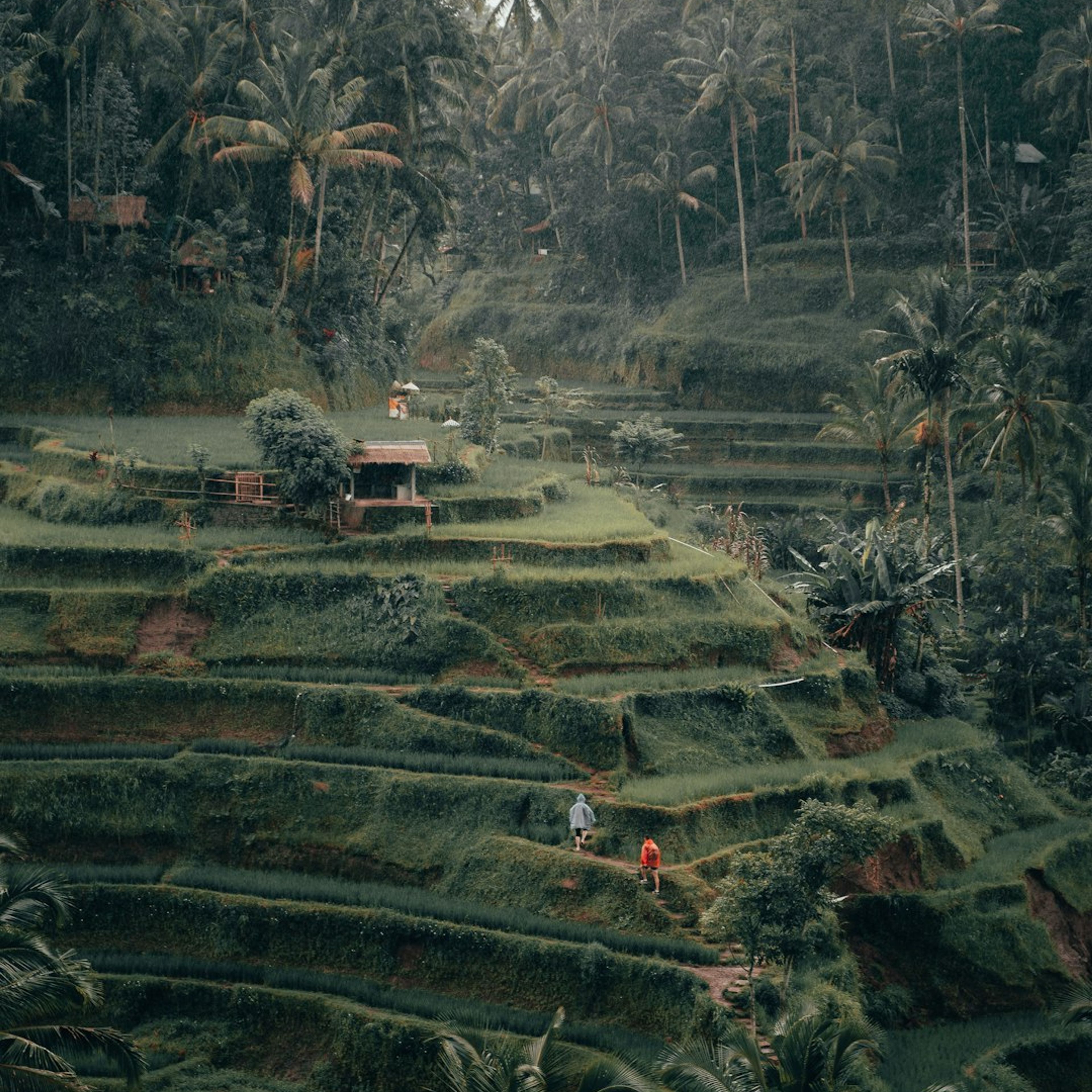
The Tegalalang Rice Terrace is the single most photographed landscape in Bali - a sweeping valley of sculpted green paddies carved into the hillside using the traditional Balinese irrigation system known as subak, which dates back to the 9th century and is recognised by UNESCO. The terraces cascade steeply down both sides of a narrow river valley, creating the dramatic layered effect that appears on every Bali postcard and Instagram feed.
Walking paths and bamboo bridges criss-cross the terraces, and you can descend right down to the valley floor if you are steady on your feet (the steps can be slippery after rain). Local farmers maintain the paths and collect a small donation of IDR 15,000-20,000 at several points along the route. Several cafes along the main road offer terrace-view seating - perfect for a coconut or fresh juice while soaking in the view. The entire area is free to enter from the roadside; the donations go directly to the farming cooperatives who maintain it.
3Tirta Empul Temple - Sacred Purification in Holy Spring Water


Tirta Empul is one of Bali's holiest water temples, founded in 926 AD around a natural spring that Balinese Hindus believe was created by the god Indra. The temple's centrepiece is a long rectangular purification pool fed by 30 stone-carved water spouts, each believed to have different spiritual properties. Balinese worshippers and respectful visitors alike wade through the chest-deep pool, moving from spout to spout in a prescribed sequence while reciting prayers - a ritual called melukat.
Beyond the purification pools, the temple complex includes lush gardens, koi ponds, and ornate split gates that make for some of Ubud's best photography. You must wear a sarong (available free at the entrance) and follow the etiquette signs. Entry is IDR 50,000 (€3) for international visitors. The temple is open daily from 08:00 to 18:00, though the purification pools close at 17:00. Spout numbers 11 and 12 are reserved for funeral purification and should be skipped by visitors.
Check dates for Ubud
See what is available on your dates.
4Ubud Royal Palace (Puri Saren Agung) - A Living Balinese Court

Standing right at Ubud's main crossroads, Puri Saren Agung is the historic residence of the Ubud royal family and one of the town's most recognisable landmarks. Built in the early 20th century by the local lord Ida Tjokorda Putu Kandel, the palace grounds feature intricately carved stone gates, ornamental kori agung doorways, and lush tropical gardens. The front portion of the palace is open to visitors free of charge during daytime hours, though the private quarters at the rear remain off-limits as the royal family still lives here.
The palace's main draw for most visitors is the nightly Balinese dance performance held in the open-air courtyard. Legong, Barong, and Kecak dances are staged on a rotating schedule starting at 19:30, with tickets at IDR 100,000 (€5.50). Watching dancers in elaborate gold costumes perform by torchlight against the backdrop of the palace's carved stone walls is one of the most atmospheric Ubud experiences you can have.
5Campuhan Ridge Walk - Ubud's Favourite Sunrise Stroll

The Campuhan Ridge Walk is a paved path running along a narrow grassy ridge between the Wos and Cerik river valleys on Ubud's western edge. At just 2 km each way, it is a gentle stroll rather than a hike, but the views are spectacular - tall grass swaying on either side, coconut palms framing the valleys below, and on clear mornings, Mount Agung visible in the distance. It is free, open 24 hours, and arguably the single best free thing to do in Ubud Bali.
The trailhead starts beside the Gunung Lebah Temple at the bottom of Jalan Raya Campuhan (look for the signs just past the Ibah hotel). The path climbs gently to the ridge, passes through a painters' studio area, and ends at a road near the village of Keliki. Most walkers turn around at the ridge's high point and retrace their steps. The entire out-and-back takes 30-45 minutes at a leisurely pace. There are no facilities along the path itself, so bring water.
6Goa Gajah (Elephant Cave) - A 9th-Century Archaeological Marvel

Goa Gajah, known as the Elephant Cave, is a 9th-century archaeological site carved into a rock face on the banks of the Petanu River. The cave's entrance is its most striking feature - a massive carved demon face (often interpreted as the earth god Bhoma) with a gaping mouth that serves as the doorway. Inside the T-shaped cave you will find a small meditation chamber with rock-cut niches holding lingam and yoni statues, indicating the site's mixed Hindu-Buddhist heritage.
Outside the cave, stone steps descend to a lush river valley with bathing fountains depicting six female figures that were only excavated in 1954. The grounds also include a crumbling Buddhist stupa and rice paddies that you can wander through. The site is relatively compact - most visits take 30-45 minutes. Entry is IDR 50,000 (€3) including sarong rental. Open daily 08:00-16:00. Despite the name, the site has no connection to elephants - the name likely derives from a misinterpretation by early European visitors.
7Ubud Art Market (Pasar Seni Ubud) - Handmade Crafts and Balinese Souvenirs

Sitting directly across from the Royal Palace, the Ubud Art Market (Pasar Seni Ubud) is a sprawling two-storey maze of stalls selling handmade Balinese crafts, textiles, paintings, wood carvings, woven baskets, and silver jewellery. The market is open daily from around 08:00 to 18:00, though it is busiest and most vibrant in the morning when local artisans sell their own work. By mid-morning, the stalls shift to more tourist-oriented vendors, but bargains and quality pieces can be found throughout the day if you know what to look for.
Haggling is expected and part of the experience - start at roughly 40-50% of the first asking price and work your way to a fair middle ground. Standout buys include hand-painted batik fabric, rattan bags (the round Ata bags are a Bali icon), carved wooden masks, and silver rings from the nearby village of Celuk. The market's narrow alleys can feel claustrophobic when busy, but that is part of the charm. Budget at least 30-60 minutes to browse properly.
8Pura Taman Saraswati - The Lotus Temple of Ubud

Pura Taman Saraswati is a water temple dedicated to the Hindu goddess of learning and the arts, tucked just off the main road behind a stunning lotus pond. The temple was designed in the 1950s by the legendary Balinese architect and artist I Gusti Nyoman Lempad, and its ornate stone carvings are considered among the finest in Ubud. The front lotus pond, filled with pink and white blooms, frames the temple's ornamental gate in one of the most photographed compositions in town.
Entry to the temple grounds is free, making it one of the best value Ubud sightseeing stops. The inner courtyard features detailed relief carvings of Saraswati, Garuda, and other mythological figures. Several evenings per week, traditional dance performances are staged on the open-air stage fronting the lotus pond - tickets run IDR 100,000 (€5.50) and the setting, with dancers reflected in the water, is magical. During the day, the Starbucks and Lotus Cafe on the temple's entrance path offer lotus-pond seating for a drink.
9Tegenungan Waterfall - A Jungle Cascade Minutes from Town

Tegenungan is the most accessible waterfall near Ubud - a powerful cascade dropping roughly 15 metres into a wide natural pool surrounded by lush jungle. Unlike Bali's more remote waterfalls that require long drives and steep treks, Tegenungan is just 20 minutes south of central Ubud with a well-maintained stairway of around 100 steps leading down to the base. The pool at the bottom is deep enough for swimming (though currents can be strong after heavy rain), and the spray from the falls keeps the whole area pleasantly cool.
Entry costs IDR 20,000 (€1.10) and the site is open from 06:30 to 18:30 daily. Changing rooms and lockers are available at the base. The waterfall is at its most powerful during and just after the wet season (December to March), but flows year-round. There are also viewpoints and swing platforms along the cliff edge above the falls for those who prefer to stay dry. Several warungs at the top of the stairs serve cold drinks and local food.
10Mount Batur Sunrise Trek - Volcanic Summit at Dawn

Watching the sunrise from the summit of Mount Batur (1,717 m) is one of the most unforgettable things to do in Ubud Bali. The trek starts with a pickup from your Ubud accommodation around 02:00-02:30, a one-hour drive to the trailhead at Toya Bungkah on the crater lake shore, and then a guided two-hour climb in the dark by headlamp. The trail is steep but non-technical - reasonable fitness is all you need, plus warm layers for the chilly summit temperatures.
At the top, guides serve hot coffee and banana sandwiches cooked over volcanic steam vents while the sun rises over Mount Agung and the shimmering expanse of Lake Batur below. On clear mornings, you can see all the way to Lombok's Mount Rinjani. The descent takes about 1.5 hours, and most groups are back in Ubud by 10:00-11:00. Licensed guides are mandatory (the local guides' association enforces this strictly). Expect to pay IDR 500,000-800,000 (€28-45) per person including transport and breakfast.
11Neka Art Museum - A Journey Through Balinese Painting

Founded in 1982 by art collector Wayan Suteja Neka, the Neka Art Museum is Ubud's finest gallery and the best place to understand the evolution of Balinese art from traditional Kamasan-style paintings to modern abstract works. Set across six pavilions on a hillside overlooking the Campuhan valley, the collection spans centuries and styles - from intricate mythological scenes on bark cloth to bold contemporary canvases by Indonesian and resident foreign artists.
Highlights include the Arie Smit Pavilion (featuring the Dutch-born artist who founded the Young Artists movement in Bali), the Photography Archive with black-and-white images of Bali from the 1930s-1950s, and the Lempad Pavilion showcasing the renowned Ubud architect-artist. The museum is well-labelled in English and you can easily spend 1-2 hours here. Entry is IDR 100,000 (€5.50) and the museum is open daily 09:00-17:00. The garden terraces are lovely for a quiet sit between pavilions.
12Gunung Kawi Temple - Ancient Rock-Cut Shrines in a River Valley

Gunung Kawi is an 11th-century temple complex featuring ten massive rock-cut shrines (called candi) carved directly into the cliff face of the Pakerisan River valley. Each shrine stands about 7 metres tall and is believed to be a memorial to members of the Udayana dynasty. The site is one of Bali's oldest and most atmospheric - moss and ferns cling to the rock carvings, palm trees tower overhead, and the sound of the river echoes through the narrow valley.
Reaching the shrines requires descending a steep staircase of roughly 300 steps through a ravine lined with rice paddies and coconut palms - a stunning approach that adds to the experience but means you need to climb back up afterwards. The temple complex at the bottom includes a monks' meditation cave and bathing pools. Entry is IDR 50,000 (€3) including sarong. Open daily 08:00-18:00. The site sees far fewer visitors than Tirta Empul despite being just 5 minutes away, so you can often explore in near-solitude.
Take this guide with you
Get every place in this guide, with addresses and map links, in your inbox — easy to open on your phone during the trip.
One email to the address on your account. No newsletter.

CEO and co-founder
Tomas is the co-founder and director of trip1, an European company specializing in reservation services. He launched the company in 2025 with a focus on building scalable, efficient operations.
Ubud Travel Guide FAQ
Yes. Ubud is Bali's cultural capital, and it offers what the beach resorts of the south don't: the Tegalalang rice terraces, water temples like Tirta Empul, the Sacred Monkey Forest, nightly Balinese dance at the Royal Palace and the Campuhan Ridge Walk at sunrise. At around 200 metres above sea level, it is also cooler than the coast.
The monkeys first: at the Sacred Monkey Forest they grab water bottles, sunglasses and hats, so secure your belongings, avoid eye contact and never offer food. The steps at Tegalalang get slippery after rain, currents at Tegenungan Waterfall can be strong after heavy rain, and temples require a sarong. At Tirta Empul, skip spouts 11 and 12, which are reserved for funeral purification.
Yes. Alcohol is legal and served in Ubud's restaurants, bars and hotels. Stick to branded drinks from licensed venues: there have been cases of methanol poisoning in Bali from drinks made with illegally produced spirits.
Three to four days. Two days covers the highlights: the Monkey Forest, Tegalalang Rice Terrace, a temple or two and the Campuhan Ridge Walk. A third and fourth day add the Mount Batur sunrise trek, with pickup around 02:00, Gunung Kawi and the art museums.
The dry season, from April to October, when rain is minimal and temperatures are around 27 to 30 degrees. June to September is the driest and busiest time, so book the Mount Batur trek at least a day ahead. The wet season, from November to March, brings afternoon showers but greener landscapes, fewer crowds and Tegenungan Waterfall at its most powerful.
Yes. On trip1 you can book hotels across Ubud, from guesthouses in the centre to villas in the Sayan valley, and pay with over 120 cryptocurrencies, including Bitcoin, Ethereum and USDC, or by Visa and Mastercard.