Guides · Marrakech
15 Top Places to Visit in Marrakech, Morocco
By Tomas Achmedovas · CEO and co-founder

CEO and co-founder
Marrakech - Where Ancient Traditions Meet Modern Morocco
Marrakech is one of those rare cities that overwhelms every sense from the moment you step through its ochre walls. The places to visit in Marrakech range from 12th-century mosques and crumbling palaces to electric-blue gardens and smoke-filled food stalls, all packed into a compact Medina that has traded in spices, textiles, and stories for nearly a thousand years. Known as the Red City for its distinctive terracotta-hued buildings, Marrakech sits at the foot of the snow-capped Atlas Mountains and has served as a crossroads between sub-Saharan Africa and the Mediterranean world since its founding by the Almoravid dynasty in 1070.
Today Marrakech is Morocco's most-visited city and one of Africa's most compelling destinations. Its UNESCO-listed Medina is a labyrinth of narrow alleys, hidden riads, and artisan workshops where copper is still hammered by hand and leather is dyed in centuries-old tannery pits. Beyond the walls, the modern Gueliz district offers French-influenced cafes, galleries, and boutiques. Whether you are bargaining for a handwoven rug in the souks, sipping mint tea on a rooftop terrace overlooking Djemaa el-Fna, or watching sunset paint the Atlas peaks from the Menara Gardens, Marrakech delivers an intensity of experience that few cities anywhere can match.
This guide covers the 15 top places to visit in Marrakech - the essential landmarks, gardens, palaces, and neighbourhoods that make this city unforgettable. Each entry includes practical details on location, transport, and insider tips to help you plan a trip that balances iconic Marrakech attractions with hidden gems most visitors walk right past.
Check dates for Marrakech
See what is available on your dates.
1Djemaa el-Fna - The Beating Heart of Marrakech


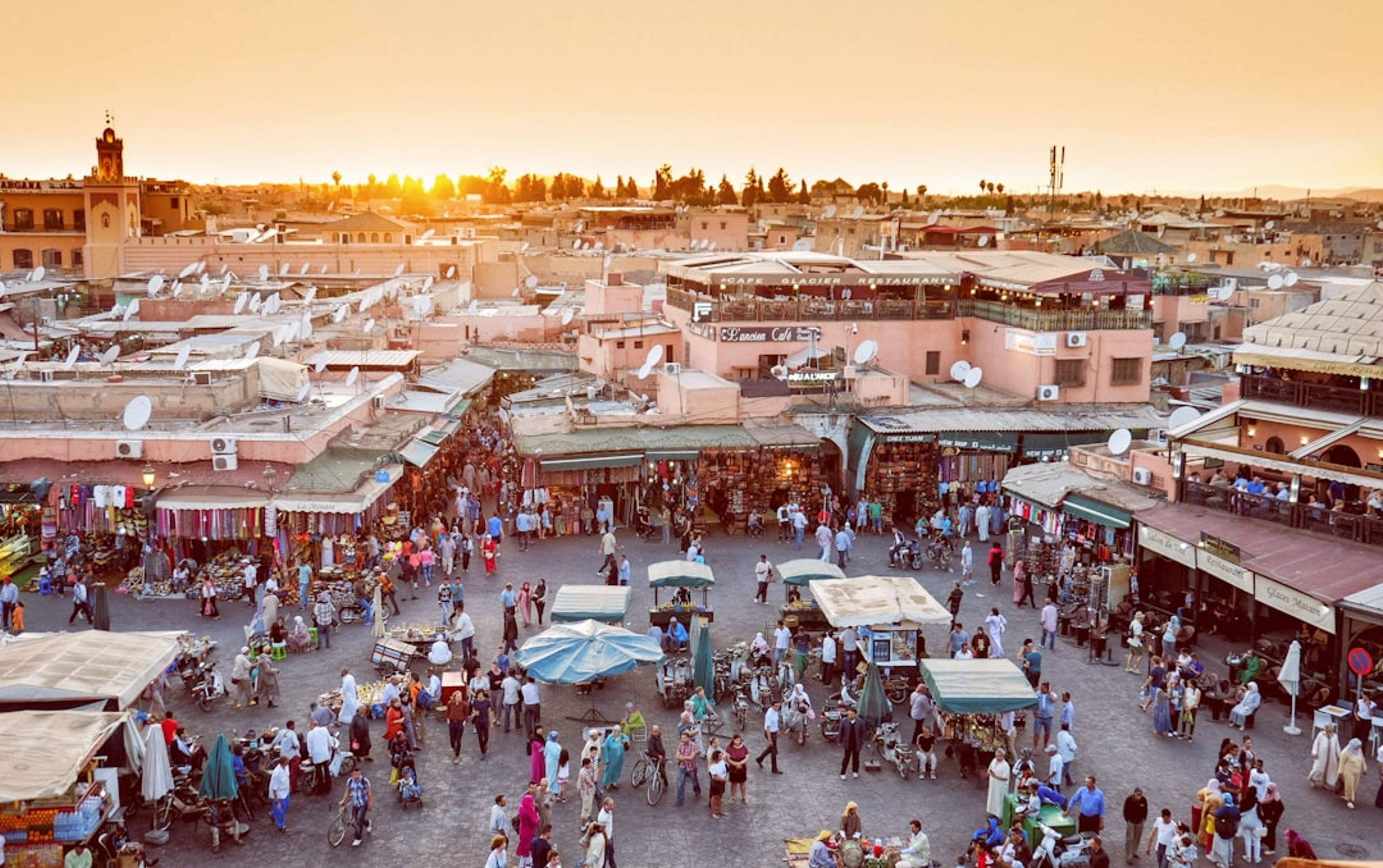
No list of places to visit in Marrakech can start anywhere else. Djemaa el-Fna is a UNESCO-recognised Masterpiece of the Oral and Intangible Heritage of Humanity - a grand title for what is essentially the world's most theatrical public square. By day, the vast open space fills with orange juice vendors pressing fresh fruit for 5 MAD (~€0.50), henna artists, Gnawa musicians, and the occasional snake charmer. The energy is relentless but manageable in the morning hours.
At sunset, Djemaa el-Fna transforms completely. Dozens of food stalls assemble in a cloud of charcoal smoke, serving everything from lamb brochettes and snail soup to harira and fried aubergine. The square becomes a sensory overload of sizzling meat, drumming circles, storytellers, and acrobats. Grab a spot at one of the rooftop cafes along the northern edge - Cafe de France or Cafe Glacier - for a panoramic view across the entire spectacle. A meal at the food stalls costs 30-60 MAD (~€3-6) and is as much about the experience as the food itself.
2Koutoubia Mosque - Marrakech's Most Iconic Skyline Landmark


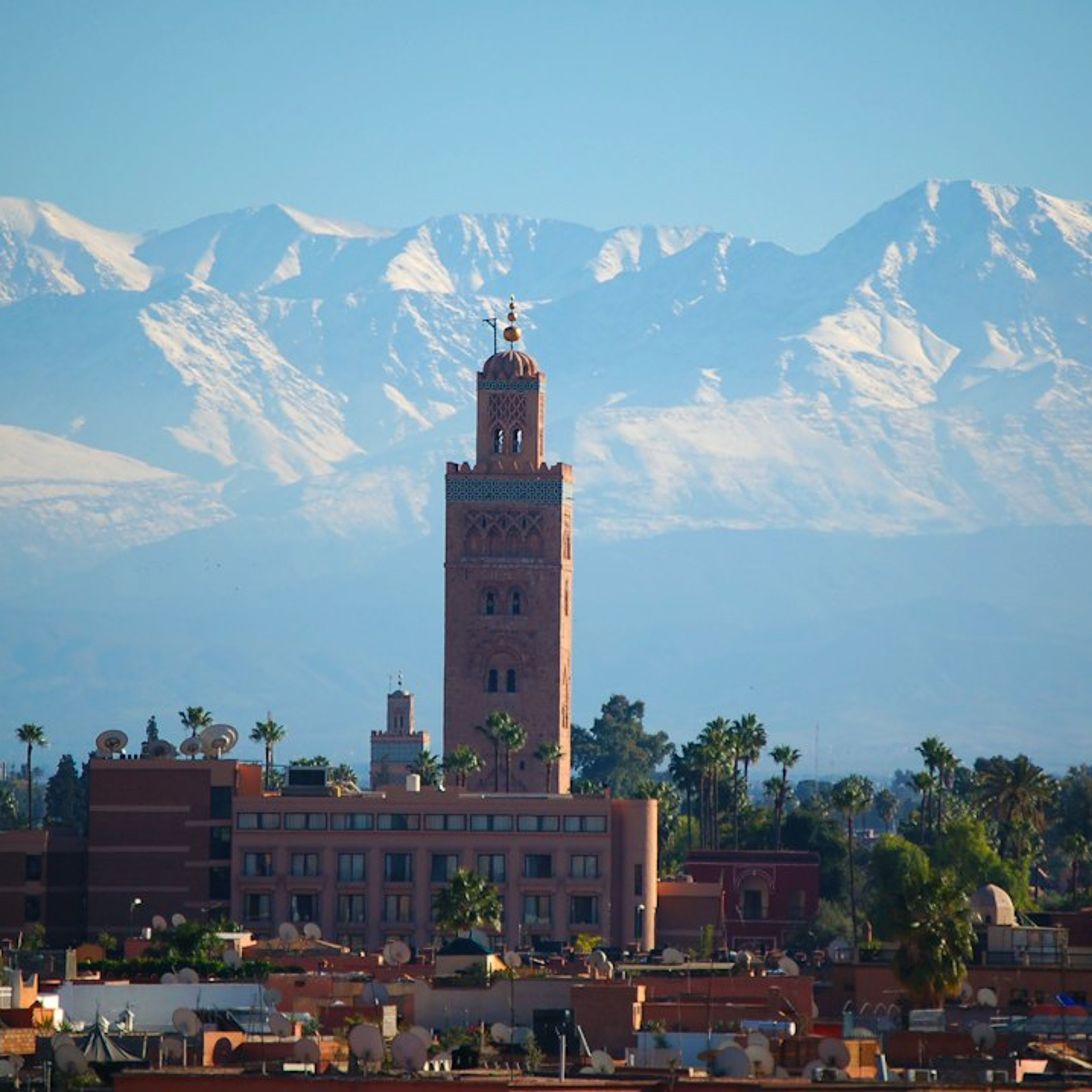
The Koutoubia Mosque is to Marrakech what the Eiffel Tower is to Paris - the defining silhouette on the skyline and the city's most recognisable landmark. Its 77-metre minaret, completed in the 12th century under the Almohad dynasty, set the template for the Giralda in Seville and the Hassan Tower in Rabat. The proportions are elegant: the tower's height is exactly five times its width, and the decorative stonework shifts pattern on each face, rewarding a slow walk around the perimeter.
Non-Muslims cannot enter the mosque itself, but the surrounding gardens and the minaret's exterior are the real draw. The Koutoubia Gardens stretch south and west of the mosque - a welcome patch of green with orange trees, rose bushes, and benches ideal for escaping the Medina's intensity. The minaret is beautifully illuminated after dark, making it a reliable navigation landmark when the Medina's alleys become disorienting. The ruins of the original Almoravid mosque are visible at the base - look for the excavated foundations on the north side.
3Bahia Palace - A Masterpiece of Moroccan Craftsmanship


Bahia Palace is the most visually stunning Marrakech attraction you can actually walk through. Built in the late 19th century for Grand Vizier Ba Ahmed, the palace was designed to be the finest in Morocco - and its 8,000 square metres of intricate zellige tilework, carved cedar ceilings, and stucco ornamentation make a strong case that it succeeded. The name means "Palace of the Beautiful" and every courtyard delivers on that promise.
The highlight is the Grand Court - a vast marble-paved courtyard surrounded by painted wooden galleries and rooms with dazzling geometric tilework from floor to ceiling. The harem quarters, with their intimate gardens and fountain courtyards, are equally impressive. Bahia Palace is one of the few Marrakech sites where you can appreciate the full range of Moroccan decorative arts in a single visit: zellige, tadelakt plaster, carved wood, and wrought iron all working together. Entry costs 70 MAD (~€7) and the palace is open daily 9:00-17:00.
Check dates for Marrakech
See what is available on your dates.
4Ben Youssef Madrasa - A Jewel of Islamic Architecture

Ben Youssef Madrasa is the single most beautiful interior in Marrakech. This 14th-century Islamic college was once the largest in North Africa, housing up to 900 students in 130 dormitory cells arranged around a central courtyard. The courtyard is where the magic hits: a rectangular marble basin reflects the sky between walls covered in carved stucco so intricate it looks like lace, framed by cedar wood panels and crowned by green-tiled rooflines.
After a major restoration, the madrasa reopened with improved lighting that brings out details in the carvings you might otherwise miss. The student cells upstairs are spartan by contrast - tiny rooms with small windows looking onto the courtyard, a reminder that this was a place of study, not luxury. The prayer hall at the far end contains some of the finest muqarnas (honeycomb vaulting) in Morocco. Entry is 100 MAD (~€10) and it is open 9:00-18:00 daily. Budget at least 45 minutes to appreciate the details.
5Jardin Majorelle - The Blue Garden That Captivated Yves Saint Laurent

Jardin Majorelle is the most-visited garden in North Africa and one of the top places to visit in Marrakech for a reason. Created by French painter Jacques Majorelle in the 1920s and later rescued from demolition by Yves Saint Laurent and Pierre Berge, the garden is a riot of cobalt blue, cadmium yellow, and emerald green set against cacti, bougainvillea, bamboo groves, and lily-pad pools. The signature Majorelle Blue - a vivid ultramarine - covers every building surface and creates an otherworldly contrast against the desert sky.
The garden spans about 2.5 acres and contains over 300 plant species from five continents, including towering palms, giant agaves, and fragrant jasmine. Inside Majorelle's former studio, the Berber Museum displays an excellent collection of North African textiles, jewellery, and woodwork. Tickets cost 150 MAD (~€15) for the garden or 200 MAD (~€20) including the museum. It is open daily 8:00-18:00 (extended hours in summer). The adjacent Musee Yves Saint Laurent is a separate ticket and visit.
6Saadian Tombs - A Hidden Royal Necropolis

The Saadian Tombs were sealed up and forgotten for centuries until a French aerial survey rediscovered them in 1917. That long isolation preserved something extraordinary: the 16th-century mausoleum of Sultan Ahmad al-Mansur, with its twelve marble columns supporting a ceiling of gilded cedarwood and honeycomb muqarnas, remains one of the finest examples of Saadian-era decoration in Morocco. The tombs house around 66 members of the Saadian dynasty in two main mausoleums surrounded by a garden of roses and fruit trees.
The Hall of Twelve Columns is the highlight - Italian Carrara marble pillars frame elaborately carved tombs beneath a domed ceiling so detailed it could take an hour to study. The adjacent second mausoleum is simpler but holds the tombs of Sultan Ahmad al-Mansur's mother and other royal women. Entry costs 70 MAD (~€7), and the site is open daily 9:00-17:00. The narrow entrance passage creates bottlenecks, so expect queuing during busy periods.
7El Badi Palace - The Magnificent Ruins of a Golden-Age Palace

El Badi Palace is the most atmospheric ruin in Marrakech. Built in 1578 by Sultan Ahmad al-Mansur to celebrate his victory at the Battle of the Three Kings, it was once a marvel of gold, turquoise, and crystal - a palace so extravagant its name translates to "The Incomparable." In 1683, Sultan Moulay Ismail stripped it of every valuable surface to decorate his own capital in Meknes. What remains is a vast sunken courtyard with crumbling pisé walls, reflecting pools, and orange groves that are hauntingly beautiful in their emptiness.
The scale of El Badi is impressive even stripped bare - the central courtyard stretches 135 metres long and 110 metres wide, with sunken gardens and a large central pool. Climb the rampart walls for panoramic views over the Kasbah rooftops to the Atlas Mountains. The underground chambers now house the original minbar (pulpit) from the Koutoubia Mosque, a masterpiece of Almoravid woodcarving that took eight years to complete. Entry is 70 MAD (~€7) and the palace is open daily 9:00-17:00.
8Marrakech Souks - A Labyrinth of Colour, Craft, and Haggling

The Marrakech souks are the largest traditional market in Morocco and among the best places to visit in Marrakech for anyone who enjoys sensory overload. Stretching north from Djemaa el-Fna in a dense network of covered alleys, the souks are loosely organised by trade: Souk Semmarine for textiles and clothing, Souk el-Attarine for spices and perfumes, Souk des Teinturiers for leather and dyed fabrics, Souk Haddadine for metalwork, and Souk Chouari for woodworking and carpentry.
Haggling is expected and essential - start at roughly one-third of the asking price and work from there. Quality varies enormously, so handle items before committing and compare across several stalls. The souks also contain hidden gems beyond shopping: look for the Rahba Kedima (old grain market) where herbalists sell traditional remedies, and the tiny Place des Epices with its rooftop cafes. The northern souks near Ben Youssef Madrasa tend to be less touristy and more focused on genuine artisan workshops. Most stalls are open 9:00-20:00, with some closing for a midday break.
9Le Jardin Secret - A Restored Riad Garden in the Heart of the Medina

Le Jardin Secret is a beautifully restored Islamic garden hidden behind an unassuming door on busy Rue Mouassine. The riad dates to the Saadian era (16th century) and was painstakingly restored starting in 2008, reopening as a public garden in 2016. It contains two distinct garden spaces: an exotic garden with plants from across the tropics, and an Islamic garden with the traditional four-part layout symbolising the four gardens of paradise, fed by an original khettara (underground irrigation channel).
The real draw is the contrast with the chaotic Medina outside. Step through the entrance and the noise drops instantly - replaced by birdsong, trickling water, and the scent of jasmine. The tower offers a small rooftop terrace with views over the Medina to the Atlas Mountains and Koutoubia Mosque. Entry to the garden is 70 MAD (~€7), with an additional 40 MAD (~€4) for the tower. Open daily 9:30-18:00 (extended hours in summer). There is a pleasant onsite cafe for mint tea.
10Musée Yves Saint Laurent Marrakech - Where Fashion Meets Moroccan Art

The Musée Yves Saint Laurent Marrakech (mYSLm) opened in 2017 as a purpose-built museum dedicated to the legendary fashion designer who made Marrakech his second home. The building itself is a work of art - designed by Studio KO, its terracotta-brick exterior echoes the city's ochre palette while the interior reveals airy, light-filled galleries. The museum holds a rotating selection from YSL's archive of 5,000 garments and 15,000 accessories, displayed in thematic exhibitions that change twice yearly.
Beyond the fashion galleries, the museum includes a 130-seat auditorium, a bookshop, a research library, and a cafe with a terrace. The permanent exhibition traces Saint Laurent's relationship with Morocco and how Moroccan colours, patterns, and light influenced his work - from the famous Mondrian dress to the North African-inspired collections. Tickets are 100 MAD (~€10), and the museum is open daily except Wednesday 10:00-18:00. Combine it with Jardin Majorelle next door for a full half-day in Gueliz.
11Maison de la Photographie - Marrakech Through the Lens of History

The Maison de la Photographie houses a fascinating private collection of vintage Moroccan photography spanning from the 1870s to the 1950s. Spread across three floors of a restored riad, the exhibition includes glass-plate negatives, original prints, and early Amazigh (Berber) portraits that offer a window into a Morocco most visitors never see. The images of pre-tourism Marrakech are particularly striking - empty souks, camel caravans crossing the desert, and Atlas Mountain villages untouched by modernity.
The museum is small enough to visit in 30-45 minutes, making it an easy add-on to a Ben Youssef Madrasa visit nearby. The rooftop terrace cafe is the real hidden gem - it serves excellent mint tea and light lunches with a panoramic view across the Medina rooftops to the Koutoubia and Atlas Mountains, without the crowds of Djemaa el-Fna's cafes. Entry is 50 MAD (~€5) and the museum is open daily 9:30-19:00.
12Menara Gardens - A Peaceful Olive Grove with Atlas Mountain Views

The Menara Gardens are one of the oldest and most serene places to visit in Marrakech - a vast 12th-century olive grove surrounding a reflective basin that perfectly mirrors the snow-capped Atlas Mountains on clear days. The gardens were originally planted by the Almohad dynasty in the 1100s as a royal retreat, and their 100-hectare expanse of olive, palm, and fruit trees still provides a welcome escape from the intensity of the Medina just 3 km to the east.
The centrepiece is a large rectangular basin fed by an ancient khettara irrigation system, with a 19th-century pavilion (menzeh) on its southern bank. This pavilion-and-pool-with-mountains composition is one of the most photographed scenes in Marrakech. The gardens are free to enter and open daily from sunrise to sunset. There is no shade near the basin, so bring a hat in summer. The olive groves behind the basin are much quieter and ideal for a slow stroll or picnic.
13Mellah - The Historic Jewish Quarter of Marrakech

The Mellah is Marrakech's historic Jewish quarter, established in 1558 when the Saadian sultan relocated the Jewish community to this area near the royal palace for their protection. It is architecturally distinct from the rest of the Medina - look for the wooden balconies overhanging the streets, a style found only in the Mellah. At its peak, the quarter housed thousands of Jewish residents who formed a vital part of the city's commercial and artisan life.
Today the Mellah is predominantly Muslim, but traces of its Jewish heritage remain. The Lazama Synagogue on Derb Manchoura has been restored and is open to visitors (20 MAD/~€2), with its blue-and-white tiled courtyard and prayer hall still intact. The Miara Jewish Cemetery, one of the largest in Morocco, contains hundreds of whitewashed tombs. The Mellah's spice market is less touristy than the main souks and its jewellery stalls offer better prices. The area around Place des Ferblantiers (Tinsmiths' Square) is lively with lantern and metalwork shops.
14Dar Si Said Museum - A Treasure House of Moroccan Decorative Arts

Dar Si Said is Marrakech's museum of Moroccan arts and crafts, housed in a 19th-century palace built by Si Said, the brother of Grand Vizier Ba Ahmed (who built Bahia Palace). The palace itself is worth the visit - its courtyard features a central fountain surrounded by zellige tilework, carved stucco, and painted cedarwood ceilings that rival Bahia next door, but with a fraction of the visitors. The building quietly holds its own as one of the most beautiful Marrakech attractions.
The collection spans centuries of Moroccan craftsmanship: Amazigh jewellery from the Atlas Mountains, antique carpets from the High Atlas and Middle Atlas regions, cedarwood doors and window screens, pottery, weapons, and textiles. The highlight is the marble basin from the 10th-century Almoravid hammam, intricately carved with griffins and eagles - one of the oldest surviving decorative objects in Marrakech. Entry is 30 MAD (~€3) and the museum is open Wednesday to Monday 9:00-18:00 (closed Tuesdays).
15Palmeraie - An Ancient Palm Oasis on the City's Edge

The Palmeraie is a 13,000-hectare palm grove that has surrounded Marrakech since the Almoravid era. Legend says it grew from date pits discarded by soldiers in the 11th century. Today it contains over 100,000 palm trees, luxury resorts, and is the main base for camel rides - the classic Marrakech excursion. A one-hour camel trek through the palm groves costs roughly 200-300 MAD (~€20-30) per person and passes through dusty trails between the palms with views back toward the city and Atlas Mountains.
Beyond camel rides, the Palmeraie offers quad biking, horse riding, and cycling among the palm groves. Several luxury resorts here have day-pass options for their pools and spas, making it a refreshing retreat from Medina intensity on hot days. The palm grove is under environmental pressure from development and water scarcity, but remains one of the most distinctive landscapes near any city in North Africa. A half-day is enough for a camel ride and exploration.
Take this guide with you
Get every place in this guide, with addresses and map links, in your inbox — easy to open on your phone during the trip.
One email to the address on your account. No newsletter.

CEO and co-founder
Tomas is the co-founder and director of trip1, an European company specializing in reservation services. He launched the company in 2025 with a focus on building scalable, efficient operations.
Marrakech Travel Guide FAQ
Djemaa el-Fna, twice: in the morning for orange juice and again after 6pm when the food stalls fire up. Then the Bahia Palace tilework, the carved courtyard of Ben Youssef Madrasa, the Saadian Tombs and Jardin Majorelle. Get lost in the souks north of the square, and end a day at the Menara Gardens for the view of the Atlas Mountains.
Three to four days. Two days covers Djemaa el-Fna, Bahia Palace, Ben Youssef Madrasa and the souks, but feels rushed. With four you can add Jardin Majorelle, the Saadian Tombs, a hammam and a day trip to the Atlas Mountains or Essaouira. If you also plan a Sahara trip, allow five to six days in total.
Do haggle in the souks, starting at about a third of the asking price, and handle items before you buy. Do arrive at the big sights at opening and book Jardin Majorelle online. Don't follow touts who offer to guide you, and book camel rides through your riad rather than at Djemaa el-Fna. If you get lost, any shopkeeper can point you back to the square.
Knee-length shorts are fine in Gueliz, at hotels and around pools, but very short shorts draw attention in the Medina. For palaces, madrasas and religious sites, cover your shoulders and knees. Loose, light clothing in natural fabrics is the most comfortable choice in the heat, and wear closed walking shoes, since the Medina's cobbles and uneven lanes are hard on sandals.
March to May and September to November, when days sit around 20 to 30°C. Winter, December to February, is a good-value escape at about 8 to 18°C, with chilly evenings but clear light: the Menara Gardens reflection of the Atlas peaks is sharpest on calm days from October to April. Avoid June to August, when midday heat regularly passes 40°C.
Yes. On trip1 you can book hotels in Marrakech and pay with over 120 cryptocurrencies, including Bitcoin, Ethereum and USDC, or by Visa and Mastercard. Options range from riads in the Medina to hotels in Gueliz and resorts in the Palmeraie.