Guides · Mexico City
15 Best Things to Do in Mexico City
By Tomas Achmedovas · CEO and co-founder

CEO and co-founder
Deciding what to prioritise among the things to do in Mexico City can feel overwhelming. The capital holds over 150 museums, dozens of sprawling markets, pre-Columbian ruins buried beneath modern streets, and a food scene that earned UNESCO recognition. This guide narrows the field to 15 stand-out attractions - the places that deliver the strongest impression of the city's layered history, creative energy, and culinary depth. Whether you have three days or a full week, these 15 entries give you a practical framework for planning your Mexico City itinerary.
The list opens with the Historic Centre sites you can cover on foot - the Zocalo, Templo Mayor, and Palacio de Bellas Artes - then moves to the green expanse of Chapultepec Park and its world-class museums. From there it heads south to Coyoacan for the Frida Kahlo Museum and onward to the canals of Xochimilco. A day trip to the Teotihuacan pyramids earns its own entry, and the guide rounds out with street-food markets, mezcal bars, and a night of lucha libre wrestling. Every entry includes the exact address, nearest Metro or Metrobus stop with walking time, distance from the Zocalo, admission costs in MXN and EUR, and a Pro Tip drawn from on-the-ground experience.
Mexico City rewards visitors who slow down and pay attention. Use this guide as a checklist or a loose route - either way, these 15 Mexico City attractions cover the essential ground between ancient temples and late-night mezcalerias.
Check dates for Mexico City
See what is available on your dates.
1Zocalo (Plaza de la Constitucion) - The Political and Cultural Heart of the City


The Zocalo is one of the largest public squares in the world, measuring roughly 240 metres on each side. It sits on what was once the ceremonial centre of the Aztec capital Tenochtitlan, and today it remains the political anchor of modern Mexico. The Palacio Nacional lines the eastern edge, housing Diego Rivera's sweeping murals that chronicle Mexican history from pre-Columbian times through the Revolution. Directly north stands the Catedral Metropolitana, a cathedral that took nearly 250 years to complete and blends Gothic, Baroque, and Neoclassical styles into a single facade.
The square itself is pedestrianised and free to enter at all hours. On weekends and national holidays, expect flag-raising ceremonies, traditional Aztec dance performances, and temporary art installations. Street vendors sell elote (grilled corn) and esquites along the perimeter. Admission to the Palacio Nacional is free but you need a valid ID. The Catedral Metropolitana is also free to enter.
2Templo Mayor - Aztec Ruins in the Middle of Downtown


Templo Mayor was the main temple of the Aztec capital Tenochtitlan, rediscovered by accident in 1978 when electrical workers hit a massive carved stone disc depicting the moon goddess Coyolxauhqui. The excavated ruins now sit in an open-air archaeological zone just northeast of the Zocalo, revealing layer upon layer of construction as successive rulers expanded the temple over two centuries. The adjacent museum displays over 7,000 artefacts pulled from the site, including sacrificial knives, jade masks, and the original Coyolxauhqui monolith.
Walking the raised platforms and viewing the twin shrines dedicated to Huitzilopochtli (god of war) and Tlaloc (god of rain) gives you an unmatched sense of how the Aztec world sat directly beneath the Spanish colonial city. Admission is 85 MXN (about 4.50 EUR). The site is open Tuesday to Sunday, 09:00 to 17:00. Sundays are free for Mexican nationals and residents, which makes weekdays quieter for international visitors.
3Palacio de Bellas Artes - Art Nouveau and Art Deco Under One Roof


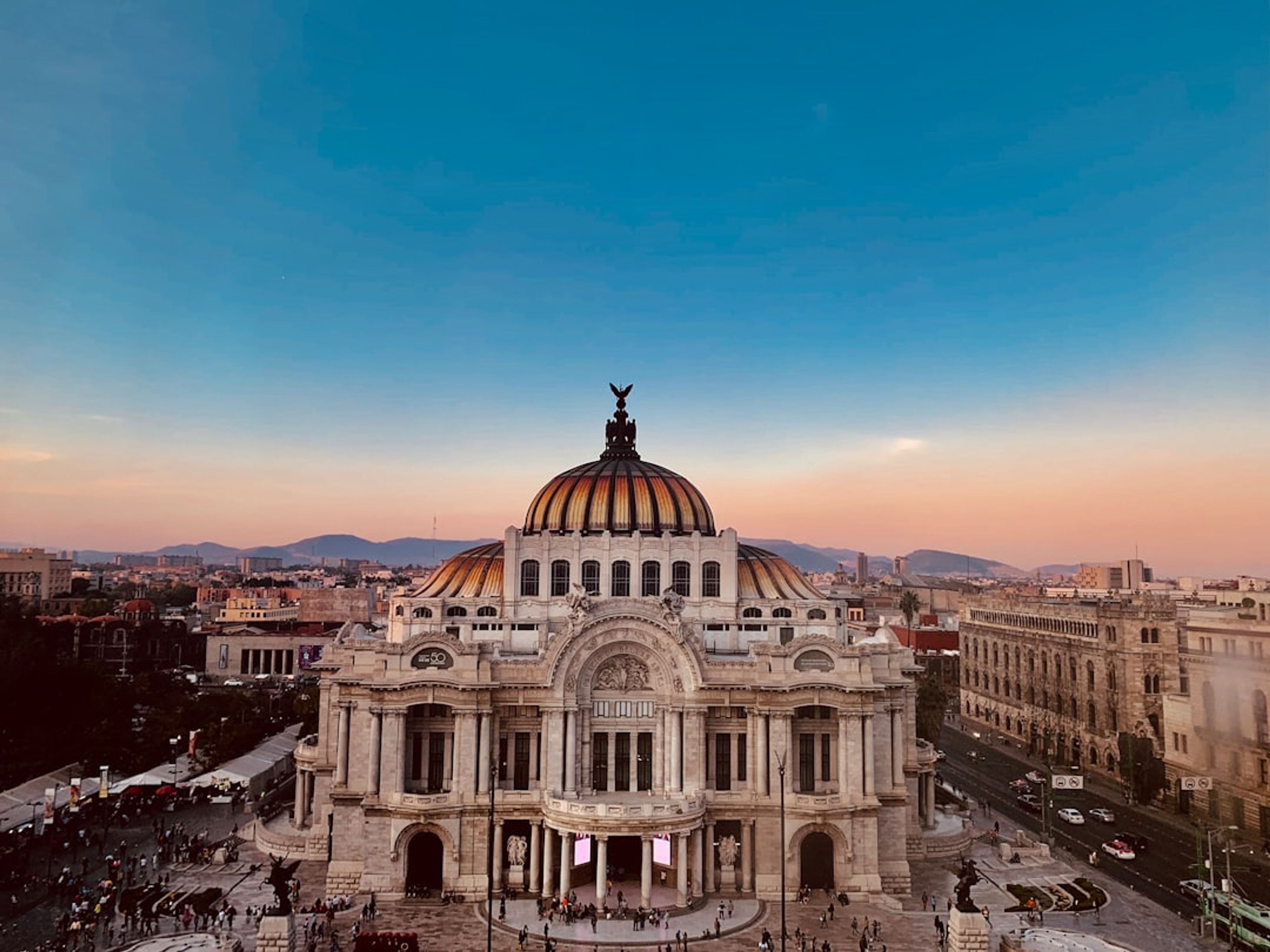
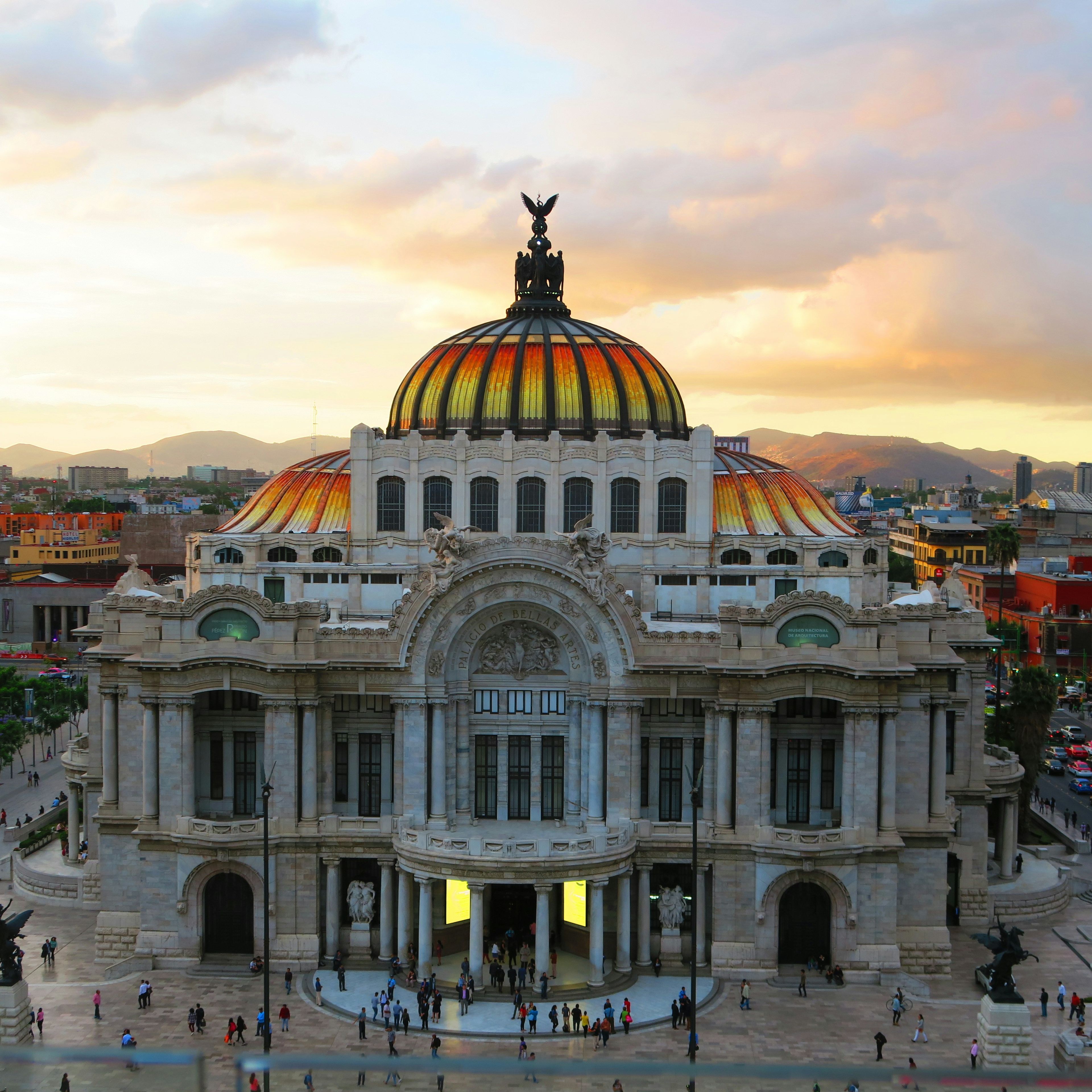
Palacio de Bellas Artes is Mexico's most important cultural venue, a building that took 30 years to complete due to the Mexican Revolution and engineering challenges caused by the soft lakebed soil beneath the city. The exterior is white Carrara marble in the Art Nouveau style, while the interior pivots to bold Art Deco geometry. Inside, murals by Diego Rivera, David Alfaro Siqueiros, Rufino Tamayo, and Jose Clemente Orozco cover the upper floors. Rivera's famous recreation of "Man at the Crossroads" - originally commissioned and then destroyed by the Rockefeller Center in New York - hangs on the third floor.
The palace also hosts opera, ballet, and the renowned Ballet Folklorico de Mexico, which performs on Wednesday and Sunday evenings. Museum admission is 85 MXN (about 4.50 EUR). Performance tickets range from 300 to 1,600 MXN depending on seating. The rooftop terrace of the nearby Sears building offers a direct overhead view of the Bellas Artes dome at no cost.
Check dates for Mexico City
See what is available on your dates.
4Museo Nacional de Antropologia - The Best Museum in Latin America

The Museo Nacional de Antropologia is the largest and most visited museum in Mexico, spreading across 45,000 square metres inside Chapultepec Park. Its 23 exhibition halls trace Mesoamerican civilisation from the earliest Olmec settlements through the Maya, Zapotec, Mixtec, and Aztec empires. The centrepiece is the Aztec Sun Stone (Piedra del Sol), a 24-tonne basalt calendar disc carved in the late 15th century. The ground floor covers archaeology; the upper floor documents the living indigenous cultures of modern Mexico.
Architect Pedro Ramirez Vazquez designed the building around a central courtyard shaded by a single aluminium column that doubles as a fountain - a structure so distinctive it has become an architectural icon. Admission is 85 MXN (about 4.50 EUR). Open Tuesday to Sunday, 09:00 to 19:00. Allow at least three hours; serious enthusiasts often spend a full day. Free on Sundays for Mexican nationals.
5Bosque de Chapultepec - A 1,695-Acre Urban Forest

Chapultepec Park is one of the Western Hemisphere's largest urban parks, covering 686 hectares across three sections. The first section - closest to the Metro station - holds the zoo (free admission), the Museo Nacional de Antropologia, the Museo de Arte Moderno, and the hilltop Castillo de Chapultepec. Ancient ahuehuete cypress trees, some over 700 years old, line the walkways. Chapultepec Lake sits at the park's western edge, where you can rent a paddleboat for 60 MXN (about 3 EUR) per 30 minutes.
The second section is quieter and includes La Feria amusement park and the Papalote children's museum. Joggers, cyclists, and families fill the paths on weekday mornings, and the park takes on a festival atmosphere every Sunday when vendors set up food stalls and musicians perform. Entry to the park itself is free. Individual museums and attractions inside the park charge separate admission.
6Castillo de Chapultepec - The Only Royal Castle in the Americas

Chapultepec Castle perches on top of Chapultepec Hill at 2,325 metres above sea level, making it one of the highest-altitude royal residences ever built. Construction began in 1785 as a viceregal summer house and the building later served as a military academy, an imperial residence for Emperor Maximilian I and Empress Carlota in the 1860s, and a presidential home. Today it houses the Museo Nacional de Historia, whose galleries walk you through Mexican history from the Conquest to the 1917 Constitution.
The Alcazar section preserves Maximilian and Carlota's private rooms, complete with European furnishings, stained-glass panels, and a rooftop garden that overlooks Paseo de la Reforma all the way to the Torre Latinoamericana. Admission is 85 MXN (about 4.50 EUR), free on Sundays for Mexican nationals. Open Tuesday to Sunday, 09:00 to 17:00. The uphill walk from the park entrance takes about 15 minutes.
7Museo Frida Kahlo (Casa Azul) - The Blue House in Coyoacan

Casa Azul is the cobalt-blue house where Frida Kahlo was born in 1907, lived with Diego Rivera, and died in 1954. Converted into a museum in 1958, the rooms preserve the couple's personal belongings, Frida's wheelchair and painting easel, her plaster corsets, pre-Columbian ceramics, and a selection of original artworks. The courtyard garden features papier-mache skeletons, tropical plants, and a small pyramid Rivera built to display his collection of ancient figurines.
Coyoacan itself is worth exploring before or after your visit - the neighbourhood plaza has cafes, a Mercado de Antojitos (snack market), and the red-walled Jardin Centenario. Admission is 250 MXN (about 13 EUR) on weekdays, 270 MXN on weekends. An extra 35 MXN grants access to the temporary photography exhibition. Open Tuesday to Sunday, 10:00 to 17:30 (Wednesday until 18:00). Tickets must be purchased in advance on the official website - walk-ups are not accepted.
8Xochimilco Floating Gardens - Ancient Canals and Trajinera Rides

Xochimilco is the last surviving trace of the lake system that once covered the entire Valley of Mexico. The canals weave through chinampas - artificial islands built by pre-Hispanic farmers to grow crops on the shallow lake bed. Today, flat-bottomed boats called trajineras carry passengers through the waterways, painted in bright colours and named after women. Floating vendors paddle alongside selling corn on the cob, micheladas, fruit, and handmade crafts. Mariachi and marimba bands drift past on their own boats, offering songs for a tip.
A trajinera holds up to 20 people and costs roughly 500 MXN (about 26 EUR) per hour per boat at the main Embarcadero Nuevo Nativitas. Splitting the cost among a group makes it affordable. The ride lasts one to two hours depending on your route. Weekends are lively and loud; weekday mornings offer a quieter, more reflective experience. Xochimilco is a
9Teotihuacan Pyramids - The City of the Gods Beyond CDMX

Teotihuacan was one of the largest cities in the ancient world, home to an estimated 125,000 people at its peak around 450 CE. The site covers roughly 83 square kilometres, anchored by the 65-metre Pyramid of the Sun and the slightly smaller Pyramid of the Moon, connected by the 2.5-kilometre Avenue of the Dead. Climbing the Pyramid of the Sun is no longer allowed (INAH, the site's operator), but the Avenue of the Dead puts both pyramids and the surrounding valley in view. The Temple of the Feathered Serpent (Quetzalcoatl) at the southern end features carved stone heads that retain traces of original paint.
Admission is 85 MXN (about 4.50 EUR). The site opens daily at 09:00 and closes at 17:00. Buses depart every 15 minutes from Terminal del Norte (Autobuses del Norte Metro station, Line 5) and cost around 104 MXN return. The ride takes 50 to 60 minutes. Bring sunscreen, a hat, and at least a litre of water - the site sits at 2,300 metres with almost no shade.
10Mercado de la Merced - The Largest Traditional Market in the City

Mercado de la Merced occupies an entire city block east of the Historic Centre and is the largest traditional market in Mexico City. Thousands of stalls sell produce, dried chillies, mole pastes, fresh tortillas, flowers, pirated goods, and household items. The food section alone can occupy a full morning - vendors serve barbacoa (slow-cooked lamb), quesadillas stuffed with huitlacoche (corn fungus), blue-corn tlacoyos, and fresh-squeezed juices in every tropical flavour. Prices are significantly lower than in tourist-oriented markets like Mercado Roma.
The market traces its history back to pre-Hispanic tianguis (open-air trading posts). The current building dates to 1957, though fire damage in 2013 led to partial reconstruction. A plate of barbacoa with consomme costs 60 to 80 MXN (about 3 to 4 EUR). Go early - the freshest ingredients and the best food stalls are active from 07:00 to 12:00. Admission is free.
11Museo Soumaya - Carlos Slim's Free Art Collection in Polanco

Museo Soumaya is impossible to miss - its curving aluminium-clad facade, covered in 16,000 hexagonal tiles, rises from Plaza Carso in the Polanco district like a warped silver column. The museum was funded by billionaire Carlos Slim Helu and named after his late wife. Inside, six floors display 66,000 works spanning 30 centuries. The collection includes the largest grouping of Auguste Rodin sculptures outside France, along with paintings by El Greco, Dali, Renoir, and Mexican masters like Diego Rivera and Rufino Tamayo.
Admission is completely free, seven days a week. The museum is open from 10:30 to 18:30 (until 20:00 on Saturdays). The top-floor gallery, reached by a spiralling ramp, offers close-up views of the dimpled exterior through floor-to-ceiling windows. Budget at least 90 minutes for the full circuit.
12Biblioteca Vasconcelos - A Cathedral of Books

Biblioteca Vasconcelos opened in 2006, designed by architect Alberto Kalach as an open, light-filled space that challenges every expectation of what a public library should look like. Transparent walls, steel shelving that floats on suspension cables, and intentionally mismatched floor levels create an interior that feels more like a modernist sculpture than a reading room. The building holds over 600,000 volumes across six storeys. A suspended whale skeleton by artist Gabriel Orozco hangs in the central atrium, adding to the surreal atmosphere.
Outside, a 26,000-square-metre botanical garden surrounds the building with native plants and walking paths. The library regularly hosts free concerts, dance performances, and film screenings - check the schedule on the official website. Admission is free. Open Monday to Sunday, 08:30 to 19:30. Photography is permitted for personal use.
13Lucha Libre at Arena Mexico - Masked Wrestling on a Friday Night

Arena Mexico is the spiritual home of lucha libre, the masked professional wrestling tradition that has been a fixture of Mexican popular culture since the 1930s. Bouts feature tecnicos (heroes) against rudos (villains) in high-flying, theatrical matches filled with acrobatics, dramatic betrayals, and crowd interaction. The atmosphere inside the arena on a Friday night is electric - vendors circulate with beer and tequila, fans hurl insults at the rudos, and children press against the ropes hoping for an autograph.
General admission (Grada) starts at 56 MXN (about 3 EUR). Ringside seats cost up to 400 MXN. Bouts run Tuesday and Friday evenings, with the Friday card attracting the biggest stars and the loudest crowd. Buy tickets at the arena box office (taquilla) the day of the event - avoid scalpers and third-party tour operators who mark up prices heavily. Cameras may be checked at the door.
14Coyoacan Street Food and Mezcalerias - Tostadas, Churros, and Smoky Spirits

Coyoacan is one of Mexico City's oldest neighbourhoods, and its food scene reflects centuries of culinary layering. The Mercado de Coyoacan, a covered market two blocks from the central plaza, is the best starting point. Stalls serve tostadas de tinga (shredded chicken with chipotle), tamales wrapped in banana leaf, and fresh-pressed sugar cane juice. Outside the market, vendors sell churros filled with cajeta (goat-milk caramel) and handmade ice cream in flavours like mezcal, tuna (cactus fruit), and mamey.
After dark, the neighbourhood shifts from daytime snacking to mezcal culture. Mezcalerias like La Clandestina and Pare de Sufrir pour single-origin mezcals from Oaxaca, Durango, and Guerrero by the copita (small clay cup) for 60 to 150 MXN (about 3 to 8 EUR). Sip slowly and ask the bartender to explain the agave variety - espadín, tobalá, and madrecuixe each carry a distinct character. A full evening of street food and two or three mezcals will cost around 400 MXN.
15Paseo de la Reforma and Angel de la Independencia - CDMX's Grand Boulevard

Paseo de la Reforma stretches 15 kilometres across Mexico City, modelled on the Champs-Elysees by Emperor Maximilian in the 1860s. The avenue's most recognisable landmark is the Angel de la Independencia (El Angel), a 36-metre victory column topped by a gilded bronze angel that commemorates Mexico's independence from Spain. The monument's base holds the remains of national heroes including Miguel Hidalgo and Jose Maria Morelos. At night, the column is illuminated in gold, and during major sporting victories or political events the roundabout transforms into an impromptu public celebration.
Walking the full Reforma corridor from Chapultepec Park to the Historic Centre takes about 90 minutes and passes the Bolsa Mexicana de Valores (stock exchange), the Torre BBVA, and the Cuauhtemoc monument. Every Sunday from 08:00 to 14:00, the avenue closes to motor traffic for cyclists, runners, and rollerbladers - a tradition that draws hundreds of thousands of participants each week. Renting an EcoBici (bike-share) costs 118 MXN for a full day, with the first 45 minutes of each ride included free.
Take this guide with you
Get every place in this guide, with addresses and map links, in your inbox — easy to open on your phone during the trip.
One email to the address on your account. No newsletter.

CEO and co-founder
Tomas is the co-founder and director of trip1, an European company specializing in reservation services. He launched the company in 2025 with a focus on building scalable, efficient operations.
15 Best Things to Do in Mexico City: Museums, Markets & Mezcal - FAQ
Yes. Mexico City packs Aztec ruins, more than 150 museums and one of the world's great street-food scenes into one trip. You can stand over Templo Mayor beside the Zocalo, float through Xochimilco's canals on a trajinera, see Frida Kahlo's Casa Azul in Coyoacan, shout through a Friday night of lucha libre at Arena Mexico and end the evening with mezcal.
Yes. Jeans are a sensible choice, because the city sits at over 2,200 metres and mornings and evenings are cool even when afternoons are warm. Jeans are everyday wear for locals, so with a light jacket you will fit in well. Wear comfortable shoes for long walks, and for Teotihuacan add a hat and sunscreen, as there is almost no shade.
Four to five days covers the main sights without rushing. Spend one day in the Historic Centre (Zocalo, Templo Mayor, Palacio de Bellas Artes), one in Chapultepec Park for the anthropology museum and the castle, and one in Coyoacan and Xochimilco. Teotihuacan takes most of a day on its own. With three days, pick either Teotihuacan or Xochimilco.
Yes. The Pyramids of the Sun and Moon and the 2.5 km Avenue of the Dead are on a scale photos cannot show. Buses leave from Terminal del Norte and take about an hour. Entry is 210 MXN for international visitors, and the site opens 08:00 to 17:00. Climbing the Pyramid of the Sun is not allowed. Arrive early and carry water.
Yes. Tickets for Casa Azul in Coyoacan are sold through the museum's official website and often sell out days ahead, so book before you travel. The museum is closed on Mondays and opens Tuesday to Sunday, from 10:00 (11:00 on Wednesdays) to 18:00. The first slot of the day is the quietest. Afterwards, walk to the Mercado de Coyoacan for tostadas.
Yes, for most sights. A Metro ride costs 5 MXN with the rechargeable mobility card. Zocalo station sits beside the Historic Centre, Chapultepec station on Line 1 serves the park and its museums, and Viveros on Line 3 is the stop for Coyoacan. Xochimilco is reached by light rail from Tasquena. For Teotihuacan, take a bus from Terminal del Norte.