


Guides · Warsaw
12 Top Things to Do in Warsaw
By Tomas Achmedovas · CEO and co-founder

CEO and co-founder
Warsaw rewards visitors who look beyond the surface. Levelled during World War II and painstakingly rebuilt brick by brick, the Polish capital wears its scars with pride and channels that resilience into a creative, fast-evolving city. This guide covers the 12 top things to do in Warsaw - from the UNESCO-listed Old Town and royal parks to cutting-edge science museums and the sombre remnants of the wartime ghetto. Each entry includes the exact address, nearest metro or tram stop, and a practical Pro Tip so you can plan efficient days on the ground.
The attractions are ordered to help you build logical sightseeing routes. Start in the Old Town and Royal Route cluster (entries 1-4), then branch south to Lazienki Park and the Palace of Culture (5-6), explore the Praga district across the river (7-8), and finish with museums and memorial sites that round out Warsaw's layered story (9-12). Most are reachable by Warsaw Metro lines M1 and M2, trams, or a short walk, and the Warsaw City Card covers public transport plus museum discounts.
Warsaw is one of Europe's most affordable capitals. Expect museum entry fees around 20-30 PLN (roughly 4-7 EUR), and filling pierogi lunches for under 30 PLN. Spring and early autumn deliver the best weather and manageable crowds, but the Christmas markets in December and the summer rooftop bar scene each give the city a distinct character.
Check dates for Warsaw
See what is available on your dates.
1Warsaw Old Town (Stare Miasto) - The Rebuilt Heart of the City


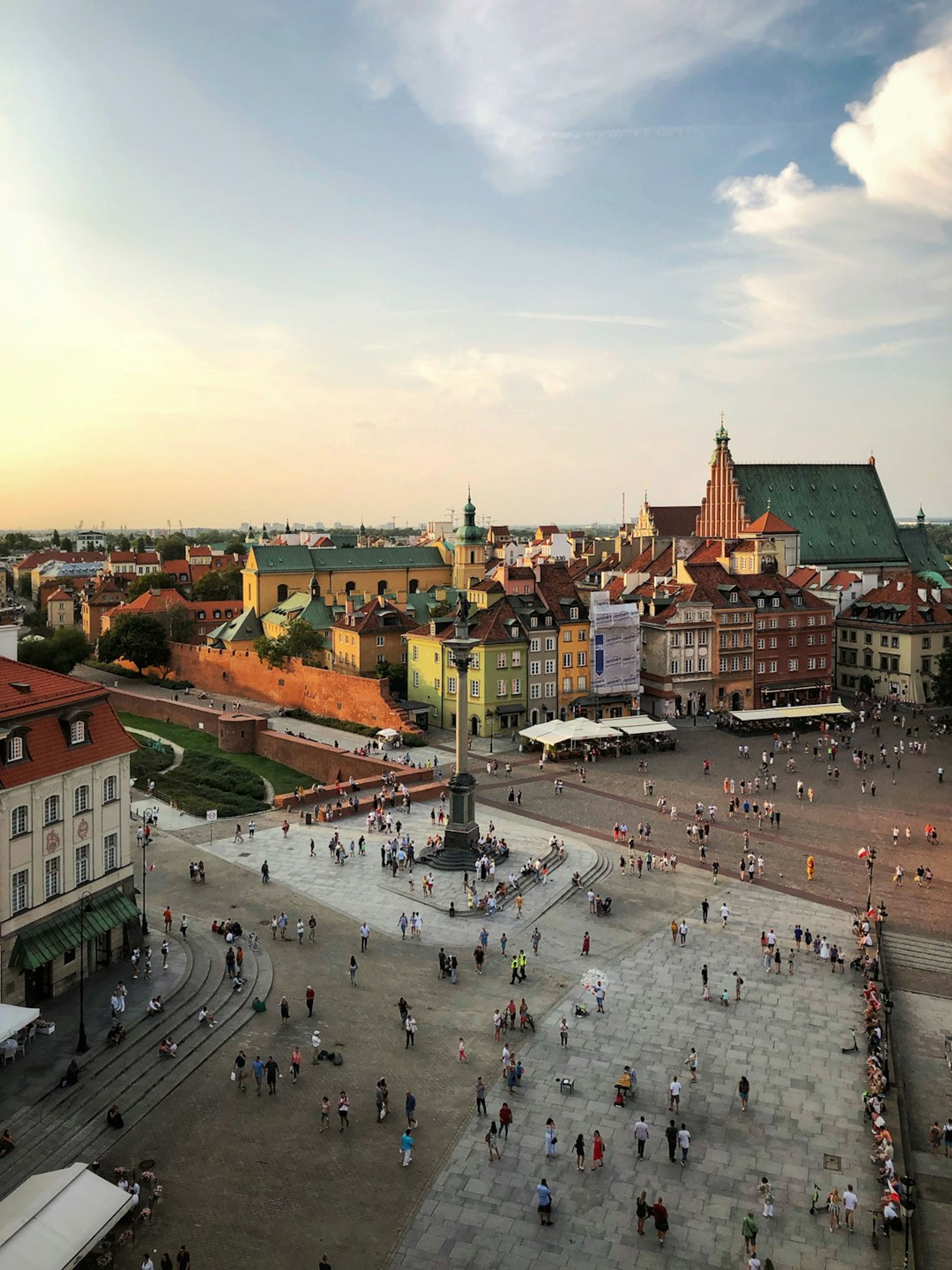
Warsaw Old Town is a UNESCO World Heritage Site and arguably the most remarkable urban reconstruction in history. Destroyed almost entirely during the 1944 Warsaw Uprising, the district was rebuilt between 1949 and 1963 using 18th-century paintings by Bernardo Bellotto as blueprints. The result is a faithful recreation of baroque and Renaissance townhouses surrounding the Old Town Market Square (Rynek Starego Miasta), complete with the bronze Mermaid of Warsaw statue at its centre.
Wander the narrow cobbled lanes, duck into St. John's Archcathedral (the oldest church in Warsaw, dating to the 14th century in its original form), and walk the Barbican - a semicircular red-brick fortification that once guarded the northern approach. Street musicians, outdoor cafes, and artists selling watercolours fill the square from spring through autumn. Budget roughly 2-3 hours to explore properly.
2Royal Castle (Zamek Krolewski) - Poland's Seat of Power Reborn


Standing at the southern entrance to the Old Town, the Royal Castle served as the official residence of Polish monarchs from the 16th century until the Third Partition of Poland in 1795. The Nazis dynamited the building in 1944, and it was reconstructed between 1971 and 1984 using salvaged fragments and meticulous archival research. Today the castle operates as a museum showcasing original Canaletto paintings, the Marble Room, the Throne Room with its gilded canopy, and the Senators' Chamber where the Constitution of 3 May 1791 - the first modern constitution in Europe - was adopted.
Admission is 30 PLN for adults (about 7 EUR). Free entry on Wednesdays draws long queues, so arrive before 10:00 if you aim for that. The castle courtyard and Plac Zamkowy (Castle Square) with the Sigismund III Vasa Column are free to access at any time - the square offers one of Warsaw's most recognisable photo spots.
3Krakowskie Przedmiescie - Warsaw's Most Elegant Boulevard


Krakowskie Przedmiescie is the northernmost section of the Royal Route (Trakt Krolewski), a grand boulevard stretching from Castle Square south through Nowy Swiat and on to Lazienki Park. This 1.2 km pedestrianised stretch is lined with palaces, churches, and university buildings. Key stops include the Presidential Palace (Palac Prezydencki), the Church of the Holy Cross where Chopin's heart is entombed in a pillar, and the main campus of the University of Warsaw.
Walking the full Royal Route from the castle to Lazienki covers about 4 km and takes 45-60 minutes without stops - though the cafes, bookshops, and galleries along Nowy Swiat will slow you down. The Chopin benches along the route play short piano compositions when you press the button, a charming touch unique to Warsaw. On summer weekends, the street fills with pop-up markets and buskers.
Check dates for Warsaw
See what is available on your dates.
4Lazienki Park and Palace on the Isle - Warsaw's Green Crown Jewel

Lazienki Park covers 76 hectares in central Warsaw, making it the city's largest park and one of the grandest urban green spaces in Europe. The centrepiece is the Palace on the Isle (Palac na Wyspie), a neoclassical summer residence of King Stanislaw August Poniatowski built in the late 18th century. The palace sits on a small island in an artificial lake, surrounded by peacocks, red squirrels, and formal gardens. Inside you will find the Baroque ballroom, the Solomon Room, and a gallery of Dutch and Flemish paintings.
Entry to the park itself is free. The Palace on the Isle charges 25 PLN (about 6 EUR). On Sundays from May to September, free Chopin piano concerts are held at the Chopin Monument at noon and 16:00 - they draw hundreds of listeners who spread blankets on the grass. The park also contains the Old Orangery, the Myslewicki Palace, and the White House, each worth a quick look.
5Palace of Culture and Science (PKiN) - Warsaw's Towering Landmark

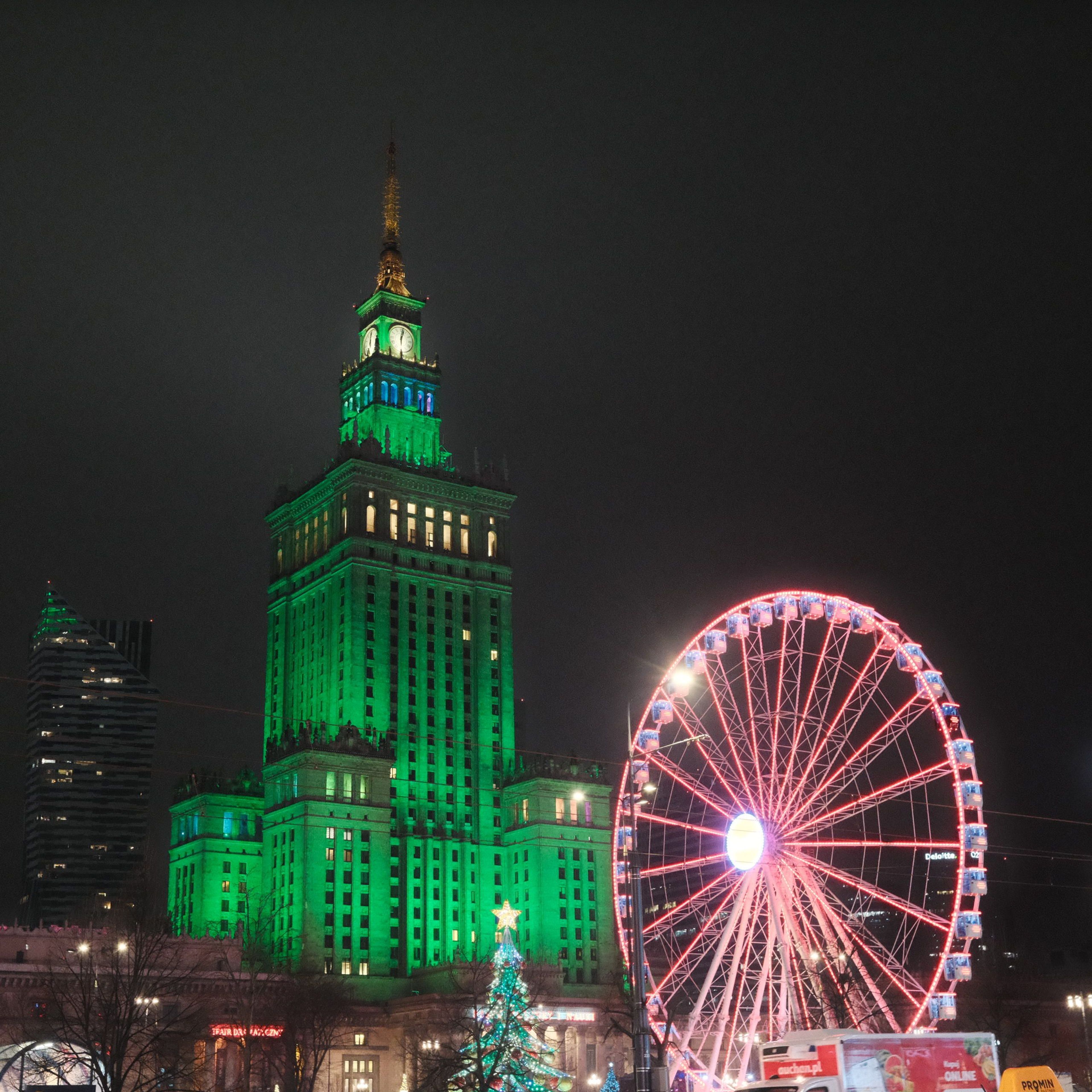
The Palace of Culture and Science (Palac Kultury i Nauki, or PKiN) is the tallest building in Poland at 237 metres including its spire. A "gift" from Stalin to the Polish people, completed in 1955, it was modelled on Moscow's Seven Sisters skyscrapers. Varsovians have a complicated relationship with it - some see an unwanted Soviet relic, others a defining part of the skyline. Regardless, the 30th-floor observation terrace at 114 metres gives the best 360-degree panorama of Warsaw, including views across to the Vistula River and the distant forests beyond.
Tickets for the viewing terrace cost 25 PLN (about 6 EUR). The building also houses theatres, cinemas, a swimming pool, and the Congress Hall where the Rolling Stones played the first major Western rock concert in the Eastern Bloc in 1967. The surrounding Plac Defilad is being redeveloped with the new Museum of Modern Art and TR Warszawa theatre complex.
6POLIN Museum of the History of Polish Jews - A Story of a Thousand Years

POLIN Museum opened in 2013 on the site of the former Warsaw Ghetto and tells the thousand-year story of Jewish life in Poland. The permanent exhibition spans eight galleries arranged chronologically - from the legendary arrival of Jews in medieval Poland through the golden age of the Polish-Lithuanian Commonwealth, to the Holocaust and postwar diaspora. The exhibition design is immersive: you walk through a reconstructed wooden synagogue ceiling from the 17th century, a recreated prewar Jewish street, and multimedia installations with survivor testimonies.
Admission is 30 PLN (about 7 EUR). The building itself, designed by Finnish firm Lahdelma & Mahlamaki, won the European Museum of the Year Award in 2016. Allow 3-4 hours minimum for the permanent exhibition. The museum faces the Monument to the Ghetto Heroes on Zamenhofa Street, erected in 1948 - it was here that Willy Brandt made his famous Kniefall (kneeling gesture) in 1970.
7Warsaw Uprising Museum - The City's Most Powerful Memorial

The Warsaw Uprising Museum documents the 63-day armed struggle of August-October 1944, when the Polish Home Army rose against the Nazi occupation. Housed in a converted power station in the Wola district, the museum uses replica sewers you can crawl through, a full-scale B-24 Liberator bomber suspended from the ceiling, 1,500 hours of audio testimony, and a 3D film showing the destroyed city from the air. It is one of the most emotionally affecting war museums anywhere in Europe.
Entry costs 25 PLN (about 6 EUR), free on Sundays (expect long queues). The museum is enormous - give yourself at least 2.5 hours. The rooftop viewing tower offers a bird's-eye view over Wola, and the Freedom Park behind the building contains a memorial wall listing all 11,000 identified insurgents killed during the rising.
8Copernicus Science Centre - Hands-On Discovery for All Ages

The Copernicus Science Centre (Centrum Nauki Kopernik) sits on the west bank of the Vistula River and is Poland's largest interactive science museum. Over 450 exhibits spread across six zones let you generate electricity on a human-powered bicycle, test your reaction speed, lie on a bed of nails, and explore optical illusions. The Heavens of Copernicus planetarium on the rooftop runs shows in English and Polish on a 16-metre dome screen - tickets sell out fast, so book the moment you arrive.
General admission is 35 PLN (about 8 EUR), planetarium an additional 27 PLN. The centre draws families and school groups, so weekday mornings (Tuesday-Friday before 11:00) are the quietest. The Discovery Park outside extends the experience with outdoor physics experiments, water features, and a rooftop garden overlooking the river.
9Praga District - Warsaw's Creative Left Bank

Praga sits on the east bank of the Vistula and is the only major Warsaw district that survived the war largely intact. While the rest of the capital was rebuilt in neat socialist or reconstructed baroque style, Praga kept its prewar tenement blocks, bullet-scarred facades, and gritty industrial character. Over the past decade it has transformed into Warsaw's creative quarter - artists' studios, craft breweries, and galleries now fill former factories, while the original prewar streetscapes remain.
Key spots include Soho Factory (a cultural complex in a converted vodka distillery housing the Neon Museum and galleries), Bazaar Rozyckiego (a once-legendary open-air market now partially revived), and Saska Kepa - a leafy residential neighbourhood with art deco villas. Zabkowska Street is the main bar and cafe strip. Cross the Vistula on the Swietokrzyski Bridge for one of the best skyline photos of Warsaw's western bank.
10Wilanow Palace - The Polish Versailles

Wilanow Palace was built between 1677 and 1696 as the summer residence of King Jan III Sobieski, the military commander who broke the Ottoman siege of Vienna in 1683. The baroque palace survived both world wars intact - one of very few royal residences in Warsaw that did - and its interiors preserve original frescoes, period furniture, and a portrait gallery spanning four centuries. The surrounding formal gardens, modelled on Versailles, cascade through Italian, English, and Chinese-styled sections.
Entry to the palace is 30 PLN (7 EUR), gardens 5 PLN. The palace is 10 km south of the city centre, so plan a half-day trip. Bus 116 or 180 runs directly from Lazienki Park. Between September and March, the Royal Garden of Light festival transforms the grounds with large-scale illuminated installations - tickets sell out, so book online at least a week ahead.
11Warsaw University Library Rooftop Garden - A Hidden Urban Oasis

The Warsaw University Library (Biblioteka Uniwersytecka w Warszawie, or BUW) is worth visiting for its rooftop alone. Completed in 1999, the building's roof supports one of Europe's largest rooftop gardens - over 1 hectare of greenery split into an upper and lower terrace, linked by streams, fish ponds, and climbing plants that drape over the concrete structure. The design by Irena Bajerska divides the space into themed sections including a gold garden, silver garden, and a crimson section planted with red-leafed species.
Access to the roof garden is free, open daily from April to October (closed in winter). The upper terrace provides panoramic views of the Vistula, the Swietokrzyski Bridge, and the Praga skyline. The lower terrace connects to the Vistula Boulevards. Few tourists know about this spot, so even on summer weekends you can find a quiet bench. The library facade itself is covered in copper plates etched with text from classic literature - worth a look from street level.
12Powazki Cemetery - One of Europe's Great Necropolises

Powazki Cemetery (Cmentarz Powazkowski) opened in 1790 and is the oldest and most prestigious burial ground in Warsaw. Spread across 43 hectares, it is the resting place of Polish presidents, Nobel laureates, composers (including Wladyslaw Szpilman, whose story inspired The Pianist), military leaders, and countless ordinary Varsovians. The cemetery is a sculpture gallery in the open air - elaborate 19th-century tombs, weeping angels, and mausoleums line the avenues under ancient linden and chestnut trees.
Entry is free. Just south of Powazki lies the separate Jewish Cemetery (Cmentarz Zydowski), established in 1806, which contains over 200,000 graves and is the largest Jewish cemetery in Europe after the one in Budapest. Together these two cemeteries form a powerful testament to Warsaw's layered history. Budget about 90 minutes for a combined walk.
Take this guide with you
Get every place in this guide, with addresses and map links, in your inbox — easy to open on your phone during the trip.
One email to the address on your account. No newsletter.

CEO and co-founder
Tomas is the co-founder and director of trip1, an European company specializing in reservation services. He launched the company in 2025 with a focus on building scalable, efficient operations.
12 Top Things to Do in Warsaw - FAQ
The rebuilt Old Town and the Royal Castle, the Warsaw Uprising Museum, and the POLIN Museum of the History of Polish Jews. Walk the Royal Route south to Lazienki Park and the Palace on the Isle, go up the Palace of Culture and Science for the view from the 30th floor, and cross the river to Praga, the district that came through the war largely intact.
Yes. The Old Town was almost entirely destroyed in 1944 and rebuilt between 1949 and 1963 using Bernardo Bellotto's paintings, and it is now a UNESCO World Heritage Site. The city also has some of Europe's most moving museums, large royal parks and the creative Praga district. It is affordable too, with filling pierogi lunches for under 30 PLN.
Day one: the Old Town, the Royal Castle and a walk down the Royal Route to Lazienki Park. Day two: the Warsaw Uprising Museum, which is closed on Tuesdays, then POLIN and the Palace of Culture at sunset. Day three: Wilanow Palace, 10 km south by bus 116 or 180, then Praga in the afternoon. Two days covers the centre but not Wilanow or Praga.
Its rebuilding after World War II. Most of the city was levelled, and the Old Town and Royal Castle were reconstructed from paintings, salvaged fragments and archives. Warsaw is also known for the 1944 Uprising, for Chopin, whose heart lies in a pillar of the Church of the Holy Cross, and for the Palace of Culture and Science, the Stalin-era tower that still dominates the skyline.
Several of the big ones have one free day a week. The Warsaw Uprising Museum and POLIN are both free on Thursdays, and POLIN's free day covers the core and temporary exhibitions. The Royal Castle is free on Wednesdays on a shorter route, with a limited number of tickets handed out at the castle ticket office on the day. Arrive at opening to beat the queues.
Spring and early autumn, for the best weather and manageable crowds. From May to September, free Chopin piano concerts are held by the Chopin Monument in Lazienki Park on Sundays at noon and 16:00, and the BUW rooftop garden opens from April to October. December brings Christmas markets, and on 1 November Powazki Cemetery glows with candles for All Saints' Day.