Guides · Tenerife
Top 10 Places to Visit in Tenerife, Spain - 2026 Guide
By Tomas Achmedovas · CEO and co-founder

CEO and co-founder
This guide ranks the 10 best places to visit in Tenerife - the sights that earn a spot on your itinerary whether you have three days or a full week on Spain's largest Canary Island. Each entry includes the exact address, nearest bus stop or transit connection, distance from the centre, and a practical Pro Tip drawn from on-the-ground experience. We have grouped the list to help you plan efficient routes: the volcanic highlands first, then the north and northeast, the dramatic west coast, and finally the south coast attractions.
Tenerife packs an extraordinary range of landscapes into a single island. You will find a UNESCO-listed volcanic crater above the clouds, ancient laurel forests, 600-metre sea cliffs, black-sand beaches, a colonial university town, and one of the world's top-rated waterparks. The places to visit in Tenerife on this list cover every corner of the island and mix well-known landmarks with quieter spots that reward the drive.
A hire car is the most flexible way to connect these 10 Tenerife attractions, though TITSA buses reach most of them. We have noted public transport options for each stop. Pack layers - sea-level temperatures sit around 22-25 C year-round, but Teide's caldera drops to single digits, and the Anaga mountains can be misty even on a sunny coast day.
Check dates for Tenerife
See what is available on your dates.
1Teide National Park - Spain's Highest Peak and a Volcanic Moonscape


Every list of places to visit in Tenerife starts here, and for good reason. Teide National Park is a UNESCO World Heritage Site centred on Mount Teide (3,718 m), the highest point in Spain and the third-tallest volcanic structure on Earth measured from its ocean-floor base. The park covers 189 square kilometres of caldera landscape at around 2,000 m altitude - a surreal terrain of hardened lava flows, pumice fields, and rock formations like the Roques de Garcia that look borrowed from another planet.
The Teleferico del Teide cable car lifts visitors from 2,356 m to 3,555 m in eight minutes (around EUR 40 return). From the upper station, two short trails lead to viewpoints over the caldera and neighbouring islands. The summit trail to the actual 3,718 m peak requires a free permit from the national park website - only 200 are issued per day, so book weeks ahead. Even without the summit, the cable car views are extraordinary on clear mornings. The park is also a certified Starlight Reserve, and night-time stargazing tours run year-round.
2Masca Village - A Mountain Hamlet Clinging to the Cliffs


Masca sits at 650 m in the Teno massif, a cluster of stone houses wedged into a ravine so steep it was only accessible by mule track until the 1960s. The setting is Tenerife's most photographed: terraced plots drop away on both sides, palm trees shoot up between the buildings, and the jagged peaks of the Teno mountains frame every view. The village has around 100 permanent residents and a handful of restaurants serving goat cheese and local wine.
The famous Masca Gorge hike descends from the village to Masca beach (roughly 4.5 km, 3-4 hours one way), passing through a dramatic canyon with 600 m walls. Since 2023, the trail requires a free permit booked through the Cabildo de Tenerife website - slots fill fast in peak season. A boat ferries hikers from the beach to Los Gigantes harbour (around EUR 10). The gorge trail is rated moderate to difficult, with some scrambling over boulders and a river crossing.
3Los Gigantes Cliffs - Tenerife's Dramatic Western Wall


The Acantilados de Los Gigantes (Cliffs of the Giants) plunge 600 metres straight into the Atlantic on Tenerife's western coast. These basalt walls are the island's most dramatic geological feature and visible from kilometres away. The town of Los Gigantes sits at their southern base, with a small marina, a black-sand beach tucked against the cliff foot, and a string of seafood restaurants along the waterfront.
The best way to appreciate the scale is from the water. Boat trips depart from Los Gigantes marina daily - options range from two-hour catamaran cruises (EUR 25-35) to small zodiac trips that hug the cliff base. Many tours combine the cliffs with whale and dolphin watching, since resident pods of short-finned pilot whales and bottlenose dolphins live in the channel between Tenerife and La Gomera. From land, the viewpoint at the top of Calle Flor de Pascua gives a free cliff-edge perspective.
Check dates for Tenerife
See what is available on your dates.
4Anaga Rural Park - Ancient Laurel Forests and Coastal Trails

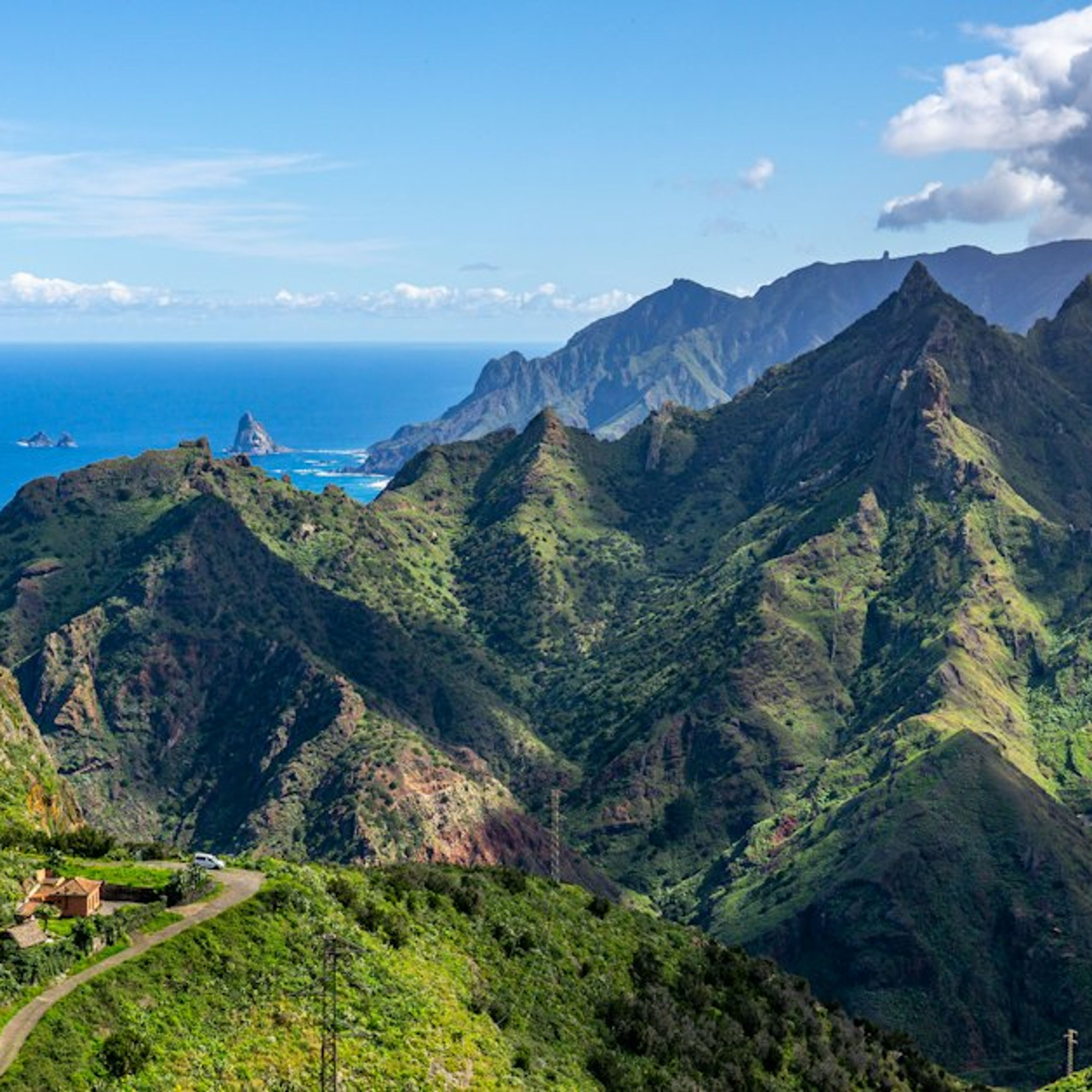
Anaga Rural Park occupies the rugged northeastern tip of Tenerife, a UNESCO Biosphere Reserve protecting one of the largest surviving laurel forests (laurisilva) in the world. These forests are a relic of the subtropical woodlands that covered southern Europe millions of years ago. The park's landscape is all sharp ridges, deep ravines, and peaks wrapped in cloud - a complete contrast to the dry south coast just an hour's drive away.
Cruz del Carmen (944 m) is the main trailhead and visitor centre, reachable by car or TITSA bus 076 from La Laguna. From here, the Sendero de los Sentidos (Trail of the Senses) is a short, accessible loop through moss-draped laurel trees - perfect for families. More serious hikers can take the trail from Cruz del Carmen down to the isolated beach hamlet of Taganana (roughly 2.5 hours one way), passing through dense forest and emerging above terraced hillside farms. Punta del Hidalgo on the north coast is another popular starting point for coastal walks.
5San Cristobal de La Laguna - A UNESCO World Heritage Colonial Town

La Laguna was Tenerife's original capital and is now a UNESCO World Heritage Site thanks to its unfortified colonial grid layout - the same urban plan exported to cities across Latin America. The old town is a concentration of 16th- to 18th-century mansions with carved wooden balconies, inner courtyards, and painted facades in terracotta, mustard, and pale blue. Calle San Agustin and Calle Obispo Rey Redondo are the two main streets to walk.
As a university town (the University of La Laguna is the Canary Islands' oldest), it has a livelier, younger feel than the tourist resorts. Bars, bookshops, and tapas restaurants cluster around Plaza del Adelantado. Key sights include the Cathedral of La Laguna (rebuilt in neo-Gothic style, free entry), the Church of the Immaculate Conception with its distinctive bell tower, and the Casa Lercaro museum documenting the island's history. The Tenerife Tram (Tranvia, line 1) connects La Laguna to Santa Cruz in about 35 minutes for EUR 1.35.
6Siam Park - The World's Most Awarded Waterpark

Siam Park in Costa Adeje has been voted the world's best waterpark by TripAdvisor users for multiple consecutive years, and the Thai-themed complex lives up to the hype. Built around a central artificial beach with a wave machine generating 3-metre swells, the park packs in 20+ slides and attractions across landscaped grounds with teak pavilions, floating market stalls, and a sea lion colony.
The headline ride is the Tower of Power - a near-vertical 28-metre drop that sends you through a transparent tube inside an aquarium of rays and sharks. Singha is Europe's fastest water coaster, and the Dragon ride is a high-speed funnel slide. For families, the Lost City play area and the lazy river (Mai Thai River) offer calmer options. Full-day adult tickets cost around EUR 40-44 online (cheaper than gate price). Lockers, towels, and sun loungers are available to rent.
7Santa Cruz de Tenerife - The Island's Underrated Capital

Most visitors fly straight to the southern resorts and skip Santa Cruz de Tenerife entirely, which is a mistake. The island's capital is a compact, walkable city with genuine Canarian character - local markets, cafe-lined plazas, street art, and a striking modernist concert hall (Auditorio de Tenerife, designed by Santiago Calatrava) that has become Tenerife's architectural icon. The harbourside Palmetum is a botanical garden built on a former landfill, now home to one of Europe's largest collections of tropical palms.
The Mercado de Nuestra Senora de Africa (Our Lady of Africa Market) is the city's social hub - a courtyard market selling fish, cheese, flowers, and Canarian produce every morning. Calle Castillo is the main pedestrianised shopping street, running from Plaza de Espana (with its artificial lake and memorial) to the old quarter around Iglesia de la Concepcion. Santa Cruz also hosts one of the world's largest carnivals each February, second only to Rio de Janeiro in scale.
8Loro Parque - A World-Class Zoo on Tenerife's North Coast

Loro Parque in Puerto de la Cruz started as a parrot park in 1972 and has grown into one of Europe's most respected zoos, with a strong conservation and breeding programme. The collection spans gorillas, tigers, jaguars, penguins (in a climate-controlled Antarctic exhibit), sharks, jellyfish, and of course the original parrot collection - over 350 species, the largest diversity anywhere. Four live shows rotate daily: orcas, dolphins, sea lions, and parrots.
The park is well-maintained and shaded, making it comfortable even on hot days. The aquarium tunnel, Planet Penguin exhibit (with real snow), and the gorilla habitat are particular highlights. Adult tickets cost around EUR 42 online. A combined Loro Parque + Siam Park twin ticket is available for around EUR 70 and is valid for non-consecutive days, which is good value if you plan to visit both. A free shuttle train runs from central Puerto de la Cruz to the park entrance.
9Garachico - A Historic Town Rebuilt from Volcanic Destruction

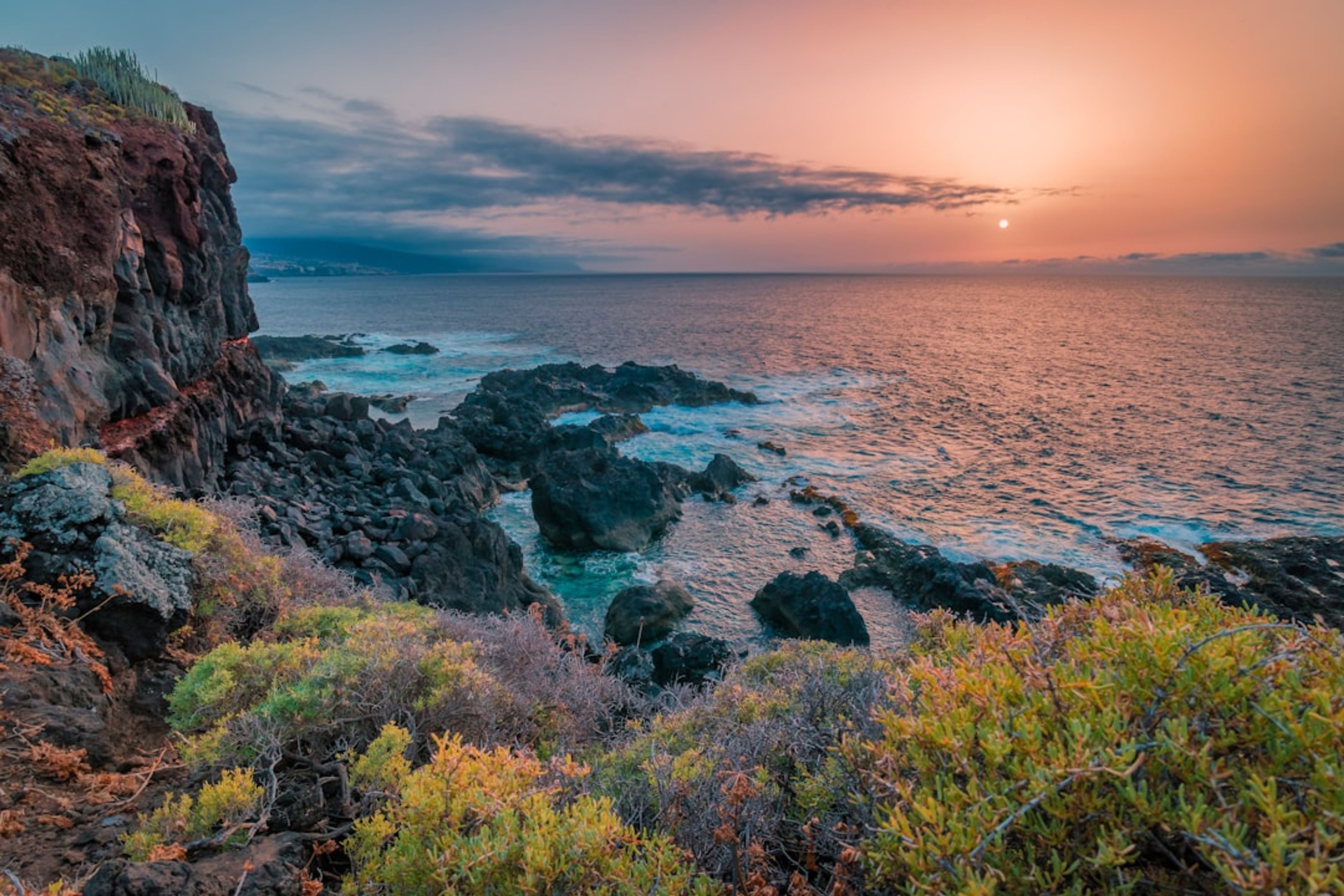
Garachico was once Tenerife's main port until a volcanic eruption in 1706 buried the harbour under lava. The town rebuilt slowly, and today that lava field has become its biggest draw: natural rock pools (El Caleton) formed where molten rock met the sea, now filled with clear Atlantic water and perfect for swimming. The pools are free, open all day, and sheltered enough to swim year-round.
Beyond the pools, Garachico is a quiet, photogenic town with cobbled streets, a 16th-century castle (Castillo de San Miguel, now a small museum), and a former convent converted into a cultural centre. Plaza de la Libertad is the main square, shaded by Indian laurel trees and ringed by traditional Canarian buildings. The town sees far fewer tourists than the southern resorts, making it one of the more authentic places to visit in Tenerife for anyone interested in the island's pre-tourism character.
10Playa de las Teresitas - Tenerife's Golden Beach Below the Mountains

Tenerife's beaches are mostly black volcanic sand, which makes Playa de las Teresitas immediately distinctive - a 1.5-km crescent of golden sand imported from the Sahara in the 1970s. Backed by the dark green slopes of the Anaga mountains and lined with palm trees, it looks more Caribbean than Atlantic. The beach sits in the fishing village of San Andres, 7 km northeast of Santa Cruz de Tenerife, and is used almost exclusively by locals rather than tourists.
A breakwater keeps the waves gentle, making this one of the safest swimming beaches in Tenerife and ideal for families. Facilities include free showers, changing rooms, lifeguards, and a handful of chiringuitos (beach bars) serving fried fish and cold beer. There is no entrance fee. TITSA bus line 910 runs from Santa Cruz bus station to San Andres in about 20 minutes. Parking is free along the seafront road but fills up on weekends by late morning.
Take this guide with you
Get every place in this guide, with addresses and map links, in your inbox — easy to open on your phone during the trip.
One email to the address on your account. No newsletter.

CEO and co-founder
Tomas is the co-founder and director of trip1, an European company specializing in reservation services. He launched the company in 2025 with a focus on building scalable, efficient operations.
Top 10 Places to Visit in Tenerife - FAQ
Teide National Park, with the cable car to 3,555 m, is the one thing every visitor should do. Then see Masca village in the Teno mountains, the 600-metre Los Gigantes cliffs from a boat, the laurel forests of Anaga and the colonial old town of La Laguna. For families, Siam Park and Loro Parque are the island's two big attractions.
Masca is the most photographed: a hamlet of stone houses at 650 m, wedged into a steep ravine in the Teno mountains with palm trees between the buildings. Close behind are the moonscape of Teide's caldera and the Roques de Garcia, the Los Gigantes cliffs, and Playa de las Teresitas, a golden beach under the green Anaga mountains.
It depends on your trip. The south, around Costa Adeje and Los Cristianos, is the sunniest and driest, with resort beaches and Siam Park. The greener north has more local character: La Laguna, Puerto de la Cruz with Loro Parque, Garachico and the Anaga forests. Most sights are within about an hour's drive, so with a hire car you can see both.
Four to five days for sightseeing, or a week with beach time. Give Teide its own early morning, before clouds roll in around midday, spend a day in the northeast on La Laguna, Anaga and Las Teresitas, and do Masca, Los Gigantes and Garachico as one west coast loop. Add Santa Cruz and Loro Parque on a fourth day and Siam Park on a fifth.
Yes. It's a UNESCO World Heritage Site around Mount Teide (3,718 m), Spain's highest peak, with lava fields and rock formations at about 2,000 m. The cable car costs 42 euros return. Climbing to the summit needs a permit booked on Tenerife ON, which costs non-residents 15 euros in 2026, with 200 places a day. Bring a jacket: it's about 15 C colder than the coast.
Yes. The descent from Masca village to the beach must be booked on the official Camino Barranco de Masca website, and in 2026 it costs 40.66 euros for adults, including a helmet and insurance. The boat from Masca beach to Los Gigantes is a separate, mandatory ticket, and hikers take TITSA bus 355 from Santiago del Teide. Groups are limited to 25 people every 30 minutes.