


Guides · Santorini
Top 10 Places to Visit in Santorini, Greece - 2026 Guide
By Tomas Achmedovas · CEO and co-founder

CEO and co-founder
This guide covers the 10 best places to visit in Santorini - the caldera viewpoints, archaeological sites, beaches, and villages that make this volcanic Greek island one of the most photographed destinations in the Mediterranean. Each entry includes the address, nearest KTEL bus connection from Fira, and a practical Pro Tip. We have ordered the list with the iconic caldera villages first, then the southern archaeological and beach zone, followed by the eastern coast and hilltop villages.
Santorini is compact - just 18 km from tip to tip - but the places to visit in Santorini on this list span dramatically different landscapes. You will walk along caldera-edge paths 300 metres above the sea, descend to a red-sand cove beneath volcanic cliffs, explore a Minoan city buried by ash for 3,600 years, and taste Assyrtiko wine at a terrace overlooking the submerged volcano. The contrast between the whitewashed western caldera and the dark-sand eastern beaches gives each day a different character.
KTEL buses from Fira's central station reach most of these Santorini attractions, though a rented car or ATV offers more flexibility for the southern sites and wineries. Budget 3-4 days to see everything comfortably. Visit between late April and June or in September for warm weather without the crushing July-August crowds.
Check dates for Santorini
See what is available on your dates.
1Oia - The World's Most Famous Sunset Village


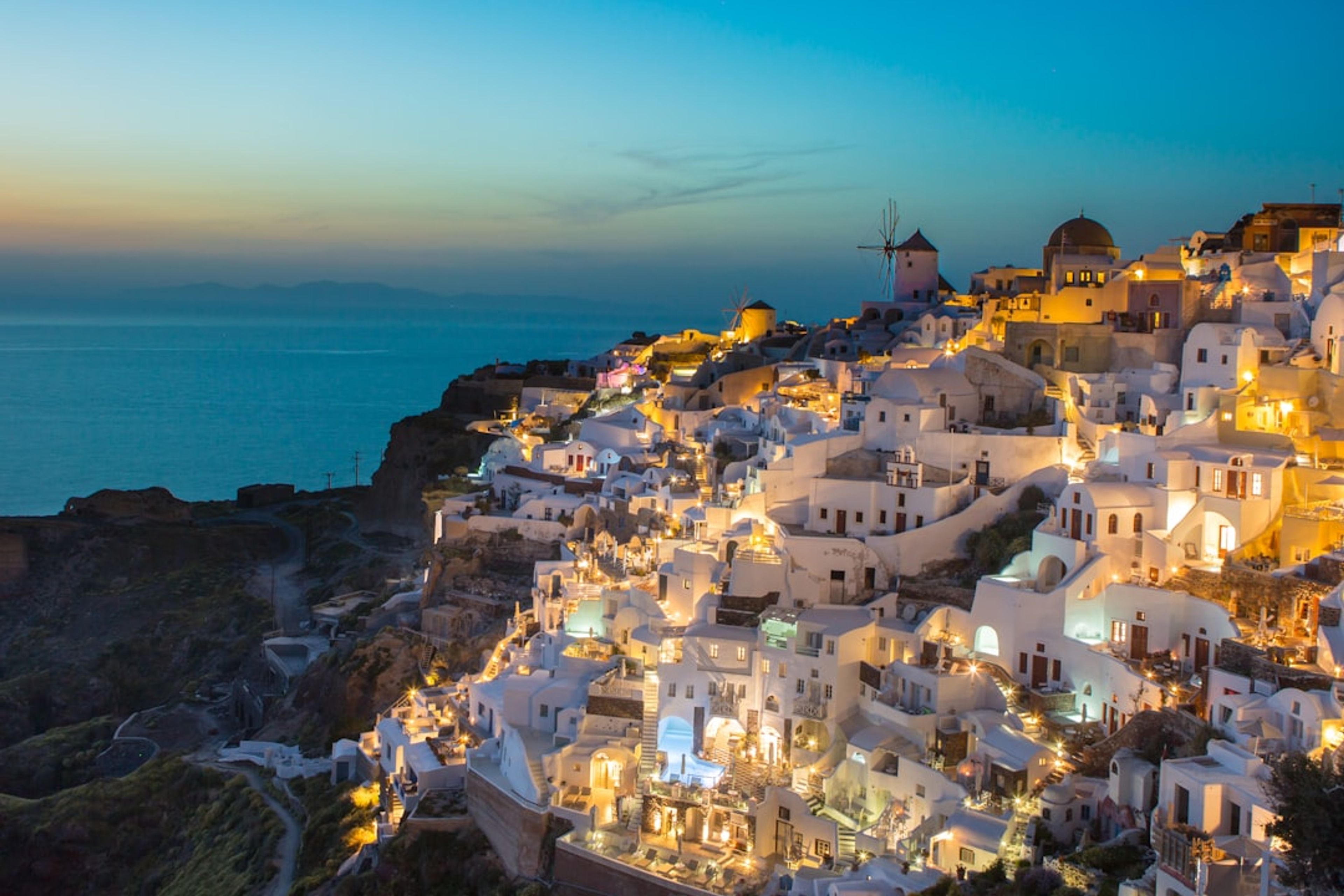
No list of places to visit in Santorini can start anywhere else. Oia (pronounced ee-ah) sits on the northern tip of the caldera rim, a cascade of whitewashed houses, blue-domed churches, and cave dwellings tumbling down the cliff face. The village was largely rebuilt after a devastating earthquake in 1956, and the architecture you see today - the iconic white-and-blue that defines Santorini's global image - dates from that reconstruction.
The main draw is the sunset. Each evening, hundreds of visitors gather at the ruins of the Byzantine castle (Kastro) at the western edge of the village to watch the sun drop into the caldera. The spectacle is genuine - the light turns the cliffs gold and pink as cruise ships sit motionless in the caldera below. Beyond the sunset, Oia has excellent art galleries, high-end jewellery shops, and some of Santorini's best restaurants. The Naval Maritime Museum on the main path documents the island's seafaring history.
2Fira - Santorini's Buzzing Caldera Capital


Fira (also spelled Thira) is the island's capital and transport hub, perched on the caldera rim roughly halfway along Santorini's western coast. The town is more energetic and less polished than Oia - a tangle of narrow shopping streets, cocktail bars, restaurants, and churches that funnel toward dramatic caldera viewpoints. The cable car from the Old Port to Fira town (EUR 6 one way, 3 min) is an experience in itself, gliding up the 220-metre cliff face.
The Museum of Prehistoric Thera on Mitropoleos Street houses artefacts from the Akrotiri excavation, including the famous golden ibex figurine and Minoan-era frescoes. The Archaeological Museum near the cable car station covers a broader timeline. For caldera views without the Oia crowds, walk north from Fira along the cliffside path toward Firostefani and Imerovigli - this 3 km stretch is arguably Santorini's best free attraction, passing the iconic blue-domed Anastasi Church (the most photographed church on the island).
3Akrotiri Archaeological Site - A Minoan City Frozen in Ash


Akrotiri is one of the most important Bronze Age archaeological sites in Europe, often called the 'Pompeii of the Aegean'. This Minoan settlement was buried under metres of volcanic ash during the catastrophic eruption of around 1600 BCE, preserving multi-storey buildings, streets, drainage systems, and stunning frescoes in extraordinary detail. Unlike Pompeii, no human remains have been found - the inhabitants apparently evacuated before the eruption.
The site is covered by a modern bioclimatic roof and explored via raised walkways above the excavated streets. You can look down into rooms, see original storage jars (pithoi) still in place, and trace the city's remarkably advanced plumbing. The original frescoes are in the National Archaeological Museum in Athens, but high-quality reproductions are displayed at the Museum of Prehistoric Thera in Fira. Admission is EUR 12 (EUR 6 reduced). Allow 1-1.5 hours for a thorough visit.
Check dates for Santorini
See what is available on your dates.
4Red Beach - Santorini's Most Striking Volcanic Cove

Red Beach (Kokkini Paralia) is a small cove backed by towering red and black volcanic cliffs on Santorini's southern coast, about 800 metres south of the Akrotiri archaeological site. The beach gets its colour from iron-rich volcanic rock eroded from the cliff face, creating a mix of red pebbles and coarse dark sand. Set against the deep blue Aegean, the colour contrast is extraordinary and makes this one of the most photographed places to visit in Santorini.
Access is via a 10-minute walk from the Akrotiri site car park, ending with a short scramble over rocks to reach the beach. The path skirts the cliff edge - wear proper footwear, not flip-flops. The beach itself is small and gets crowded by midday in summer. There are no permanent facilities, though a seasonal canteen sometimes operates. Important safety note: the cliffs above Red Beach are unstable and rockfalls have occurred - do not sit directly beneath the cliff face.
5Santorini Caldera Boat Tour - Volcano, Hot Springs, and Sunset

Seeing the Santorini caldera from the water transforms your understanding of the island's geology. Boat tours depart from Fira's Old Port (reached by cable car, donkey, or 588 steps), Ammoudi Bay below Oia, and Vlychada marina. The standard route visits Nea Kameni (the active volcanic island at the caldera's centre), Palea Kameni (hot springs), and optionally Thirassia island. The hike to Nea Kameni's crater takes about 30 minutes over loose volcanic gravel to reach the steaming fumaroles at the 130-metre summit.
The hot springs at Palea Kameni are sulphur-tinged seawater (around 30-35 C) reached by swimming 50 metres from the boat - wear a dark swimsuit, as the minerals stain light fabrics permanently. Sunset catamaran cruises are Santorini's premium experience: 4-5 hours sailing the caldera, swimming, dinner, and open bar, typically EUR 100-150 per person. Standard day tours on larger boats cost EUR 40-60 and run 5-6 hours. Both book out days ahead in peak season.
6Fira-to-Oia Caldera Trail - The Best Walk in the Cyclades

The caldera trail connecting Fira to Oia is a 10 km clifftop path that ranks among the finest coastal walks in all of Greece. The route follows the caldera rim northward through Firostefani, Imerovigli, and along exposed volcanic ridges before descending into Oia. Elevation changes are moderate (the highest point is Imerovigli at around 300 m), but the path is rocky, unshaded, and occasionally narrow with sheer drops to the caldera below.
Allow 3-4 hours at a comfortable pace with photo stops. The section from Fira to Imerovigli (2 km, 30 min) is the most polished - paved paths, church viewpoints, and the iconic Anastasi Church blue dome below. Beyond Imerovigli, the path becomes a proper hiking trail over volcanic rock, passing Skaros Rock (a dramatic promontory worth a 15-minute detour) before winding through scrubland to Oia. The views are continuous and spectacular - the entire caldera, Nea Kameni volcano, and Thirassia island spread out below.
7Amoudi Bay - Fresh Seafood Below the Oia Cliffs

Amoudi Bay is the tiny fishing port tucked at the base of Oia's cliffs, reached by walking down roughly 300 steps from the village (or by car via a winding road to a small car park). The bay is little more than a handful of fishing boats, a rocky swimming area, and four waterfront tavernas built into the red volcanic rock. What it lacks in size it makes up for in atmosphere - this is where locals and in-the-know visitors come to eat fresh-off-the-boat seafood with the caldera cliffs towering above.
The swimming off the rocks at Amoudi is excellent - the water is deep, clear, and calm in the caldera's shelter. Brave visitors cliff-jump from the rocks on the bay's western side (roughly 5-8 metres, check depth carefully). From the bay, you can also swim or take a short boat ride to a small volcanic islet with a chapel. The tavernas specialise in grilled octopus, sea bream, and lobster pasta - prices are high by Greek standards (mains EUR 18-35) but the setting justifies it.
8Perissa Black Sand Beach - Santorini's Longest Beach Strip

Perissa is a long, dark volcanic sand beach on Santorini's southeastern coast, backed by the dramatic vertical face of Mesa Vouno mountain (369 m). The beach stretches for several kilometres, merging into Perivolos to the south, and is lined with beach bars, tavernas, and sunbed operations. This is the most developed beach on the island and the best option for a full day of swimming, eating, and relaxing away from the caldera crowds.
The black sand absorbs heat intensely - by midday in summer it is too hot to walk on barefoot, so water shoes or a direct path to a sunbed are essential. Sunbed and umbrella sets cost EUR 8-15 depending on the beach bar. The water deepens gradually and is generally calm, making it suitable for families. Perivolos (the southern extension) has a more party-oriented scene with DJ beach bars and water sports. KTEL buses from Fira run to Perissa every 30 minutes in season (EUR 2.50, 20 min).
9Ancient Thera - Hilltop Ruins with Panoramic Views

Ancient Thera occupies a dramatic ridge on top of Mesa Vouno (369 m), the rocky headland separating Perissa and Kamari beaches. Founded in the 9th century BCE by Dorian settlers, the site spans Greek, Roman, and Byzantine periods. Excavated ruins include a theatre, agora (marketplace), temples to Apollo and Dionysos, residential terraces, and carved inscriptions. The site itself is less visually spectacular than Akrotiri, but the setting is extraordinary - ruins spread along a narrow ridge with sheer drops to the Aegean on both sides.
Admission is EUR 4 (EUR 2 reduced). The site is reached by a winding road from either the Kamari or Perissa side - you can drive up (parking at the top), take the summer shuttle bus from Kamari, or hike from Perissa (steep, 45 min). The ridge walk through the ruins takes about an hour. There is no shade or water at the top, so come prepared. Views from the summit encompass the entire southeastern coast of Santorini, neighbouring islands, and on clear days, the distant outline of Crete.
10Pyrgos Village and Santo Wines - Hilltop Calm and Caldera Wine

Pyrgos is a fortified medieval village sitting on a conical hill in central Santorini, roughly 7 km south of Fira. It was the island's capital until the 19th century, and its concentric layout - narrow lanes spiralling up to a Venetian castle ruin at the summit - remains intact. Unlike Oia and Fira, Pyrgos sees relatively few tourists, giving it an authentic, lived-in feel. The handful of tavernas on the upper lanes serve traditional Santorinian dishes (fava, tomatokeftedes) at lower prices than the caldera villages.
Santo Wines, one of Santorini's most visited wineries, sits on the caldera edge just below Pyrgos. The terrace offers sweeping caldera views rivalling any restaurant in Oia, and a tasting flight of 6 wines (focusing on Assyrtiko, Nykteri, and Vinsanto - all indigenous Santorini varieties) costs EUR 15-25. The vines here grow in the distinctive kouloura style - coiled into low baskets to protect grapes from the fierce Cycladic wind. Santorini's volcanic soil produces wines with a pronounced mineral character found nowhere else in Greece.
Take this guide with you
Get every place in this guide, with addresses and map links, in your inbox — easy to open on your phone during the trip.
One email to the address on your account. No newsletter.

CEO and co-founder
Tomas is the co-founder and director of trip1, an European company specializing in reservation services. He launched the company in 2025 with a focus on building scalable, efficient operations.
Top 10 Places to Visit in Santorini - FAQ
Oia for its whitewashed caldera village and sunset, Fira and the 10 km clifftop trail north to Oia, the Bronze Age town at Akrotiri, Red Beach, and a boat trip to the Nea Kameni volcano and the Palea Kameni hot springs. Add Amoudi Bay for seafood, Perissa's black sand beach, the ruins of Ancient Thera and the quiet hilltop village of Pyrgos. Allow three to four days.
It is spectacular, but hundreds of people pack the castle ruins each evening in peak season. To enjoy it without the crush, book a caldera-view restaurant table days ahead or watch from a sunset catamaran, or head to Pyrgos, a much quieter sunset spot. See the village itself between 08:00 and 10:00, before cruise passengers arrive, when the light on the white houses is better for photos.
Yes. Santorini's capital sits on the caldera rim and is livelier than Oia, with shopping lanes, cocktail bars and caldera viewpoints. The Museum of Prehistoric Thera shows finds from Akrotiri, and the cable car from the Old Port climbs the cliff for 10 euros one way. For free views, walk the 3 km path north to Firostefani and Imerovigli, past the blue-domed Anastasi Church.
Yes. Akrotiri is a Minoan town buried by a volcanic eruption around 1600 BCE, with multi-storey buildings, streets, drains and storage jars still in place, seen from walkways under a modern roof. Entry is 20 euros. Signs are few, so take an audio or printed guide, and allow 1 to 1.5 hours. Arrive at opening, before tour groups, and walk on to Red Beach afterwards.
Yes, but with care. The cove, backed by red and black volcanic cliffs, is a 10-minute walk from the Akrotiri site car park, ending in a short scramble over rocks. Rockfalls have happened and the path is sometimes closed, so check locally first and never sit beneath the cliff face. Wear proper shoes, bring water and shade, or see it from a summer water taxi from Akrotiri port.
Yes, it shows the volcano up close. Tours leave from Fira's Old Port, Ammoudi Bay and Vlychada for Nea Kameni, where a 30-minute hike over loose gravel reaches steaming vents, and for the warm sulphur springs of Palea Kameni. Wear a dark swimsuit, as the minerals stain. A sunset catamaran with dinner is the best choice for most people; book three to four days ahead from June to September.