

Guides · Thessaloniki
Top 10 Places to Visit in Thessaloniki, Greece
By Tomas Achmedovas · CEO and co-founder

CEO and co-founder
This guide ranks the top 10 places to visit in Thessaloniki for travellers planning two to three days in Greece's second city in 2026. Each entry includes the exact street address, nearest bus or new metro connection, distance from Aristotelous Square (the city's heart), and a Pro Tip - whether to climb the White Tower at sunset, when to visit the Rotunda for empty mosaics, or how to time the Modiano Market reopening. The list is grouped to follow walking routes between the seafront, centre, Ano Poli, and Ladadika.
Thessaloniki holds 15 UNESCO-listed Byzantine and early Christian monuments within a 1.5 km radius - more than anywhere in Europe per square kilometre. Most of these top 10 places to visit in Thessaloniki are free or cost under EUR 8. The newly opened metro (November 2024) plus the OASTH bus network make every attraction reachable in 20 minutes. Stay near Aristotelous Square or Ladadika to walk to dinner. Pair Thessaloniki with Athens for a complete Greek mainland trip.
Check dates for Thessaloniki
See what is available on your dates.
1White Tower - The Symbol of Thessaloniki


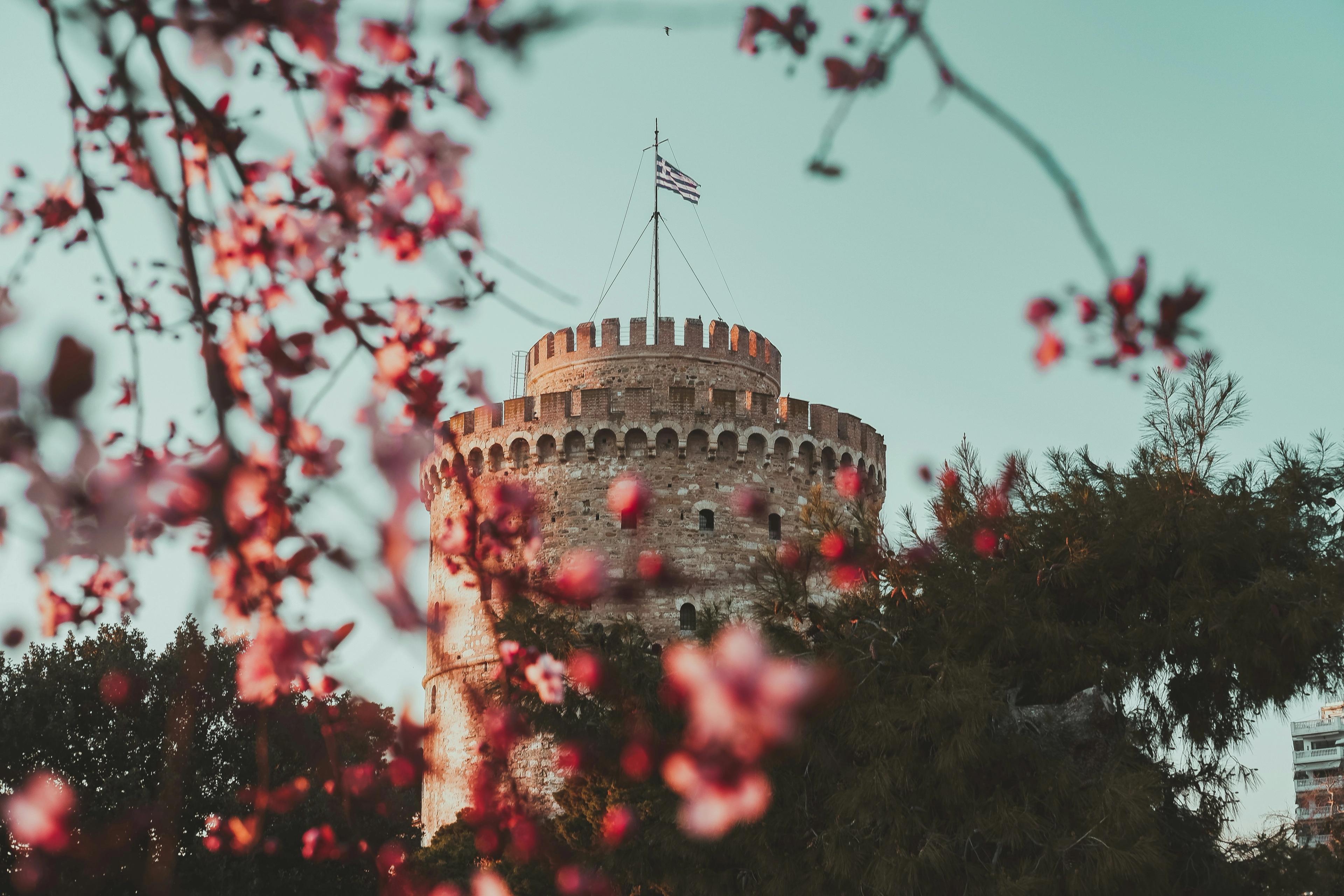
The Lefkos Pyrgos (White Tower) is Thessaloniki's symbol - a 34-metre cylindrical Ottoman fortress on the seafront, originally built in the 15th century as part of the city walls. The tower was painted white in 1890 to atone for its grim history as the Ottoman 'Tower of Blood' (the site of the 1826 massacre of Janissaries). Today it houses a 6-floor museum on Thessaloniki's history from the 4th century BC to the present.
Entry is EUR 6. The 92-step spiral staircase climbs to a rooftop terrace with the city's best panoramic view - over the Thermaic Gulf, Mount Olympus on a clear day, and across to Ano Poli. Closed Tuesdays. Allow 60-90 minutes. The audio guide (free with entry) is excellent.
2Aristotelous Square - The City's Grand Plaza


Aristotelous Square is Thessaloniki's grand civic plaza - a 100,000 sq m semicircle facing the Thermaic Gulf, designed by French architect Ernest Hebrard in 1918 after the Great Fire of 1917 destroyed two-thirds of the city. The square is ringed by the elegant arcaded Olympion Cinema (1923), the Electra Palace Hotel, and 18 neoclassical apartment buildings.
The square is free, always open. The bronze Aristotle statue (1989) at the north end is a popular meeting point - tradition says rubbing his big toe brings wisdom (you can see how shiny it is). The square anchors Thessaloniki's main pedestrian street (Tsimiski) east-west and the seafront promenade south.
3Rotunda and Arch of Galerius


The Rotunda of Galerius (also called the Church of Agios Georgios) is one of Thessaloniki's 15 UNESCO-listed Paleochristian monuments. Built around AD 306 as part of the imperial complex of Roman emperor Galerius, the 24.5-metre-diameter cylindrical structure was converted into a church in the 4th century, a mosque in the 16th century (the only surviving Ottoman minaret in Greece is here), and back to a church in 1912.
The 4th-century gold mosaics on the dome are some of the earliest Christian iconography surviving anywhere. Entry is EUR 6. Just 200 metres south stands the Arch of Galerius (AD 298-299), a triumphal arch celebrating Galerius's victory over the Persians - free, in the open air. Together they form the city's Roman ceremonial axis.
Check dates for Thessaloniki
See what is available on your dates.
4Ano Poli (Upper Town) and the Byzantine Walls

Ano Poli is Thessaloniki's medieval upper town - the only neighbourhood that survived the Great Fire of 1917 - a maze of stepped lanes, Ottoman-era timber houses (still inhabited), Byzantine churches, and the eastern walls of the 4th-century city walls climbing to the Heptapyrgion (Yedi Kule) fortress at 150 metres above sea level.
Free, always open. The Trigonion Tower viewpoint at the northeast corner of the walls offers the city's iconic photo - the Thermaic Gulf, the White Tower, and Mount Olympus in the distance. Eptapyrgio fortress (used as a prison until 1989) is now a free museum. Allow 2-3 hours for the full Ano Poli walk and bring water - it is uphill.
5Hagia Sophia of Thessaloniki - The Byzantine Cathedral

The Hagia Sophia of Thessaloniki is an 8th-century Byzantine basilica - the city's UNESCO-listed cathedral, modelled directly on Constantinople's Hagia Sophia (537) and one of the oldest surviving Byzantine churches in continuous use. The cross-in-square plan, the surviving 9th-century gold mosaic of the Ascension in the dome, and the 11th-century iconostasis are the unmissable features.
Free, open daily 7.30am-1pm and 5-8pm. Modest dress required (shoulders and knees covered). The church is still active for daily Greek Orthodox services - tourist visits should avoid 9-10am Sundays. The exterior plaza is small but pleasant for a coffee at the surrounding cafes.
6Archaeological Museum of Thessaloniki

The Archaeological Museum of Thessaloniki holds the most important Macedonian antiquities outside Vergina - 8,000 sq m of Bronze Age, Iron Age, Macedonian, Roman, and Hellenistic finds from across northern Greece. The Macedonian Royal Tomb gold and silver collection, the Derveni Krater (a 4th-century BC bronze vessel, the largest surviving), and the Lord of the Rings 'helm of Hades' golden burial wreath are the highlights.
Entry is EUR 8 (or combined ticket with the Museum of Byzantine Culture next door, EUR 15). Allow 2-3 hours. The 1962 building (designed by Patroklos Karantinos) is a fine example of mid-century Greek modernism. The audio guide costs EUR 4 and is essential for context.
7Ladadika - The Old Quarter Tapas District

Ladadika (literally 'oil shops') was Thessaloniki's commercial Jewish quarter for 400 years until WWII - 1,200 olive oil and grain warehouses around the port. After 1941 the Sephardic Jewish community was deported to Auschwitz; the warehouses survived intact. Since the 1990s, Ladadika has been restored as the city's tapas district - a pedestrian grid of 60+ ouzeris, mezedopoleia, jazz bars, and rebetiko underground music venues.
Free entry, busiest 9pm-1am Thursday-Saturday. Recommended ouzeris: Tsiknopempti, Diavasi, Toixos Toixo (small plates and ouzo). For traditional rebetiko music, try Tris Yiortes Kafenes (mid-week) or Sklavenitis (weekends). Mezes (small plates) average EUR 5-8; a glass of tsipouro EUR 3.
8Modiano Market - Thessaloniki's Historic Food Hall

Modiano Market is Thessaloniki's historic covered market - a 1922 belle epoque iron-and-glass structure designed by architect Eli Modiano (the son of a wealthy Sephardic family). After 50 years of decline, the market underwent a EUR 30 million restoration completed in 2022 and reopened with 75 stalls: butchers, cheesemongers, fishmongers, fresh produce, plus 25 sit-down food bars.
Free entry. Open 8am-midnight daily; food bars open 11am. The market is the best lunch destination in Thessaloniki - try the bougatsa stall, the spanakopita bakery, the Modiano oyster bar (Aegean oysters EUR 3 each), or the fresh fish at Ouzeri Modiano. Adjacent Kapani Market is the older, smaller, scruffier alternative for produce shopping.
9Church of Agios Dimitrios - Thessaloniki's Patron Saint

The Hagios Demetrios is Thessaloniki's largest church (43 by 33 metres) and the city's UNESCO-listed cathedral built on the spot where Saint Demetrius (the city's patron) was martyred in AD 306. The original 5th-century basilica burned in 1917; the current church is a faithful 1948 reconstruction preserving 7 surviving 5th-7th century mosaics in situ. The crypt holds the original Roman bath where Demetrius was killed.
Free entry to the church (modest dress required); the crypt and small museum cost EUR 3. The church is active for daily Orthodox services. The annual feast of Agios Dimitrios on 26 October draws huge crowds and a citywide procession. Allow 45 minutes for the church and crypt together.
10Vergina Royal Tombs - Day Trip to the Macedonian Kingdom

The Royal Tombs of Vergina are the UNESCO-listed burial site of the kings of Macedon - including Tomb II, identified by archaeologist Manolis Andronikos in 1977 as the tomb of Philip II of Macedon (Alexander the Great's father). The undisturbed tomb yielded 36 kg of gold artefacts, the iconic gold larnax with the 16-pointed Vergina Sun, and the only known portrait of Philip II. The Polycentric Museum opened in 2022 above the tombs themselves.
Entry is EUR 12. KTEL Imathias buses run hourly from the Thessaloniki Macedonia terminal (Bus 78 from Aristotelous to the terminal first) to Veroia, then a 20-minute local bus to Vergina - total 2 hours each way, EUR 8 + 1.50. Allow 6-7 hours for the full day trip including travel. Entry includes the Royal Tombs (Tomb II, the Persephone tomb), the Aigai palace ruins, and the museum.
Take this guide with you
Get every place in this guide, with addresses and map links, in your inbox — easy to open on your phone during the trip.
One email to the address on your account. No newsletter.

CEO and co-founder
Tomas is the co-founder and director of trip1, an European company specializing in reservation services. He launched the company in 2025 with a focus on building scalable, efficient operations.
Top 10 Places to Visit in Thessaloniki, Greece - FAQ
The White Tower on the seafront, the Rotunda and Arch of Galerius, and the Byzantine churches of Hagia Sophia and Agios Dimitrios, part of the city's 15 UNESCO-listed monuments. Then walk up through Ano Poli to the Trigonion Tower for sunset, eat at Modiano Market and spend an evening at the ouzeris of Ladadika.
Yes. It packs Roman and Byzantine monuments, a seafront promenade and one of Greece's best food scenes into a compact, walkable centre, and most of its top sights are free or cost under 8 euros. It works as a long weekend on its own or paired with Athens.
Its Byzantine heritage and its food. Thessaloniki has 15 UNESCO-listed early Christian and Byzantine monuments, the White Tower as its symbol, and the Roman Rotunda, with some of the earliest Christian mosaics anywhere. It is also known for bougatsa, ouzeris and its evening seafront walk.
Two to three days. Spend one on the seafront and centre (the White Tower, Aristotelous Square, the Rotunda, Hagia Sophia and the Archaeological Museum) and one on Ano Poli, Agios Dimitrios and the markets. A third day allows the trip to the royal tombs of Vergina, about 2 hours each way by public transport.
Bougatsa, a flaky filo pastry filled with custard or cheese, is the classic breakfast. The city is also known for koulouri, a sesame bread ring, trigona Panoramatos, cream-filled filo triangles, and long evenings of small plates with tsipouro or ouzo in Ladadika. For lunch, Modiano Market has fresh Aegean oysters.
May, June, September and October, when it is warm but not as hot as July and August. Late October brings the feast of Agios Dimitrios on 26 October, and November the Thessaloniki International Film Festival, the city's biggest annual event.