Guides · Jaipur
12 Top Places to Visit in Jaipur, India
By Tomas Achmedovas · CEO and co-founder

CEO and co-founder
This guide covers the 12 top places to visit in Jaipur - the forts, palaces, observatories, and bazaars that make Rajasthan's capital one of India's most rewarding cities to explore. Each entry includes the exact address with postal code, nearest transport option with walk times, distance from the city centre, and a practical Pro Tip drawn from on-the-ground experience. We have grouped the attractions to help you plan efficient sightseeing routes: the hilltop forts (Amber, Jaigarh, Nahargarh) cluster together on the Aravalli ridge north of town, while the Pink City core (Hawa Mahal, City Palace, Jantar Mantar) sits within a walkable 500-metre radius inside the walled old city.
Jaipur rewards early starts. The Rajasthan sun is fierce by mid-morning, especially from March onward, so the best strategy is to tackle outdoor forts at opening time (8:00 or 9:00) and save indoor attractions like City Palace Museum and Albert Hall for the hottest hours. Most places to visit in Jaipur charge separate entry fees, but the composite ticket (1,000 INR / 11 EUR for foreigners) bundles five major sites and is valid for two days - well worth the investment if you plan to see more than three attractions.
Whether you are spending two days here as part of the Golden Triangle circuit or dedicating a full week to Rajasthan, this Jaipur travel guide gives you the practical details you need to plan each day without wasted time or surprise closures. Distances between attractions are short - nothing on this list is more than 15 km from the city centre - so a hired car or a few auto-rickshaw rides can cover the lot.
Check dates for Jaipur
See what is available on your dates.
1Amber Fort - Jaipur's Hilltop Rajput Masterpiece


Amber Fort (also spelled Amer Fort) tops every list of places to visit in Jaipur, and for good reason. Built from red sandstone and white marble starting in 1592 under Raja Man Singh I, this sprawling hilltop complex blends Rajput military architecture with Mughal decorative flourishes. The fort sits on a ridge overlooking Maota Lake, and its honey-coloured walls catch the morning light in a way that makes the entire structure glow. The Sheesh Mahal (Mirror Palace) inside the fort is the standout room - thousands of convex glass pieces cover the walls and ceiling, reflecting a single candle flame into a constellation of light. The Ganesh Pol gateway, painted with detailed frescoes of elephants and flowers, marks the transition from the public audience halls to the private royal quarters.
Amber Fort was designated a UNESCO World Heritage Site in 2013 as part of the Hill Forts of Rajasthan group. The complex is enormous - allow a minimum of two hours to explore the four main courtyards, the Zenana (women's quarters), and the underground tunnel connecting to Jaigarh Fort above. Entry costs 500 INR (5.50 EUR) for foreign visitors, and the fort opens daily at 8:00.
2Hawa Mahal - The Iconic Pink Facade of the Wind Palace


Hawa Mahal (Palace of Winds) is the single most photographed building in Jaipur and an icon of Rajasthan. Maharaja Sawai Pratap Singh commissioned it in 1799 so that royal women could observe street processions and daily life without being seen. The five-storey facade features 953 small windows (jharokhas) fitted with intricate lattice screens that channel cool breezes through the interior - an early form of air conditioning that gives the palace its name. The building is essentially a decorative screen wall - from the side, it is only one room deep.
The structure is built from pink sandstone in the Kachchwaha Rajput style, and the morning sun turns the facade an even deeper shade of rose. You can enter from the rear and climb narrow stairways to the upper floors, where the lattice windows frame views over Johari Bazaar and the Jantar Mantar. Entry is 200 INR (2.20 EUR) for foreigners or included in the composite ticket.
3City Palace - Living Royal Residence and Museum


City Palace Jaipur is unusual among Indian royal residences because part of it is still occupied by the Jaipur royal family. Built by Maharaja Sawai Jai Singh II from 1729 onward, the complex blends Rajput, Mughal, and European architectural styles across a series of courtyards, gardens, and buildings. The Chandra Mahal (Moon Palace), a seven-storey tower at the centre of the complex, remains the private residence of the current maharaja - you can peek into the ground floor but cannot ascend further.
The museum section houses an impressive collection of royal garments, weaponry, manuscripts, and miniature paintings. The Diwan-i-Khas (Hall of Private Audience) contains two enormous sterling silver urns - each 1.6 metres tall and holding 4,091 litres - which Maharaja Madho Singh II used to carry Ganges water to London for King Edward VII's coronation in 1902. They hold the Guinness World Record as the largest silver objects ever made. Entry is 500 INR (5.50 EUR) for foreigners.
Check dates for Jaipur
See what is available on your dates.
4Jantar Mantar - The World's Largest Stone Sundial

Jantar Mantar Jaipur is a UNESCO World Heritage Site and the largest of five astronomical observatories built by Maharaja Sawai Jai Singh II between 1724 and 1735. The site contains 19 architectural instruments, each designed to measure time, track celestial bodies, or predict eclipses with remarkable accuracy. The centrepiece is the Samrat Yantra, a 27-metre-tall stone sundial - the world's largest - that can tell the time to within two seconds of accuracy. Its gnomon casts a shadow that moves roughly 6 centimetres per minute across the marble scale.
Without context, the instruments can look like abstract sculptures, so the signage at each station is worth reading carefully. The Jai Prakash Yantra (a pair of hemispherical sundials sunk into the ground) and the Rashivalaya Yantra (a set of 12 instruments, one for each zodiac sign) are among the most interesting. Entry is 200 INR (2.20 EUR) for foreigners. The site is right next to City Palace, so plan to visit both back-to-back.
5Nahargarh Fort - Sunset Viewpoint Over the Pink City

Nahargarh Fort crowns the Aravalli Hills above Jaipur and was originally built in 1734 as part of the city's ring of defences together with Amber Fort and Jaigarh Fort. The Madhavendra Bhawan, added in 1883 by Maharaja Sawai Madho Singh II, is the main attraction inside - a two-storey palace with 12 identical suites built for the king's 12 queens, connected by corridors so that no queen could know if the maharaja was visiting another. The pastel-painted rooms with carved marble screens and wall murals are remarkably well preserved.
The real draw, though, is the view. Nahargarh's ramparts offer a sweeping panorama over the entire Pink City and the flat Rajasthan plains beyond. At sunset, the city below turns golden, and you can trace the grid layout that Sawai Jai Singh II planned nearly 300 years ago. Entry costs 200 INR (2.20 EUR) for foreigners. The Padao restaurant on the fort's terrace serves basic meals with the panoramic views as the main course.
6Jaigarh Fort - The Cannon King's Fortress

Jaigarh Fort sits directly above Amber Fort on the Cheel ka Teela (Hill of Eagles) and was built in 1726 by Sawai Jai Singh II as Amber's military counterpart - while Amber was the palace, Jaigarh was the armoury. The fort is home to the Jaivana cannon, the world's largest wheeled cannon. Cast in the fort's own foundry in 1720, it has a barrel length of 6.15 metres and was reportedly test-fired only once - the cannonball landed 35 km away. The fort also houses an arms and armour museum with swords, shields, and matchlock rifles from the Kachhwaha dynasty.
Jaigarh receives far fewer visitors than Amber Fort below, which makes it a quieter place to explore massive Rajput military architecture. The watchtowers along the 3-km perimeter wall offer views stretching across the Aravalli Hills. An underground passage connects Jaigarh to Amber Fort, though it is not always open to visitors. Entry costs 200 INR (2.20 EUR) for foreigners.
7Jal Mahal - The Floating Palace on Man Sagar Lake

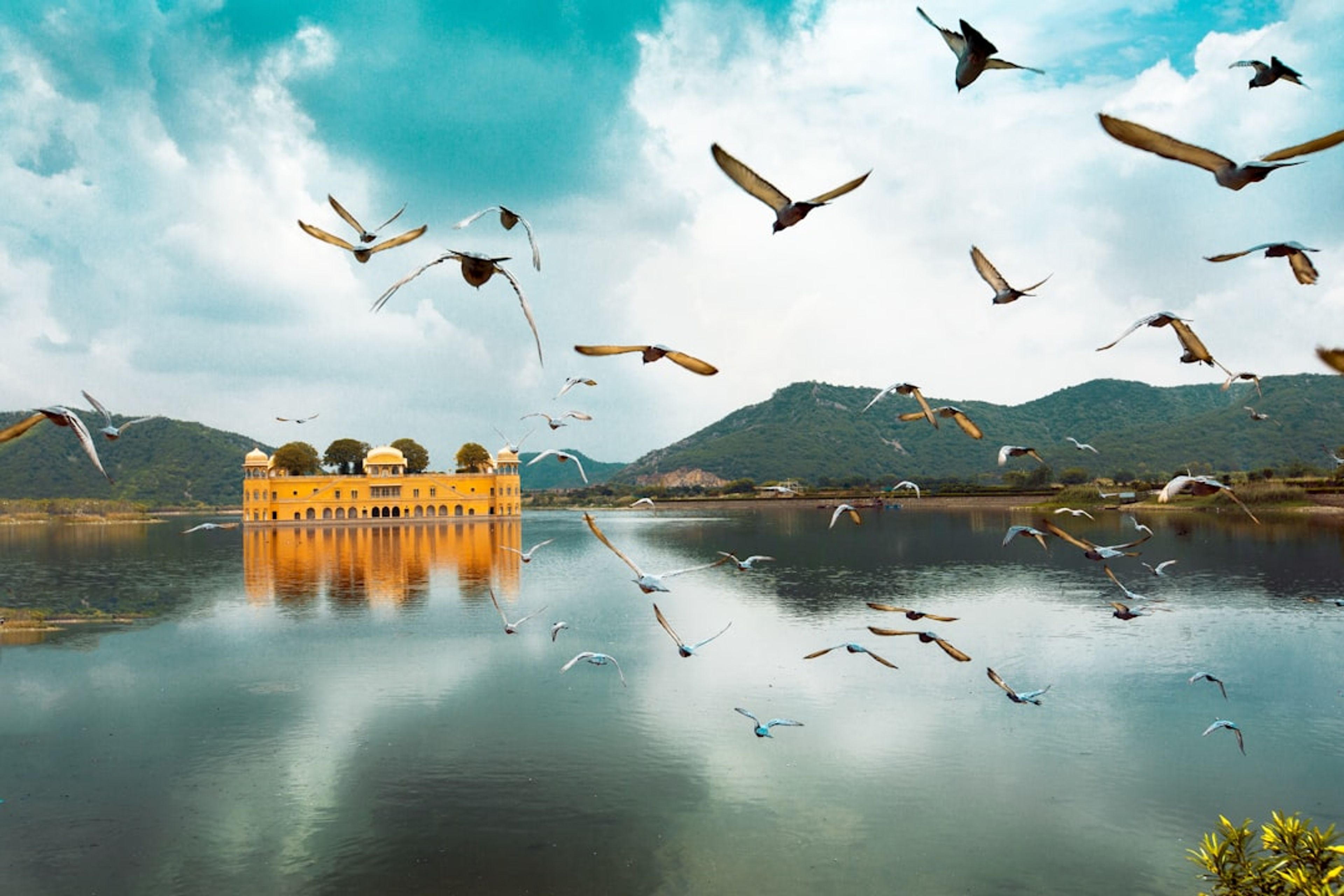
Jal Mahal (Water Palace) appears to float in the middle of Man Sagar Lake, with four of its five storeys submerged beneath the water line. The sandstone palace was renovated in the 18th century by Maharaja Madho Singh I and used as a hunting lodge and venue for royal duck-shooting parties. The building itself is closed to visitors, but the view from the lakeside promenade on Amer Road is one of Jaipur's most memorable scenes - the palace framed by the Aravalli Hills behind it and reflected in the still water.
The lake itself has been successfully restored as a wetland habitat and now attracts over 150 species of birds, including painted storks, kingfishers, and grey herons. The lakeside walkway is free to access and includes a small market selling snacks and crafts. Jal Mahal sits on the main road between Jaipur and Amber Fort, making it a natural photo stop on the way to or from the hilltop forts.
8Albert Hall Museum - Rajasthan's Oldest Public Museum

Albert Hall Museum (officially the Government Central Museum) is the oldest museum in Rajasthan, opened in 1887 as a public hall and museum. The building itself is worth the visit - designed by Colonel Sir Samuel Swinton Jacob in the Indo-Saracenic style, its elaborate facade mixes Mughal arches, Rajput chhatris (domed pavilions), and European columns. The architect studied buildings across Rajasthan for 10 years before finalising the design.
Inside, the collection spans Egyptian mummies, Persian carpets, suits of Rajput armour, and a notable gallery of Mughal miniature paintings. The ground-floor hall houses a collection of decorative arts including brass, ivory, and woodwork from across India. The museum is set in Ram Niwas Garden, a pleasant green space for a post-visit stroll. Entry is 150 INR (1.65 EUR) for foreigners. At night, the building is illuminated in changing colours, making it a popular evening photo spot.
9Birla Mandir - White Marble Temple at the Base of Moti Dungri

Birla Mandir (Laxmi Narayan Temple) stands out against the Jaipur skyline with its pure white Makrana marble - the same marble used to build the Taj Mahal. Completed in 1988 by the Birla industrial family, this Hindu temple is dedicated to Lord Vishnu (Narayan) and Goddess Lakshmi. The architecture mixes traditional Hindu temple design with modern construction techniques, and the stained-glass windows depicting scenes from Hindu mythology give the interior an unusual quality of light.
What makes Birla Mandir distinctive is its inclusive philosophy - the walls feature quotes from multiple religions, and carved panels depict figures from Hinduism, Christianity, Islam, and Buddhism side by side. The temple sits at the base of Moti Dungri hill, and the grounds are well maintained with gardens and walkways. Entry is free, and the temple is open until 9:00 PM, making it one of the few evening attractions in Jaipur.
10Panna Meena Ka Kund - Jaipur's Most Photogenic Stepwell

Panna Meena Ka Kund is a 16th-century stepwell (baori) tucked into a residential lane just below Amber Fort. Unlike many of Rajasthan's larger stepwells, this one has a criss-crossing zigzag staircase pattern on three sides, creating a geometric visual effect that makes it one of the most photographed stepwells in India. The well descends eight levels to the water, and the symmetrical staircases were designed so that people going down to collect water would not cross paths with those coming up - a clever traffic management system from 500 years ago.
Visitors are no longer allowed to descend the steps (the stone is weathered and slippery), but the viewing area at the top provides an excellent vantage point. The stepwell is free to visit and usually quiet compared to the main Amber Fort complex. A small chai stall near the entrance is a good spot to take a break before or after visiting the fort.
11Johari Bazaar - The Jewellers' Market of the Pink City

Johari Bazaar is Jaipur's most famous market street, running through the heart of the walled Pink City. The name translates to 'Jewellers' Market,' and the street lives up to it - hundreds of shops display everything from uncut emeralds and sapphires to finished kundan (gold-set gemstone) and meenakari (enamelled) jewellery. Jaipur has been a global centre for gemstone cutting since the 18th century, when Maharaja Sawai Jai Singh II invited gem cutters from across India to settle here. The city still processes roughly 90% of the world's emeralds.
Beyond jewellery, the bazaar and its side lanes sell block-printed textiles, lac bangles, tie-dye fabrics, and traditional Rajasthani juttis (embroidered leather shoes). The architecture along the street features the original terracotta-pink facades with arched doorways and upper-floor balconies. Street food vendors sell pyaaz kachori, samosas, and the famous Lassiwala lassi (thick yoghurt drink served in clay cups) from a stall that has operated on this road since 1944.
12Galtaji Temple - The Monkey Temple in the Aravalli Gorge

Galtaji (commonly called the Monkey Temple) is a 15th-century Hindu pilgrimage site set in a narrow gorge in the Aravalli Hills east of Jaipur. The complex includes several temples and seven sacred water tanks (kunds) fed by a natural spring. The main temple, dedicated to Lord Rama, features painted walls and pillared pavilions that cling to the hillside. Hundreds of macaque monkeys live on the temple grounds - they are considered sacred and are fed by priests and devotees, which is how the site earned its popular nickname.
The setting is the real attraction here. The gorge is lush with tropical vegetation, the spring water cascades between the kunds, and the pink sandstone temples look ancient and undisturbed compared to Jaipur's more polished tourist sites. The walk from the road to the main temple takes about 10 minutes through the gorge. Entry is free, and the site is open from sunrise to sunset. It sees far fewer tourists than the city-centre attractions.
Take this guide with you
Get every place in this guide, with addresses and map links, in your inbox — easy to open on your phone during the trip.
One email to the address on your account. No newsletter.

CEO and co-founder
Tomas is the co-founder and director of trip1, an European company specializing in reservation services. He launched the company in 2025 with a focus on building scalable, efficient operations.
12 Top Places to Visit in Jaipur - FAQ
Amber Fort, Hawa Mahal, City Palace, Jantar Mantar and Nahargarh Fort. Amber is the hilltop palace with the Sheesh Mahal mirror hall, and Hawa Mahal is the pink Palace of Winds with 953 small windows. City Palace and Jantar Mantar sit side by side in the walled Pink City, and Nahargarh is the sunset viewpoint over the city.
Yes, for the main sights. Spend one morning on the hill forts (Amber, Jaigarh and Panna Meena Ka Kund) with a stop at Jal Mahal, and the other in the Pink City at Hawa Mahal, City Palace and Jantar Mantar. The composite ticket covers five sites, including Amber and Hawa Mahal, and lasts two days; foreign visitor prices rose in January 2026, so check the current rate.
October to March. Days are dry and mild, and December and January nights can drop to around 8 to 10 degrees, so bring a layer. From March the sun is fierce by mid-morning, so visit the outdoor forts at opening time and save City Palace Museum and Albert Hall for the hottest hours. Winter is also the busiest season.
Gemstones and jewellery, above all. Johari Bazaar in the Pink City sells emeralds, sapphires, kundan and meenakari pieces, and its side lanes have block-printed textiles, lac bangles, tie-dye fabrics and embroidered juttis. Bargaining is expected, so start at 40 to 50 percent of the asking price. Unless you are an experienced buyer, buy gemstones only from certified shops.
Start with sunset from the ramparts of Nahargarh Fort, which closes at 5:30pm in winter and 6pm in summer. After dark, Birla Mandir stays open until 9pm and its white marble glows when lit, and Albert Hall Museum is lit up in changing colours. Remove your shoes at the temple and leave leather items in the free storage outside.
Amber Fort, which opens at 8am, before the tour buses from Delhi arrive around 10am. Go to Panna Meena Ka Kund before 9am, when shadows sharpen its zigzag steps, or Galtaji for soft light in the gorge. For Hawa Mahal, the best view is from the rooftop cafes opposite between 7am and 8am, while the street is still quiet.