


Guides · Florence
12 Top Places to Visit in Florence, Italy
By Tomas Achmedovas · CEO and co-founder

CEO and co-founder
Florence remains one of the most rewarding destinations in Europe for art, architecture, and history. This guide covers 12 essential places to visit in Florence, selected to give you a well-rounded experience of the Tuscan capital - from world-famous Renaissance museums to panoramic viewpoints and medieval landmarks. The attractions are grouped geographically so you can plan efficient walking routes across the compact historic centre, starting near the Duomo and radiating outward to the Oltrarno district south of the Arno River.
Each entry includes the exact street address, nearest transit options, distance from the city centre (measured from the Duomo or Piazza della Signoria), current ticket prices in euros, and a practical Pro Tip drawn from on-the-ground experience. Whether you have two days or five, these 12 Florence attractions form a strong foundation for any first or repeat visit. The list ranges from the Uffizi Gallery and Galleria dell'Accademia to quieter stops like the Basilica di San Miniato al Monte and the Museo Nazionale del Bargello.
Florence's historic centre is a UNESCO World Heritage Site measuring roughly 2 km across, which means every attraction on this list is reachable on foot. Advance tickets are noted where relevant, and we flag which spots are free. Pack comfortable shoes, carry a water bottle, and prepare for one of the most concentrated collections of masterpieces anywhere on Earth.
Check dates for Florence
See what is available on your dates.
1Cathedral of Santa Maria del Fiore (the Duomo) - Florence's Iconic Renaissance Cathedral and Dome


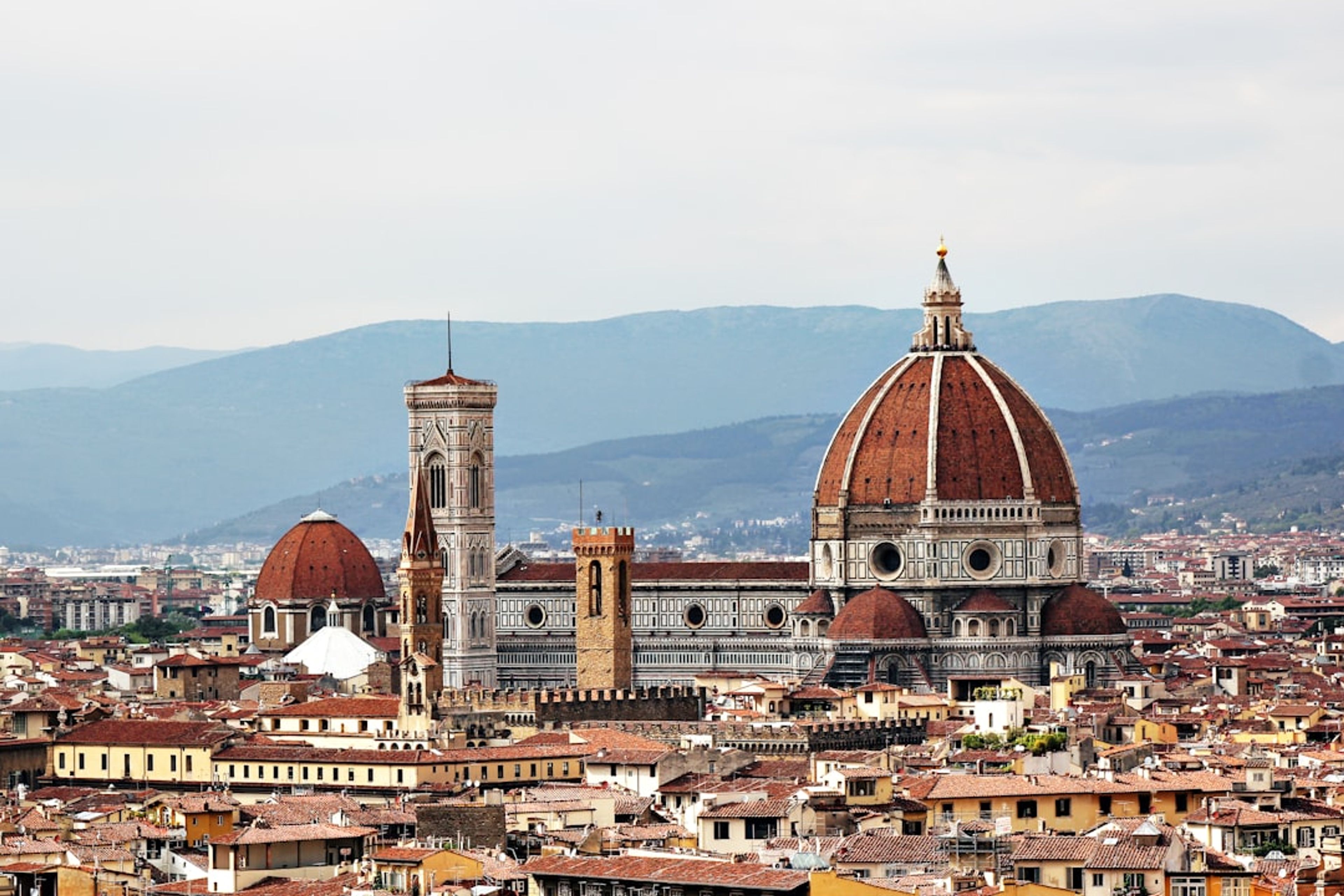
The Cathedral of Santa Maria del Fiore dominates the Florence skyline with Filippo Brunelleschi's terracotta-tiled dome, which remains the largest masonry dome ever constructed. Construction began in 1296 under Arnolfo di Cambio and continued for nearly 150 years. The exterior is clad in white, green, and pink marble panels from Carrara, Prato, and Siena. Inside, the nave stretches 153 metres long, and Giorgio Vasari's fresco of the Last Judgment covers 3,600 square metres of the dome's interior surface.
The Duomo complex is actually five sites under one ticket (EUR 30): the cathedral interior (free), Brunelleschi's Dome climb (463 steps), Giotto's Bell Tower (414 steps), the Baptistery of San Giovanni, and the Opera del Duomo Museum. Reserve a timed slot for the dome climb online, as walk-up availability is limited. The cathedral itself is free to enter but requires modest dress - shoulders and knees must be covered.
2Uffizi Gallery - Florence's World-Class Renaissance Art Museum


The Uffizi Gallery holds one of the oldest and most important art collections in the Western world. Giorgio Vasari designed the building in 1560 as administrative offices for Cosimo I de' Medici, and the Medici family later converted the upper floor into a gallery for their growing art collection. Today the museum spans 101 rooms across two floors, with works arranged chronologically from the 13th century through the 18th century.
The collection's crown jewels include Botticelli's Birth of Venus and Primavera, Leonardo da Vinci's Annunciation, Caravaggio's Medusa and Sacrifice of Isaac, and Raphael's Madonna of the Goldfinch. Admission costs EUR 20 in low season and EUR 25 from March through October. Plan two to three hours minimum. The top floor (second floor) holds the most celebrated works, so start there if your energy is limited. The reopened Vasari Corridor connecting the Uffizi to Palazzo Pitti is accessible as an add-on ticket.
3Galleria dell'Accademia - Home of Michelangelo's David


The Galleria dell'Accademia exists primarily to house Michelangelo's David, the 5.17-metre marble sculpture carved from a single block of Carrara marble between 1501 and 1504. The statue was moved here from Piazza della Signoria in 1873 to protect it from weathering, and it now stands beneath a purpose-built skylight tribune designed by Emilio De Fabris. The level of anatomical detail - from the tensed tendons in David's neck to the veins running along his right hand - rewards close and extended observation.
Beyond David, the Accademia holds Michelangelo's four unfinished Prisoners (Slaves), which reveal his subtractive sculpting method in frozen mid-process. The museum also contains the largest collection of gold-ground paintings in Florence and a room of historic musical instruments. Admission is EUR 16 in low season and EUR 22 from March through October. Most visits take 60 to 90 minutes.
Check dates for Florence
See what is available on your dates.
4Ponte Vecchio - Florence's Medieval Bridge Lined with Goldsmiths

Ponte Vecchio is the oldest surviving bridge in Florence, rebuilt in its current form in 1345 after a devastating flood. The bridge is distinctive for the rows of shops built along both sides, a practice that dates to the 13th century. In 1593, Grand Duke Ferdinando I banned butchers and tanners from the bridge and replaced them with goldsmiths and jewellers, whose successors still trade here today. The Vasari Corridor runs along the top of the east side, connecting the Uffizi to Palazzo Pitti above street level.
Walking across the bridge is free and available at any hour. The central opening between the shop rows offers framed views of the Arno in both directions. Ponte Vecchio was the only Florentine bridge spared from German demolition during the retreat from Florence in August 1944. The best photographs of the bridge itself come from the upstream Ponte Santa Trinita or from the Lungarno embankment paths on either bank.
5Palazzo Pitti - The Grand Medici Palace and Museum Complex

Palazzo Pitti is a colossal Renaissance palace that served as the primary residence of the ruling Medici family from 1550 onward, and later of the House of Lorraine and the Italian royal family. The rusticated stone facade stretches 205 metres across Piazza de' Pitti, making it the largest palace in Florence. Inside, it houses five separate museums: the Palatine Gallery, the Royal Apartments, the Gallery of Modern Art, the Silver Museum, and the Costume and Fashion Museum.
The Palatine Gallery alone justifies the visit, with major works by Raphael (including the Madonna of the Chair), Titian, Rubens, and Caravaggio hung in lavishly frescoed rooms. A combined ticket for Palazzo Pitti and the Boboli Gardens costs EUR 22 in peak season and EUR 16 in winter. Allow two to three hours for the palace museums and another hour or two for the gardens behind it.
6Boboli Gardens - Renaissance Sculpture Park Behind Palazzo Pitti

The Boboli Gardens spread across 45,000 square metres of hillside behind Palazzo Pitti, forming one of the earliest examples of an Italian formal garden. Laid out in the mid-16th century for Eleonora di Toledo, wife of Cosimo I de' Medici, the grounds served as a prototype for many European palace gardens, including Versailles. The garden features geometric hedge patterns, gravel pathways, ancient Roman and Renaissance sculptures, fountains, and a network of grottoes.
Key stops include the Buontalenti Grotto near the entrance (decorated with stalactites and copies of Michelangelo's Prisoners), the Neptune Fountain at the garden's central axis, the Isolotto oval pond with Giambologna's Ocean Fountain, and the Kaffeehaus pavilion with panoramic city views. The gardens are included in the Palazzo Pitti combined ticket (EUR 22 peak, EUR 16 low season). Plan 60 to 90 minutes for a thorough walk through the grounds.
7Piazza della Signoria and Palazzo Vecchio - Florence's Political Heart

Piazza della Signoria has been Florence's political and civic centre since the 14th century. The L-shaped square is anchored by Palazzo Vecchio, the fortified town hall with its 94-metre stone tower designed by Arnolfo di Cambio in 1299. The palace still serves as Florence's city hall while doubling as a museum with richly frescoed rooms, including the Salone dei Cinquecento - a massive hall painted by Vasari that once held the Florentine Republic's Great Council.
The piazza functions as an open-air sculpture gallery. A copy of Michelangelo's David stands at the palazzo entrance, flanked by Baccio Bandinelli's Hercules and Cacus. The Loggia dei Lanzi shelters major bronze and marble works, including Cellini's Perseus with the Head of Medusa and Giambologna's Rape of the Sabine Women. The piazza is free to enter at all hours. Palazzo Vecchio museum tickets cost EUR 12.50 for adults, with an optional tower climb for EUR 12.50 more.
8Basilica di Santa Croce - Resting Place of Michelangelo and Galileo

The Basilica di Santa Croce is the largest Franciscan church in the world and often called the Temple of Italian Glories. Begun in 1294, its Gothic interior houses the monumental tombs of Michelangelo (designed by Vasari), Galileo Galilei, Niccolo Machiavelli, Gioachino Rossini, and a cenotaph honouring Dante Alighieri. The church contains 16 chapels decorated by leading Trecento painters, including Giotto's frescoes in the Bardi and Peruzzi Chapels depicting scenes from the lives of Saint Francis and Saint John.
The cloister complex includes Brunelleschi's Pazzi Chapel, a masterwork of early Renaissance architecture with its serene proportions and Luca della Robbia terracotta roundels. The adjacent museum displays Cimabue's Crucifix, badly damaged in the 1966 Arno flood and now a symbol of Florence's art restoration efforts. Admission is EUR 8 for adults. Allow 60 to 90 minutes for a full visit including the cloisters and museum.
9Piazzale Michelangelo - Florence's Panoramic Sunset Terrace

Piazzale Michelangelo is a wide terrace on the hillside south of the Arno, designed by architect Giuseppe Poggi in 1869 as part of a major urban renovation. The terrace delivers the single most comprehensive view of Florence's skyline: the Duomo dome, Palazzo Vecchio tower, the Arno bridges, Santa Croce, and the Fiesole hills to the north are all visible in one sweeping panorama. A bronze replica of Michelangelo's David stands at the centre of the piazza.
Access is free at all hours. The piazza is a magnet for sunset gatherers from roughly April through October, when the western light turns the city's stone facades and terracotta roofs a deep golden orange. A small cafe and a few souvenir stalls operate during daylight hours. The walk up from the San Niccolo gate takes about 15 minutes on a steep, stepped path lined with cypress trees.
10Basilica di San Miniato al Monte - A Romanesque Jewel Above the City

San Miniato al Monte is one of the finest Romanesque churches in Tuscany, perched on the hill directly above Piazzale Michelangelo. The green-and-white marble facade dates to the 11th and 12th centuries and has remained largely unaltered since. Inside, the raised choir over a crypt creates a dramatic spatial effect. The floor is covered with intricate marble inlay dating to 1207, and Spinello Aretino's frescoes in the sacristy depict the life of Saint Benedict in luminous detail.
The church is free to enter and remains an active Olivetan monastery. Monks chant Gregorian vespers daily at 17:30 in winter and 18:00 in summer - attending is a profoundly atmospheric experience. The adjacent cemetery, Cimitero delle Porte Sante, contains ornate 19th-century tombs of notable Florentines, including writer Carlo Collodi (creator of Pinocchio). The terrace in front of the church offers a view rivalling Piazzale Michelangelo with a fraction of the foot traffic.
11Museo Nazionale del Bargello - Florence's Premier Sculpture Museum

The Bargello occupies a fortified 13th-century palace that once served as the seat of the chief of police (the Bargello). Today it holds Italy's most important collection of Renaissance sculpture in a building that rivals the art it contains. The ground-floor hall displays Michelangelo's early works, including his Bacchus and the Pitti Tondo relief. Upstairs, Donatello's room features his bronze David - the first freestanding nude male sculpture since antiquity - alongside his marble Saint George.
The museum also holds Ghiberti and Brunelleschi's competing bronze panels for the Baptistery doors (the famous 1401 competition that launched the Renaissance), along with major works by Verrocchio, Cellini, and Giambologna. The courtyard, with its open staircase and wall of civic coats of arms, is one of the most photogenic spaces in Florence. Admission is EUR 9 for adults. Most visitors spend 60 to 90 minutes here.
12Palazzo Vecchio Tower and Secret Passages - Medieval Power and Intrigue

Palazzo Vecchio's Arnolfo Tower rises 94 metres above Piazza della Signoria and provides the only elevated viewpoint from within the historic centre north of the Arno. The climb of 233 steps through narrow medieval staircases passes former prison cells where Cosimo de' Medici and the friar Girolamo Savonarola were each held at different points in Florence's turbulent political history. From the top, the view places you at eye level with the Duomo dome and directly above the piazza's sculpture-filled Loggia dei Lanzi.
Inside the palace, the Salone dei Cinquecento is a 54-by-23-metre hall with soaring painted ceilings by Vasari depicting Florentine military victories. The museum ticket (EUR 12.50) grants access to the Medici apartments, the Map Room with 53 painted geographical panels, and Verrocchio's bronze putto fountain in the second courtyard. The tower climb costs an additional EUR 12.50 and operates on a timed-entry basis with limited capacity.
Take this guide with you
Get every place in this guide, with addresses and map links, in your inbox — easy to open on your phone during the trip.
One email to the address on your account. No newsletter.

CEO and co-founder
Tomas is the co-founder and director of trip1, an European company specializing in reservation services. He launched the company in 2025 with a focus on building scalable, efficient operations.
12 Top Places to Visit in Florence, Italy - FAQ
The Duomo with Brunelleschi's dome, the Uffizi Gallery for Botticelli's Birth of Venus, and Michelangelo's David at the Galleria dell'Accademia. Walk across Ponte Vecchio, see the statues in Piazza della Signoria, and watch sunset from Piazzale Michelangelo, then climb five minutes to San Miniato al Monte. With more time, add Palazzo Pitti, the Boboli Gardens, Santa Croce and the Bargello.
The Uffizi Gallery and the Galleria dell'Accademia, home of Michelangelo's David, are Florence's two most visited museums. Both sell timed tickets, and booking ahead is the way to avoid long queues in peak season. The Duomo, Ponte Vecchio and Piazza della Signoria draw the biggest crowds outdoors, so visit them early in the morning or after 20:00 for space.
Yes, for the highlights. On day one, see David at the Accademia at opening, climb the dome, then visit Piazza della Signoria and the Uffizi. On day two, cross Ponte Vecchio to Palazzo Pitti and the Boboli Gardens, see Santa Croce or the Bargello, and end at Piazzale Michelangelo and San Miniato al Monte at sunset. The historic centre is about 2 km across, so you can walk everywhere.
Book the big sights ahead and walk. See David at the Accademia at 08:15, then climb Brunelleschi's dome or Giotto's Bell Tower. Cross Piazza della Signoria to the Uffizi for Botticelli, walk over Ponte Vecchio, and climb about 15 minutes from the San Niccolò gate to Piazzale Michelangelo for sunset. Finish at San Miniato al Monte, where monks sing vespers in the evening.
Yes. Its 101 rooms hold Botticelli's Birth of Venus and Primavera, Leonardo's Annunciation, Caravaggio's Medusa and Raphael's Madonna of the Goldfinch. In 2026 a ticket costs 25 euros on the day or 29 euros booked ahead, and 16 euros if you enter from 4pm. Book a timed slot at least two weeks ahead in peak season, allow two to three hours, and start upstairs.
Not for the cathedral itself, which is free to enter, though shoulders and knees must be covered. You do need a ticket for the rest of the complex: Brunelleschi's dome (463 steps), Giotto's Bell Tower (414 steps), the Baptistery and the Opera del Duomo Museum. Book a timed dome slot online, as walk-up places are limited; the earliest, at 08:15, is the least crowded.