

Guides · Sardinia
Best Things to Do in Sardinia: Beaches, Towns & Secret Spots
By Tomas Achmedovas · CEO and co-founder

CEO and co-founder
Best Things to Do in Sardinia Italy
Sardinia Italy is the kind of place that ruins every other beach holiday you take afterwards. This autonomous island - the second largest in the Mediterranean - delivers water so clear it looks digitally enhanced, coastline that shifts from powder-white Caribbean-style stretches to jagged granite coves within a single drive, and a cultural identity so distinct it barely feels Italian at all. The Sards have their own language, their own cuisine, and a fierce independence shaped by millennia of resisting outside rule.
Beyond the headline beaches and the Costa Smeralda glitz, Sardinia rewards the curious. The interior hides Bronze Age stone towers called nuraghi - over 7,000 of them scattered across pastoral landscapes. Medieval towns like Bosa and Castelsardo cling to hillsides above rivers and sea. The food is earthy and exceptional: slow-roasted suckling pig, hand-pinched pasta, crispy flatbread, and wines from grapes that grow nowhere else in the world.
This guide covers the best things to do in Sardinia - from the must-swim beaches and atmospheric old towns to the archaeological sites and wild gorges that most visitors miss. Whether you are planning a week-long road trip or a long weekend based in one area, these are the experiences that define the island.
Check dates for Sardinia
See what is available on your dates.
1Costa Smeralda - The Emerald Coast and Sardinia's Most Famous Shoreline


Stretching along the northeast coast between Olbia and Palau, the Costa Smeralda is what put Sardinia on the international map. Developed in the 1960s by the Aga Khan, this 20-km stretch of coastline is named for its emerald-green waters and has become synonymous with Mediterranean luxury. Porto Cervo sits at its heart - a manicured village of designer boutiques, superyacht marinas, and exclusive clubs that attracts the European elite every summer.
But the best part of the Costa Smeralda is free: the beaches. Spiaggia del Principe (Prince's Beach) is a perfect arc of white sand lapped by shallow turquoise water. Capriccioli has twin coves separated by granite outcrops. Liscia Ruja is one of the longest sandy stretches on the coast. Arrive early in summer - by 10am, the car parks fill and the sands get crowded. Outside of July-August, these beaches are blissfully quiet.
2Cagliari Old Town (Castello) - The Island's Walled Medieval Capital


Cagliari is Sardinia's capital and its most rewarding city. The historic Castello quarter sits on a hilltop fortified by Pisan walls, with views sweeping across the lagoon to the mountains. Narrow limestone streets wind between medieval towers, baroque churches, and the Cathedral of Santa Maria which blends Romanesque, Gothic, and baroque styles from eight centuries of renovation. The Bastion of Saint Remy offers the best panorama in the city - climb the monumental staircase for a sunset view across the rooftops and harbour.
Below Castello, the Marina quarter is where Cagliari eats and drinks. Via Sardegna and the streets around Corso Vittorio Emanuele II are packed with restaurants, wine bars, and gelaterias. The National Archaeological Museum houses one of Italy's finest collections of Nuragic bronzes and Punic artefacts. For a beach break, Poetto Beach stretches 8 km along the coast just 15 minutes from the centre by bus.
3La Pelosa Beach, Stintino - Sardinia's Most Photographed Beach


At the very tip of Sardinia's northwest cape, La Pelosa is the beach you have seen in every Sardinia tourism campaign. Fine white sand meets impossibly shallow turquoise water with the 16th-century Aragonese watchtower standing on a rocky islet just offshore and the island of Asinara looming across the strait. The water barely reaches your knees for 50 metres out, making it one of the best beaches in Sardinia Italy for families with small children.
There is a catch: La Pelosa is now access-controlled in summer. Since 2019, daily visitor numbers are capped, at 1,500 a day from 15 May to 15 October in 2026, and entry requires a ticket (EUR 3.50, free for under-12s, booked at spiaggialapelosa.it or in the La Pelosa app). Beach mats must be placed on provided wooden platforms to protect the dune ecosystem. The restrictions are worth it - they have kept the beach in far better condition than other popular spots. The small town of Stintino, 2 km south, has a handful of restaurants and a fishing-village atmosphere.
Check dates for Sardinia
See what is available on your dates.
4Cala Goloritze - A Natural Monument on the Gulf of Orosei

Cala Goloritze is regularly cited as one of Europe's most beautiful beaches, and the hype is justified. A small cove framed by towering limestone cliffs, punctuated by a 143-metre natural rock spire (Aguglia), and lapped by water so clear you can count the pebbles on the seabed from the clifftop above. This beach is a designated Italian Natural Monument, and swimming here feels like being inside a postcard.
Access is part of the experience. The only way in on foot is a well-marked trail from the Altopiano del Golgo above Baunei - about 3.5 km (1 hour downhill, 1.5 hours back up). The path descends roughly 400 metres through Mediterranean scrub and forest. Bring plenty of water, wear sturdy shoes, and start early to avoid the midday heat. Alternatively, boat tours from Cala Gonone or Santa Maria Navarrese stop offshore (swimming to the beach is permitted, landing boats is not).
5Alghero Old Town - The Catalan Jewel of Sardinia's Northwest Coast

Alghero feels more like a small coastal city in Catalonia than anywhere else in Sardinia. Conquered by the Aragonese in the 14th century, the old town still carries that heritage in its dialect (Algherese Catalan is spoken by older residents), its architecture (Gothic palaces, Catalan-style churches), and its cuisine (lobster, sea urchin, and paella variants). The walled old town juts into the sea on a narrow promontory, encircled by honey-coloured ramparts that double as the most atmospheric evening passeggiata in northwest Sardinia.
Walk the bastioni (sea walls) at sunset for views across to Capo Caccia. The old town streets are tight and pedestrianised, lined with restaurants, coral jewellery shops (Alghero is known as the Coral Riviera), and wine bars serving local Vermentino. The beach at Lido San Giovanni is within walking distance, and day trips to Neptune's Grotto, the beach at Bombarde, and the nuraghe at Palmavera are all within 15 km.
6La Maddalena Archipelago - Island Paradise off Sardinia's Northeast Coast

The La Maddalena Archipelago National Park is a cluster of seven main islands and dozens of smaller islets between Sardinia and Corsica, protected as a national park since 1994. The water here is a catalogue of blues - cobalt in the deep channels, electric turquoise over the sandy shallows, almost transparent in the coves. Spiaggia Rosa (Pink Beach) on Budelli island is the most famous, though access is restricted to protect its unique pink-tinted sand. The beaches on Spargi (Cala Corsara) and Santa Maria are equally stunning and swimmable.
The main island of La Maddalena is reached by a 20-minute Delcomar or Maddalena Lines ferry from Palau on the Sardinian mainland. The town itself has a laid-back waterfront, good restaurants, and a small naval museum. From La Maddalena, you can drive across a causeway to Caprera island, where Garibaldi - Italy's unification hero - spent his final years. His house is now a museum. Boat excursions from La Maddalena or Palau tour the outer islands with swimming stops.
7Su Nuraxi di Barumini - Sardinia's UNESCO Bronze Age Fortress

Su Nuraxi is the most important archaeological site in Sardinia and a UNESCO World Heritage Site since 1997. This massive Bronze Age complex dates from the 16th century BC and consists of a central tower surrounded by four corner towers, an outer wall with seven additional towers, and the remains of a village of circular stone huts. It is the finest and most complete example of the nuraghi - the mysterious stone towers that are Sardinia's defining cultural symbol with over 7,000 scattered across the island.
The site is located near the village of Barumini in central-south Sardinia. Visits are by guided tour only (roughly 1 hour), available in Italian and English. The adjacent Casa Zapata museum houses artefacts found during excavation and sits above a second, partially excavated nuraghe visible through glass flooring. The landscape around Barumini is quintessential Sardinian interior - rolling hills, wheat fields, and the flat-topped plateau of the Giara di Gesturi where wild Giara horses roam.
8Bosa - The Most Colourful Town in Sardinia

Bosa is a postcard-perfect town on Sardinia's west coast where pastel-painted houses climb a hillside above the Temo - the island's only navigable river. Crowned by the 12th-century Malaspina Castle, the old town (Sa Costa) is a maze of steep alleys, tiny piazzas, and medieval churches. The Ponte Vecchio spanning the river is considered one of Italy's most beautiful bridges. Along the riverbank, the former tanneries (Sas Conzas) have been restored and stand as photogenic reminders of the town's leather-working past.
Bosa's charm is its pace - this is a place for wandering, not ticking off sights. The main corso is lined with family-run restaurants serving fresh seafood and Malvasia di Bosa, a distinctive local dessert wine. The coast around Bosa is some of the least developed in Sardinia: the beaches at Bosa Marina (2 km from town), Cala 'e Moru, and Porto Alabe are quiet even in peak summer. The winding coastal road (SP49) from Bosa to Alghero is one of the most scenic drives in Italy.
9Neptune's Grotto (Grotta di Nettuno) - A Spectacular Sea Cave near Alghero

Carved into the towering cliffs of Capo Caccia, 24 km west of Alghero, Neptune's Grotto is one of the Mediterranean's most impressive sea caves. The cavern extends roughly 4 km into the rock (about 200 metres is open to visitors), filled with stalactites, stalagmites, columns, and an underground saltwater lake called La Marmora. The formations are dramatically lit and reflected in the still water, creating an otherworldly atmosphere.
There are two ways to reach the grotto. The more dramatic approach is the Escala del Cabirol - a staircase of 656 steps carved into the cliff face, descending 110 metres to the cave entrance. The views during the descent are extraordinary. Alternatively, boat services run from Alghero's port (roughly 30 minutes each way, EUR 15-17 return). The cave is open from April to October, weather permitting, with guided tours every hour. Entry costs around EUR 14 for adults.
10Gorropu Gorge - Europe's Deepest Canyon in the Sardinian Wilderness

Gola di Gorropu is one of Europe's deepest gorges, with walls reaching up to 500 metres on either side of a narrow limestone canyon. Located in the Supramonte mountain range between the territories of Urzulei and Orgosolo, it is the centrepiece of Sardinia's wild interior and a must for anyone who wants to see the island beyond its beaches. The gorge floor is a boulder field of white limestone blocks, some the size of houses, with endemic plants growing in the cracks.
The main hiking route starts from the Genna Silana pass on the SS125 road (one of Sardinia's most scenic drives). The trail descends to the Flumineddu riverbed and follows it to the gorge entrance - roughly 7 km each way, taking 3-4 hours return for the standard route. The first section of the gorge is accessible without equipment. Deeper exploration requires scrambling and a guide. Entry to the gorge costs around EUR 5 and guides are available at the entrance for the advanced sections.
11Cala Mariolu - The Gulf of Orosei's Crown Jewel Beach

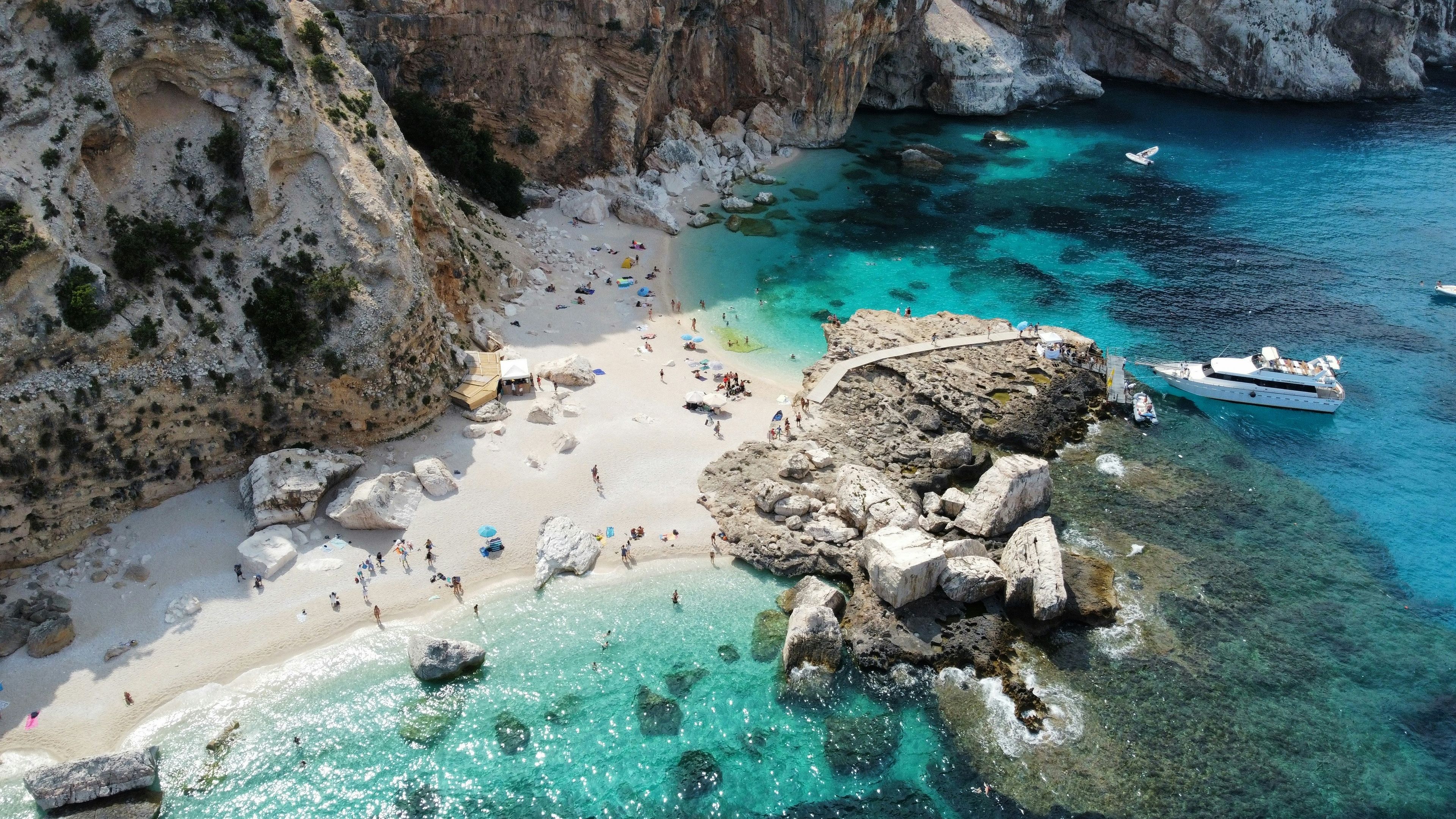
Cala Mariolu consistently ranks as one of the best beaches in Sardinia Italy and in wider Europe. Tucked into the limestone cliffs of the Gulf of Orosei, it is a double cove of smooth white and pink pebbles backed by steep, scrub-covered cliffs. The water is an almost unreal shade of turquoise, deepening to cobalt blue just metres from shore, and the snorkelling along the rocky edges is exceptional - monk seals were spotted here as recently as the early 2000s.
Most visitors reach Cala Mariolu by boat from Cala Gonone (roughly 30-40 minutes) or Santa Maria Navarrese (about 20 minutes). Full-day boat tours of the Gulf of Orosei typically include stops at Cala Mariolu, Cala Goloritze, Cala Luna, and Cala Sisine, costing around EUR 35-50 per person with lunch included. There is a hiking trail from the plateau above, but it is steep, poorly marked, and not recommended without a local guide.
12Castelsardo - A Medieval Fortress Town above the Sea

Perched on a rocky headland on Sardinia's north coast, Castelsardo is one of Italy's official Borghi piu Belli (most beautiful villages) and the view from below explains why. The medieval old town cascades down from the Doria Castle at the summit, a jumble of narrow lanes, stone stairways, and terracotta-roofed houses that have barely changed in centuries. The castle itself houses the Museo dell'Intreccio Mediterraneo, dedicated to the traditional basket-weaving that Castelsardo is famous for - you will see women weaving on their doorsteps in the old town.
The views from the castle terrace extend across the Gulf of Asinara to the Asinara island and on clear days to Corsica. Below the old town, the harbour area has several good seafood restaurants. Nearby, the Roccia dell'Elefante (Elephant Rock) is a natural trachyte rock formation shaped like an elephant, containing pre-Nuragic tombs called domus de janas (fairy houses) carved into its base. The beaches at Lu Bagnu, just west of town, are excellent and uncrowded.
Take this guide with you
Get every place in this guide, with addresses and map links, in your inbox — easy to open on your phone during the trip.
One email to the address on your account. No newsletter.

CEO and co-founder
Tomas is the co-founder and director of trip1, an European company specializing in reservation services. He launched the company in 2025 with a focus on building scalable, efficient operations.
Best Things to Do in Sardinia - FAQ
Many pick the northeast or the Gulf of Orosei. The northeast has the Costa Smeralda's white-sand beaches, such as Spiaggia del Principe and Capriccioli, and the La Maddalena Archipelago, a national park 20 minutes by ferry from Palau. The Gulf of Orosei has Cala Goloritze and Cala Mariolu under limestone cliffs. Cala Goloritze now takes 250 walkers a day, booked in advance for a small fee.
Italian, everywhere. Many Sardinians also speak Sardinian, a language of its own rather than an Italian dialect, and in Alghero some older residents still speak Algherese Catalan, a legacy of the Aragonese conquest in the 14th century. Italian law recognises both as minority languages. A few words of Italian go furthest in the inland villages.
June or September. The sea is warm and the beaches are far quieter than in July and August, when Costa Smeralda car parks fill by 10am and La Maddalena ferries need booking ahead. Summer heat also means 7am starts for Gorropu Gorge and 8am starts for the Cala Goloritze trail. Neptune's Grotto opens from April to October, weather permitting.
Swim at La Pelosa near Stintino, take the ferry from Palau to La Maddalena and drive across to Caprera for Garibaldi's house, and walk the sea walls of Alghero at sunset. From Alghero, go down the 656 steps of the Escala del Cabirol to Neptune's Grotto or take the boat from the port. Castelsardo, with its castle above the sea, and the Costa Smeralda beaches complete the north.
Bosa is a strong candidate: pastel houses climb a hillside above the Temo river, crowned by the 12th-century Malaspina Castle. Castelsardo, one of Italy's official Borghi piu Belli, cascades down from its castle above the sea, and Alghero's walled Catalan old town juts out on a promontory. Drive the SP49 coast road between Alghero and Bosa at sunset, allowing two hours with stops.
Yes, from 15 May to 15 October. Entry is capped at 1,500 people a day and costs 3.50 euros, free for children under 12, booked at spiaggialapelosa.it or in the La Pelosa app. 500 places can be booked any time ahead, and the other 1,000 open at 9am two days before. In July and August book early, and arrive before 9am for a good spot.