Guides · Kanazawa
Top Places to Visit in Kanazawa, Japan - 2026 Travel Guide
By Tomas Achmedovas · CEO and co-founder

CEO and co-founder
If you are looking for the top places to visit in Kanazawa, you have found Japan’s best-kept secret. Often called Japan’s “Little Kyoto,” Kanazawa is a city of considerable cultural depth - yet without the crowds. While Tokyo and Kyoto jostle millions of tourists every spring, Kanazawa rewards those who seek out its samurai and geisha districts, its three-centuries-old landscape garden, and its remarkable contemporary art museum at a genuinely unhurried pace.
Located on the Sea of Japan coast in Ishikawa Prefecture, Kanazawa was one of the few Japanese cities to escape World War II bombing, preserving a remarkable concentration of Edo-period (1603–1868) architecture, craft traditions, and cultural institutions that would otherwise have been lost. Kanazawa attractions range from Kenroku-en, one of Japan’s three greatest gardens, to a 21st-century circular art museum that invites visitors to walk through its walls. Add world-class seafood, gold leaf ice cream, and some of Japan’s most peaceful cherry blossom viewing, and you have a destination that needs at minimum two days - and rewards many more.
This guide covers the 15 best places in Kanazawa, with exact addresses, bus stops, distances, seasonal tips - including the best spots for Kanazawa cherry blossoms - and complete practical information for 2026.
Check dates for Kanazawa
See what is available on your dates.
1Kenroku-en Garden - Japan's Most Celebrated Landscape Garden


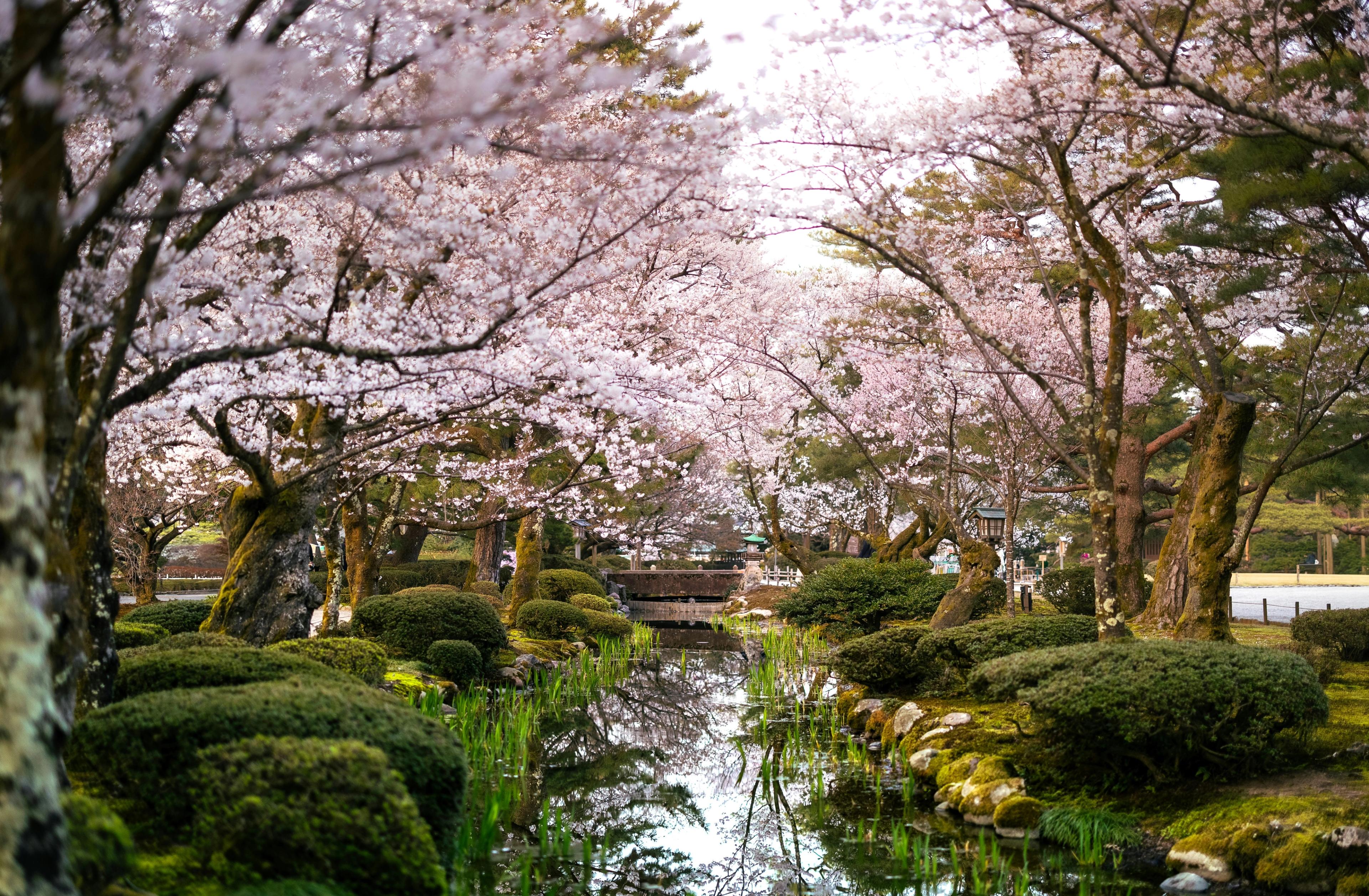
Kenroku-en is the jewel of Kanazawa and one of the top places to visit in Kanazawa at any time of year. Recognised as one of Japan’s three greatest landscape gardens (alongside Koraku-en in Okayama and Kairaku-en in Ibaraki), this 11.4-hectare strolling garden was developed over two centuries by the ruling Maeda family as the outer garden of Kanazawa Castle. Its name - meaning ‘Garden of Six Characteristics’ - refers to the six attributes of the perfect garden: spaciousness, tranquility, artifice, antiquity, water sources, and panoramic views. Kenroku-en possesses all six in full measure.
The iconic Kotoji-toro (two-legged stone lantern) standing at the edge of the Kasumiga-ike pond is the most photographed element of the garden - and the most photographed image in all of Kanazawa. The garden also contains Japan’s oldest garden fountain, still powered entirely by natural water pressure. In spring, 420 cherry trees across 10 varieties turn the garden into a sea of pink; in autumn, the maples, gingkos, and zelkovas ignite in crimson and gold; in winter, the pine trees are bound with yukitsuri rope cradles to protect their branches from snow - one of the most distinctive winter sights in Japan.
2Kanazawa Castle Park - History at the Centre of the City


Directly connected to Kenroku-en via the Ishikawa Bridge, Kanazawa Castle Park is the historic centrepiece of the city. Unlike most Japanese castles, Kanazawa Castle’s main keep (tenshu) no longer stands - it burned down in 1881 - but the beautifully reconstructed Hishi-yagura turret, Gojikken Nagaya storehouse, and Hashizume-mon Tsuzuki-yagura are impressive in their own right, particularly for their distinctive white lead-tile roofs (a unique material used in Kanazawa to repel snow).
The most spectacular element is the Ishikawa-mon Gate - a perfectly preserved Edo-period castle gate that frames the view of Kenroku-en behind it, and in spring, appears to float beneath a canopy of pink cherry blossoms. The castle grounds also include the Gyokusen-in Maru Garden, a recently restored inner garden. Nighttime cherry blossom illuminations run from 7pm to 9:30pm during peak bloom season (free entry to the park).
3Higashi Chaya District - Japan's Best-Preserved Geisha Quarter


The Higashi Chaya District (Eastern Teahouse District) is the largest and most atmospheric of Kanazawa’s three preserved geisha quarters, and for many visitors the single best Kanazawa attraction. Established in 1820 by order of the Kaga Domain lord to consolidate the city’s geisha entertainment, the district’s wooden lattice-fronted teahouses (chaya) have been immaculately preserved and designated a Japanese National Cultural Asset. Walking its central lane feels like stepping directly into Edo-period Japan - which is why it is often compared favourably to Kyoto’s Gion, but with a fraction of the crowds.
Two teahouses are open for public visits: Ochaya Shima (a museum preserving the original geisha rooms, red lacquer interior, and instruments, ¥750) and Kaikaro (a still-operating geisha house that opens for public tea service, ¥800). The district is also home to Kanazawa’s gold leaf specialty shops - try the stunning gold leaf tea ceremony room at Hakuza Gold Leaf Store, and yes, the gold leaf ice cream (soft serve coated in 24-carat gold leaf) that has become the symbol of modern Kanazawa food culture.
Check dates for Kanazawa
See what is available on your dates.
421st Century Museum of Contemporary Art - A Masterpiece of Modern Architecture

The 21st Century Museum of Contemporary Art (Kanazawa) - known locally as ‘Maru-bichi’ (round building) - is one of the most architecturally significant museums in Japan, and one of the best contemporary art destinations in Asia. Designed by Pritzker Prize-winning architects SANAA (Kazuyo Sejima and Ryue Nishizawa) and opened in 2004, the building is a perfect circle of glass and steel that blurs the boundary between museum and public space.
The permanent collection contains major works by James Turrell (including the immersive Ganzfeld room), Leandro Erlich’s Swimming Pool installation (a glass-floored pool that creates the illusion of being underwater from above and underwater from below simultaneously - one of the most shared images in contemporary art), and works by Olafur Eliasson, Yayoi Kusama, and major Japanese artists. The museum is a must-see regardless of whether you consider yourself an art lover.
5Nagamachi Samurai District - Edo-Period Warrior Residences

The Nagamachi Samurai District is one of the finest surviving samurai residential areas in Japan - a warren of earthen walls, stone-paved lanes, and wooden gates that has been carefully preserved as it appeared when Kanazawa’s samurai class lived and served the Maeda lords during the Edo period. The district’s earthy tones and wisteria-draped walls make it one of the most photogenic areas in the city - especially in spring when cherry and plum blossom drift over the walls.
The unmissable highlight is the Nomura Samurai House (野村家), a remarkably well-preserved samurai residence with beautiful Noh theatre garden, lacquerware, armour displays, and a tea ceremony room overlooking a carp pond. The garden was voted one of the most beautiful traditional gardens in Japan by a foreign travellers’ survey.
6Omicho Market (Omicho Ichiba) - Kanazawa's Kitchen

Omicho Market has served as Kanazawa’s main fresh food market since the Edo period - over 300 years of uninterrupted daily trading. With more than 200 shops spread under covered arcades, the market is the best place in Kanazawa to encounter the city’s exceptional seafood culture. Kanazawa’s location on the Sea of Japan gives it access to fish and crustaceans that are simply not available on Japan’s Pacific coast: snow crab (zuwaigani, October–March), yellow sea bream, yellowtail (buri), sweet shrimp (amaebi), and some of the finest sushi-grade fish in the country.
Beyond seafood, the market sells local vegetables, pickled foods, sweets, sake, and souvenirs. It is a working market, not a tourist attraction - and that authenticity is exactly what makes it special. For the best sushi experience, arrive at 11am on a weekday when the upper-floor sushi restaurants open and the fish is freshest.
7Kazuemachi Chaya District - Kanazawa's Most Romantic Geisha Quarter

While Higashi Chaya gets the crowds, Kazuemachi - just across the Asano River - is the geisha district that Kanazawa’s locals consider the most beautiful. Smaller and more intimate than Higashi Chaya, its single main street runs along the bank of the Asano River, lined with Edo-period wooden teahouses that are illuminated by traditional stone lanterns and paper lanterns in the evening. In spring, it is flanked by one of Japan’s most beautiful cherry blossom tunnels.
Kazuemachi is one of the few districts in Japan where the geisha tradition still operates authentically. In the evenings, shamisen music drifts from behind closed wooden shutters, and geiko walk in full dress between their engagements. A visit here at dusk in cherry blossom season is one of the most memorable experiences in all Japanese travel.
8Nishi Chaya District - The Hidden Geisha Quarter

The smallest of Kanazawa’s three geisha districts, Nishi Chaya sits in the western part of the city near the Saigawa River. It lacks the commercial development of Higashi Chaya and feels genuinely local and unhurried - the preserved wooden teahouses here are quieter, the lanes are less photographed, and the atmosphere is more authentically that of a living neighbourhood than a tourist attraction. A small free museum (Nishi Chaya Shiryokan) displays artefacts of geisha life. Nishi Chaya is also near Ninja-dera (Myoryuji Temple) - one of Kanazawa’s most fascinating hidden attractions.
9Myoryuji Temple (Ninja-dera) - The Temple of Hidden Passages

One of the most surprising and fascinating Kanazawa attractions, Myoryuji Temple - nicknamed ‘Ninja-dera’ by locals - is a 17th-century Soto Zen temple that is far more complex than it appears from the outside. Built in 1643 by the third Kaga Domain lord as a guard post overlooking the western approach to the castle, the temple was designed with an elaborate array of hidden staircases, concealed rooms, false floors, a pit trap, a secret well, and 29 staircases across what appears from outside to be a two-storey building but is actually seven floors internally.
Despite its nickname, the temple has no actual connection to ninja - it was simply designed with elaborate defensive features. Guided tours only (Japanese commentary, some English materials), pre-booking essential. Book tour tickets well in advance via the temple website, especially in spring and autumn. The tour takes ~50 min and reveals remarkable architectural ingenuity.
10D.T. Suzuki Museum - Japan's Most Tranquil Modern Museum

Designed by Pritzker-winning architect Yoshio Taniguchi (who also designed the MoMA expansion in New York), the D.T. Suzuki Museum is dedicated to the life and thought of Kanazawa-born Buddhist philosopher Daisetz Teitaro Suzuki (1870–1966), who introduced Zen Buddhism to the Western world. The museum itself is one of the most architecturally beautiful small museums in Japan - a series of low concrete pavilions surrounding a ‘contemplation space’ water garden of perfect stillness.
Even visitors with no particular interest in Zen philosophy find the museum profoundly affecting - the architecture alone, with its play of light on water and concrete, creates an atmosphere of genuine quietude that is remarkable in the middle of a city. Allow 45–60 minutes. A surprising and moving detour, especially after the bustle of Omicho Market or Higashi Chaya.
11Seison-kaku Villa - The Kanazawa Castle's Private Garden Palace

Tucked within the Kenroku-en grounds, the Seison-kaku Villa is one of Kanazawa’s most exquisite and undervisited attractions. Built in 1863 by the 13th Maeda lord as a retirement home for his widowed mother, the villa combines Japanese and Dutch (Oranda) architectural styles in a way that is entirely unique - Dutch stained glass, Indian-influenced ceiling panels, and Chinese-influenced lacquerwork sit alongside traditional Japanese tatami rooms and sliding screen paintings.
The Seison-kaku is often overlooked because visitors exhaust themselves in Kenroku-en - but the extra ¥700 and 30 min are absolutely worth it. The Dutch stained glass windows are remarkable objects in a 19th-century Japanese villa.
12Kenzan - Gold Leaf, Kutani Porcelain & Kaga Silk

Kanazawa is one of Japan’s great craft cities, a status it earned under the patronage of the Maeda family, who spent their vast wealth on arts rather than warfare. The city produces 99% of Japan’s gold leaf - an art requiring over 20 stages of hand-hammering gold into sheets thinner than human hair. Kutani ware is Kanazawa’s bold, five-coloured porcelain tradition, with distinctive red, green, yellow, blue, and purple overglaze designs. Kaga Yuzen is one of Japan’s most prized silk dyeing traditions.
All three crafts can be experienced hands-on in the city: try gold leaf application at Hakuza Gold Leaf Store or Gold Leaf Sakuda (both in Higashi Chaya District); paint Kutani porcelain at the Yamashiro Onsen Kutani Museum in nearby Kaga city; and see Kaga Yuzen dyeing at the Kaga Yuzen Tradition Hall. Gold leaf ice cream is the most-photographed Kanazawa food item - soft-serve vanilla ice cream coated in a large sheet of edible 24-carat gold leaf (~¥800).
13Kanazawa Station - Japan's Most Beautiful Train Station

Kanazawa Station is consistently ranked one of the most beautiful railway stations in the world. Its defining feature is the Tsuzumi (drum) Gate - a pair of enormous wooden drum-shaped frames 13.7 metres high inspired by the tsuzumi hand-drum used in traditional Noh theatre, which Kanazawa has supported for centuries. Beyond the gate, a vast glass canopy (Motenashi Dome, meaning ‘hospitality dome’) shelters arriving passengers from the heavy snows and rains of the Sea of Japan winter.
Beyond its architectural spectacle, Kanazawa Station is a practical hub: the East Gate (Kenrokuen-guchi) houses the Tourist Information Centre (English-speaking staff, free city maps), the Loop Bus terminal, and the Anto shopping mall with excellent souvenirs, local sake, and wagashi (traditional sweets). The Tsuzumi Gate is particularly photogenic at night (illuminated until midnight) and especially so in heavy snowfall.
14Noto Peninsula - Wild Sea of Japan Coastline

The Noto Peninsula, extending 100 km into the Sea of Japan from Kanazawa, is one of Japan’s most dramatic and under-visited coastal landscapes - and a natural complement to the city’s cultural attractions. The Okunoto (outer Noto) coast offers sheer sea cliffs, traditional lacquerware towns (Wajima is famous for Wajima-nuri lacquer), terraced rice paddies (tanada) that descend to the sea, traditional salt-making beaches, and fishing villages where life has changed little in generations.
Note: Parts of the Noto Peninsula were significantly affected by the January 2024 earthquake. As of 2026, reconstruction is ongoing in some areas. Check current access conditions before visiting.
15Shirakawa-go - UNESCO World Heritage Thatched Villages

The most popular day trip from Kanazawa, Shirakawa-go is a UNESCO World Heritage-listed mountain village of spectacular gassho-zukuri (prayer-hands) thatched farmhouses, some over 250 years old, with steeply pitched roofs designed to shed the enormous snowfalls of the Japanese Alps. The village sits in a narrow river valley surrounded by mountain forests, and in winter (January–February) is buried under metres of snow - creating one of the most iconic winter landscapes in Japan.
Cherry blossoms reach Shirakawa-go approximately 1–2 weeks later than Kanazawa (mid-to-late April), making a combined cherry blossom trip to both locations possible over 3–4 days. The combination of pink sakura and traditional thatched roofs against white mountain snow is unforgettable.
Take this guide with you
Get every place in this guide, with addresses and map links, in your inbox — easy to open on your phone during the trip.
One email to the address on your account. No newsletter.

CEO and co-founder
Tomas is the co-founder and director of trip1, an European company specializing in reservation services. He launched the company in 2025 with a focus on building scalable, efficient operations.
Top Places to Visit in Kanazawa - FAQ
Kenroku-en, one of Japan's three greatest gardens, and Kanazawa Castle Park next to it. Then the Higashi Chaya geisha district, the 21st Century Museum of Contemporary Art with Leandro Erlich's Swimming Pool, the Nagamachi samurai district with the Nomura Samurai House, and a seafood breakfast at Omicho Market. With an extra day, Shirakawa-go's thatched villages are the classic trip out.
Yes. Kanazawa escaped bombing in World War II, so it kept its Edo-period samurai and geisha districts, and it pairs them with Kenroku-en, a landmark contemporary art museum and some of Japan's best seafood. It is often called Little Kyoto, but the crowds are far smaller, and it is easy to reach by bullet train from Tokyo.
Two days for the city, three with a day trip. Day one: Kenroku-en early, Kanazawa Castle Park, then the 21st Century Museum and the D.T. Suzuki Museum. Day two: Omicho Market, Higashi Chaya and Kazuemachi, then Nagamachi, Nishi Chaya and the Ninja-dera temple. Add a third day for Shirakawa-go, and check access first if you plan to visit the Noto Peninsula.
Seafood from the Sea of Japan: sweet shrimp, yellowtail, sushi at Omicho Market and, in winter, snow crab, sold as kano-gani from 6 November to 20 March. The city's other signature is gold leaf, since Kanazawa makes almost all of Japan's: try the soft-serve ice cream wrapped in a sheet of edible gold leaf, about 800 yen, in Higashi Chaya.
Early April or November. In early April, 420 cherry trees bloom in Kenroku-en and Kanazawa Castle Park is lit up in the evenings. In November the maples and ginkgos turn red and gold, and the snow crab season opens. Winter is quieter, with yukitsuri ropes on the pines. Avoid Golden Week, when the 21st Century Museum's exhibitions can sell out.
About 2.5 hours. The fastest Kagayaki trains on the Hokuriku Shinkansen take around 2 hours 25 minutes from Tokyo Station and have reserved seats only, while the slower Hakutaka takes about 3 hours. A one-way reserved seat costs roughly 14,000 to 15,000 yen, and the Japan Rail Pass covers the line. You arrive under the station's huge wooden Tsuzumi Gate.