Guides · Maui
10 Top Things to Do in Maui
By Tomas Achmedovas · CEO and co-founder

CEO and co-founder
Maui earns its nickname the Valley Isle by fitting a 10,023-foot dormant volcano, a rainforest coast road, some of the Pacific's best beaches, and a paniolo (cowboy) upcountry onto an island you can drive across in under two hours. Deciding on the best things to do in Maui Hawaii in 2026 comes down to pacing more than choice - Haleakala National Park sunrise means a 3am wake-up, the Road to Hana (Hana Highway, Route 360) fills a full day of one-lane bridges, and Molokini Crater snorkel boats leave Maalaea Harbor before breakfast. Kahului on the central plain is the arrival hub, while Kaanapali and Wailea anchor the resort coasts and Paia holds the North Shore surf-town feel.
Build a Maui itinerary around three anchors: one land day (Haleakala or the Road to Hana), one ocean day (Molokini or a beach cluster), and one culture-and-town day covering Upcountry Maui and the West Side. The best time to visit Maui is April to May or September to October for warm weather with lower rates, while January through March overlaps peak humpback whale season in the Auau Channel. This guide covers 10 attractions with exact addresses, entry fees in USD, and practical mile-marker notes so you can slot each stop into a real schedule.
One note before you go: the historic town of Lahaina was struck by devastating wildfires in August 2023, and West Maui has reopened for respectful travel. Front Street is partially open, most Kaanapali resorts are operating, and residents welcome visitors who spend locally, follow closures, and treat the burn zone as the sensitive site it is.
Check dates for Maui
See what is available on your dates.
1Haleakala National Park - Sunrise Above the Clouds


Haleakala National Park protects the summit and eastern slope of a dormant shield volcano that rises 10,023 feet (3,055 m) above sea level. The road climbs from sea level to summit in under two hours, which is one of the steepest paved gradients on Earth, and the temperature at the top runs 30 to 40 F colder than the coast - bring a fleece, a hat, and long pants even in July. Entry costs $30 per vehicle and is valid for three days across the summit district and the Kipahulu district near Hana.
Sunrise viewing between 3am and 7am requires a separate reservation of $1 per vehicle through recreation.gov, released 60 days ahead and often gone within minutes. The National Park Service posts current conditions at nps.gov/hale. Daytime hikes across the crater floor along Sliding Sands Trail or the shorter Pa Ka'oao (White Hill) walk deliver the same lunar landscape without the alarm clock.
2Road to Hana (Hana Highway, Route 360) - The Rainforest Coast Drive


The Hana Highway (Route 360) covers 64.4 miles from Paia to Hana with roughly 620 curves and 59 bridges, most of them one-lane. Plan a full 10 to 12 hour day round-trip with early start by 7am. Key stops by mile marker include Twin Falls (mile 2, free with a $10 suggested parking donation), Waikamoi Ridge Trail (mile 9.5, a short walk through bamboo), Ke'anae Peninsula (mile 16.5, lava-scoured coast and taro fields), and Wailua Valley State Wayside (mile 18.8, valley overlook). Background on the route and its history is on Wikipedia's Hana Highway page.
Fuel up in Paia before you go, because Hana has one gas station with limited hours and premium pricing. Cell service drops out for long stretches, so download offline maps and the Shaka Guide or GyPSy audio app for narrated turn-by-turn commentary. Continue past Hana to Kipahulu (Haleakala National Park's coastal district) to see Ohe'o Gulch and, when the trail is open, the 400-foot Waimoku Falls at the end of the Pipiwai Trail.
3Molokini Crater - Snorkel a Sunken Volcanic Rim


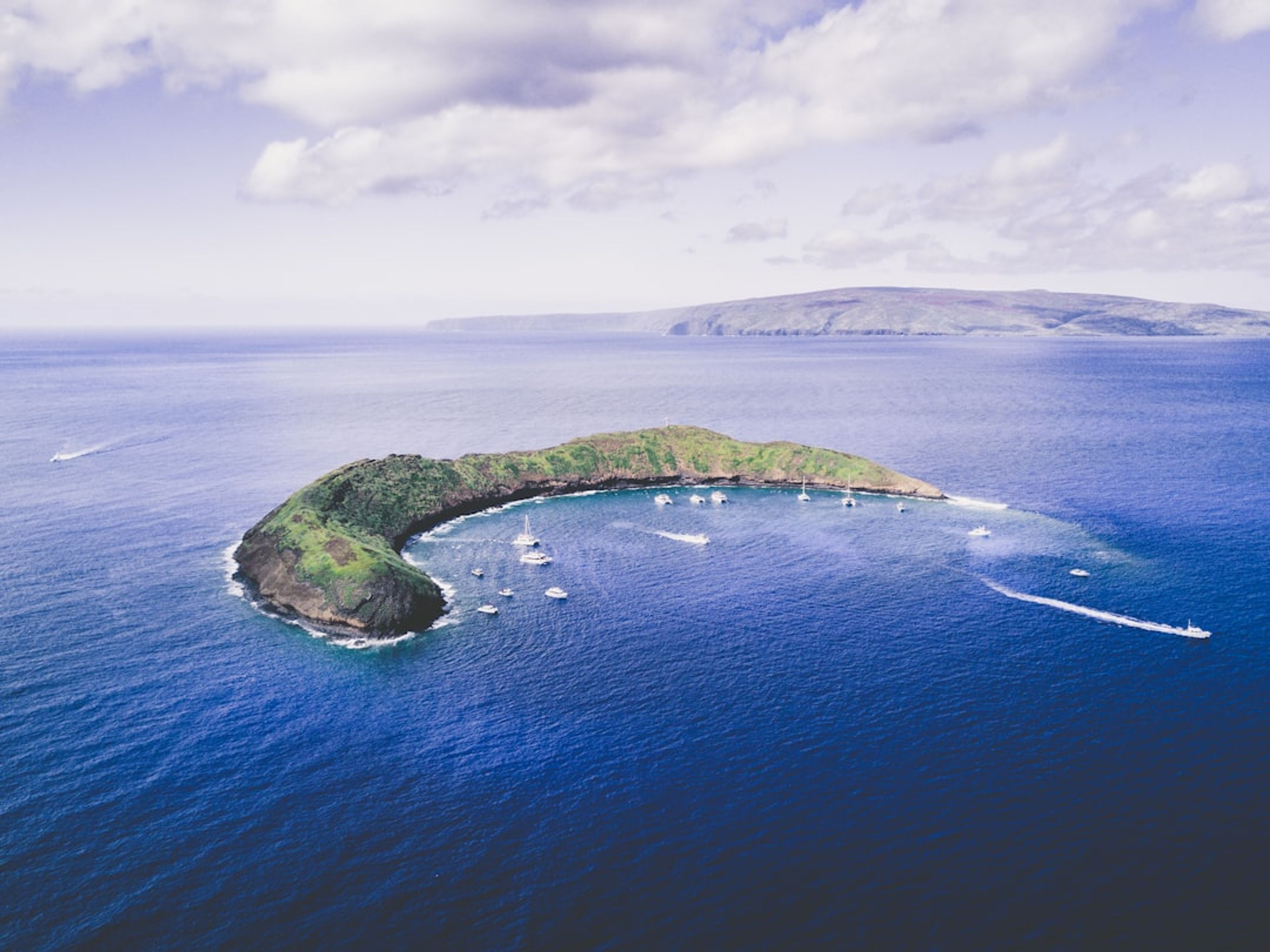
Molokini is a partially submerged volcanic tuff cone rising from the seabed between Maui and Kaho'olawe, and its crescent shape shelters the interior from swell, so visibility routinely runs 100 to 150 feet. The reef inside supports about 250 species of fish plus green sea turtles and reef sharks. Access is by boat only - the crater is a State Marine Life Conservation District, and no anchoring or shore landing is allowed. Tours run $130 to $230 per adult for a 4 to 6 hour trip that usually includes gear, breakfast, lunch, and a second stop at Turtle Town off Makena.
Boats leave the harbor between 6am and 7:30am to reach the crater before afternoon tradewinds kick up chop. Choose a smaller catamaran (25 to 50 passengers) over the large 100-plus operator boats if you want less crowded water at the mooring buoys. Book at least a week ahead in high season (December to March, June to August) and pack reef-safe mineral sunscreen - the Hawai'i state ban on oxybenzone and octinoxate has been in force since 2021.
Check dates for Maui
See what is available on your dates.
4Wai'anapanapa State Park - Honokalani Black-Sand Beach

Wai'anapanapa State Park protects a stretch of black-sand coast where lava from Haleakala hit the sea and shattered into jet-black cinder. Honokalani Beach itself is short - about 300 feet - backed by low cliffs and hala trees. Freshwater sea caves at the north end are the setting for the legend of Popoalaea, a Hawaiian princess who hid there from a jealous husband. A coastal footpath runs south along an old lava field to Hana town for those with time.
Out-of-state visitors must reserve entry in advance at gostateparks.hawaii.gov: $10 per person plus $10 for parking. Slots release 30 days ahead and sell out for popular time windows. The park opens 7am to 6pm daily. Do not enter the water when surf is up - waves break directly onto lava shelves, and rip currents pull hard.
5Iao Valley State Park - The Green Needle of Central Maui

Iao Valley State Park sits inside the eroded caldera of the West Maui Volcano, one of the wettest spots in the United States by average rainfall. The Kuka'emoku (Iao Needle) is a 1,200-foot lava-cored ridge draped in green that stands over the valley floor like a natural spire. Paved paths lead from the parking lot to a viewing platform in about 10 minutes, with side trails down to Iao Stream where you can dip your feet on hot days. The valley was the site of the 1790 Battle of Kepaniwai, when Kamehameha I's forces defeated Maui's army and left the stream literally dammed with the dead.
Entry is $5 per person for out-of-state visitors plus $10 parking, payable at gostateparks.hawaii.gov or on-site. Hours run 7am to 6pm. Come in the morning before clouds settle onto the ridge - by early afternoon the Needle often disappears into mist.
6Kaanapali Beach - The Three-Mile West-Side Resort Strand

Kaanapali Beach runs three miles along the west coast and is fronted by six resort hotels plus Whalers Village shopping center. The sand is broad and light gold, the water usually calm enough for swimming outside winter northwest swells, and public beach access points with parking are marked between the hotels. Snorkeling is strongest at Pu'u Keka'a (Black Rock) at the north end, where a lava promontory drops into a reef of yellow tangs, parrotfish, and green sea turtles. The Sheraton Maui hosts a nightly cliff-diving ceremony at sunset that reenacts the leap of King Kahekili.
A beachfront path connects the length of the strand for evening walks. Parking is the practical constraint - the free public lots at the north (near Kahekili Beach Park) and south ends fill by 9am on weekends, and resort self-park runs $25 to $45 per day.
7Wailea Beach - Calm South-Shore Crescent

Wailea Beach is a half-mile crescent of soft sand between the Grand Wailea and Four Seasons resorts, protected by rocky points at each end that keep the water noticeably calmer than beaches to the north. It is one of the more consistent swimming beaches on the island for kids and less-confident swimmers, with a gentle sandy bottom and typically small shorebreak outside of summer south swells. Two free public parking lots sit between the resorts, with about 100 spots total plus outdoor showers and restrooms.
The Wailea Beach Path is a paved 1.5-mile coastal walk connecting five beaches - Keawakapu, Mokapu, Ulua, Wailea, and Polo - past resort gardens and lava outcrops. Sunset from the path is one of the best free experiences on the island. Snorkeling is decent at the north point off Ulua Beach and the south point off Polo Beach, though visibility is more variable than Kaanapali.
8Old Lahaina - Respectful Visit to a Recovering Town

Lahaina was the seat of the Hawaiian Kingdom under Kamehameha III from 1820 to 1845 and a whaling port through the mid-19th century. The August 8, 2023 wildfire destroyed most of the historic downtown and killed 102 people, and much of Front Street north of the harbor remains a fenced burn zone under active recovery. What is open in 2026 includes the surviving 150-year-old Indian banyan tree at Banyan Tree Park (Wharf Street), the small Lahaina Harbor and its shops, and businesses south of Prison Street. Local groups such as the Lahaina Restoration Foundation share visitor guidance at their website and in-person kiosk.
Come with intention rather than casual sightseeing. Do not photograph the burn zone or block resident access. Spend money at Lahaina-based restaurants, artists, and tour operators - a direct way to support recovery. The official Hawaii tourism site at gohawaii.com/islands/maui posts current guidance on which areas are open.
9Makawao Town and Upcountry Maui - Paniolo Country at 1,600 Feet

Makawao sits at 1,600 feet on the slopes of Haleakala and is the historic center of Maui's paniolo (Hawaiian cowboy) culture, dating to the 1830s when Mexican vaqueros were brought over to train Hawaiians in cattle handling. Baldwin Avenue is a two-block stretch of false-front wooden buildings housing galleries, a saddle shop, Komoda Store & Bakery (open since 1916, famous for cream puffs and stick doughnuts, closed Wednesdays and Sundays), and the Makawao Rodeo Grounds that host the July 4th weekend Makawao Stampede.
Beyond the town, the Upcountry corridor along Highway 37 covers Kula's flower and produce farms, Ali'i Kula Lavender Farm at 4,000 feet ($3 self-guided walk, closed Tuesdays), and MauiWine at the Ulupalakua Ranch tasting room in the old jail (open daily 11am to 5pm, complimentary and paid tastings). Cooler air, jacket weather at dawn and dusk, and pastureland views make this the Maui most first-time visitors do not expect.
10Hookipa Beach Park - Windsurfers and Sea Turtles on the North Shore

Hookipa Beach Park is the North Shore's premier windsurfing and surfing arena, ranked among the world's top big-wave windsurf sites when the trades and swell align (typically October through March). A cliff-top pullout on the east end of the park offers a free grandstand view of the action - watch professional windsurfers ride the outer reef break Ho'okipa and shortboard surfers work the inside sections Pavilions and The Point. The park also has a lifeguarded swim beach on the west end (calm summer months only) plus picnic pavilions and restrooms.
By late afternoon most days, Hawaiian green sea turtles (honu) haul themselves onto the west-end sand to rest overnight. Volunteers rope off a viewing perimeter and enforce the 10-foot federal distance rule - do not cross the rope, do not touch, and do not use flash photography. Turtle arrival typically starts around 4pm and peaks by dusk.
Take this guide with you
Get every place in this guide, with addresses and map links, in your inbox — easy to open on your phone during the trip.
One email to the address on your account. No newsletter.

CEO and co-founder
Tomas is the co-founder and director of trip1, an European company specializing in reservation services. He launched the company in 2025 with a focus on building scalable, efficient operations.
10 Top Things to Do in Maui, Hawaii - FAQ
Sunrise or sunset at Haleakala National Park, at 10,023 feet, is the one sight to plan your trip around. Add a full day on the Road to Hana with the black sand at Wai'anapanapa, a morning snorkel at Molokini Crater, and an evening at Hookipa Beach Park, where green sea turtles come ashore from about 4pm. Upcountry Makawao shows Maui's cowboy side.
It is enough for the highlights, but tight. Use one day for the Road to Hana, one for Haleakala at sunrise followed by Upcountry Maui, and one ocean day with a Molokini snorkel trip and a south or west shore beach. Four to five days lets you add Iao Valley, Lahaina and Hookipa without long drives on the same day.
April to May or September to October. These months bring warm weather, smaller crowds and lower rates than peak season. January to March is peak humpback whale season in the Auau Channel, with higher hotel prices and airfares, and the last week of December into early January is the most expensive time of the year. Winter swells also make north shore waters rougher.
Yes, if you give it a full day. Route 360 covers 64.4 miles from Paia to Hana with about 620 curves and 59 mostly one-lane bridges, so plan 10 to 12 hours and leave by 7am. Stops include Twin Falls, Ke'anae Peninsula and Wai'anapanapa, which needs a reservation. Fill up with fuel in Paia and download offline maps first.
Ocean conditions first: stay out of the water at Wai'anapanapa when surf is up, as waves break onto lava shelves. Book ahead for Haleakala sunrise (released 60 and 2 days before) and Wai'anapanapa ($5 per person plus $10 parking). Keep 10 feet from resting turtles, use reef-safe sunscreen, pack warm layers for the summit, and do not photograph Lahaina's burn zone.
Yes, for practical purposes. Maui Bus links Kahului, Wailuku, Kihei, Lahaina, Kaanapali and Paia, but service is limited and it does not reach Haleakala's summit, Hana or Wai'anapanapa. Pick up a car at Kahului Airport (OGG) for the whole trip. Beach parking is the other catch: the free lots at Kaanapali and Wailea fill by mid-morning.